
VEGAN FAQ
WHAT IS VEGAN?
Join to get exclusive content!
WHY VEGAN? ⚖️
Created on: 01.09.2025
Last edited on: 01.09.2025
We clarified the questions "What does vegan mean?" and "What is veganism?" right at the top of the page. But why should you actually live vegan? You can find out here:
➡️ View and share all content on WARUM-VEGAN.COM !
The short answer: There is no ethically relevant difference between humans and non-human animals that would justify devaluing animals to slaves. That's why we live vegan.
Cows, pigs, chickens, and many other animals are at the slaughterhouse right now, terrified. This happens because people want to eat their body parts or secretions and buy other products and services for which animals are abused. Furthermore, people themselves actively abuse and murder other animals, for example, when hunting or fishing. Annually, over 80 billion land animals are slaughtered and well over 1.2 trillion fish and other aquatic creatures are annihilated - a mass murder.
Although humans can live healthily without animal products, they are usually deterred by one of the following reasons:
- Taste
- Convenience
- Tradition and personal habit
- Social pressure from the masses
Are these really sufficient justifications for abusing animals? Not really, are they? At the latest, the last two points also constitute fascism: One group (humans) declares itself superior based on an ethically irrelevant difference in characteristics (in this case, species) and thus oppresses others (non-human animals). This is maintained "because it has always been this way" and "because others do it too." You probably strongly oppose such systems in other contexts, right?
Then your mind and heart are already vegan, and now it's just about aligning your actions with that. Unlike what many think, veganism is much more than just a diet. In addition to animal foods, we also boycott animal abuse for clothing, cosmetics, entertainment, and other purposes. Anyone who acts in this way is by definition a vegan.
Definition of Veganism: Veganism is the ethical principle that humans should live without abusing other animals.
Vegans simply don't want animals to be abused for them. Doesn't sound so extreme, right? What is truly extreme, however, is that gas chambers still exist everywhere in Germany and around the world - only the victims look different and have different DNA. What unites us with them, however, is sentience. Pigs, calves, chicks, etc., just like dogs and cats, notice what is being done to them. They can feel joy, fear, and suffer. They have their own interests.
So why should we pet some as pets and abuse others as "livestock"? This irrational distinction is called speciesism, discrimination based on species membership - parallel to racism, but towards other animals. And it goes even further: Why do we protect ourselves with human rights but deny protection to other sentient beings? Why don't we create animal rights as a logical extension of human rights? There is no ethically relevant difference between humans and non-human animals that would justify devaluing animals to slaves. Anyone who wants to act anti-speciesist must live vegan. Because: animals are children, in different forms and colors.

Why vegetarianism is not enough? Animals are also abused, raped, and often murdered in the same slaughterhouses as for their meat for dairy products, eggs, leather or wool, for animal testing, in zoos, circuses, etc. And yes, this happens regardless of whether it is typical factory farming or organic farming. In addition, animals are persecuted, hunted, and fished in their natural habitats. The problem is not how someone is treated during their slavery, but that someone is considered property, an object of use, and a commodity at all. In the film Dominion you will learn the full, detailed truth. Be brave, watch it, and take responsibility! How many victims should your life still demand? Zero, or too many? If the answer is zero, you must live vegan from now on.

Okay, so vegan from now on. BUT HOW?! Don't worry, you don't have to eat grass; you can still enjoy pizza, burgers, kebabs, schnitzel, ice cream, cake, chocolate, cookies, and everything else you like. For all these delicacies, there are plant-based alternatives for which no one had to go to the slaughterhouse. We'll take you by the vegan hand: We have compiled more information and entry-level assistance for you on WIE VEGAN.
➡️ Share our answer:
What is speciesism? 🐮🐷🧑🏼
Created on: 01.09.2025
Last edited on: 01.09.2025
Speciesism is discrimination based on species. It is often the first form of discrimination we learn as children. We are shown that we pet dogs, but kill and eat pigs, cows, or chickens. This separation is just as irrational as racism, sexism, or homophobia. Nevertheless, the ever-present speciesist statement "They're just animals" is used to justify unimaginable cruelties.

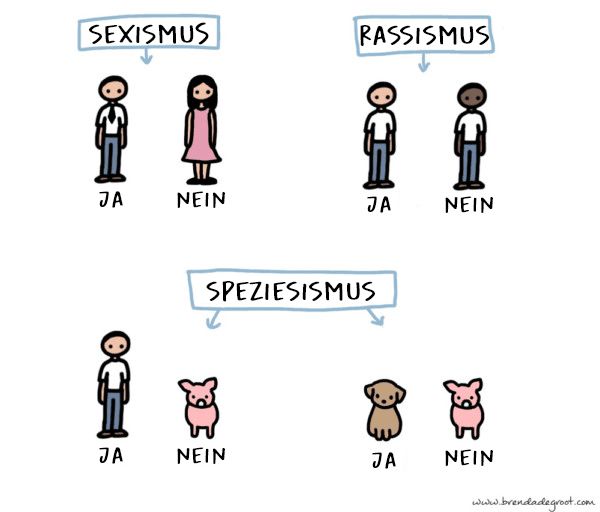
The categorization of animals into "farm animals" and "pets" is arbitrary and based on cultural traditions, not ethical logic. Where is the morally relevant difference between dogs or even humans and pigs, cows, etc., that justifies gassing or stabbing the latter?

And furthermore: Why are humans protected by human rights, while there are no animal rights for other sentient beings?
Anti-speciesism does not deny that there are differences between us and other animals. Just as there are differences between humans: eye colors, skin colors, genders, and much more. However, none of these differences is a sufficient justification to assign someone slave status - no more than species membership.
If you are against racism, sexism, and other forms of discrimination, you should also question speciesism, live vegan, and actively advocate for animals whose voices are suppressed day after day!
➡️ Share our answer:
Is honey vegan? 🍯
Created on: 01.09.2025
Last edited on: 01.09.2025
In short: no.
Because honey bees are likely sentient and are regularly abused and killed in honey production. Honey is their own food, which is taken from them and usually replaced by nutrient-poor sugar water. Practices such as artificial insemination, wing clipping, live transport, and mass extermination of entire colonies are common. Since we can live without honey, it is our ethical obligation to do so – especially since there are plenty of delicious and even healthier alternatives.
And now in more detail: Why is honey not vegan?
Bees possess a nervous system and display complex behavior. Therefore, it is plausible that they could be sentient to at least some extent.

Thus, they most likely perceive the immoral practices carried out on them for honey:
The mere act of taking honey is usually ethically problematic. Honey is food for the bees themselves, for which they expend a great deal of effort and energy. Because humans want to take honey from bees, they are usually fed sugar water instead. This often deprives bees of important nutrients for their health.
Honey bees, for example, have been bred for honey yield and docility, so they can now be considered domesticated animals. Similar to the dairy industry, a surplus of honey only arises through breeding for performance, i.e., high yield. This is not in the interest of honey bees and can harm them, especially through reduced genetic diversity, increased susceptibility to disease, and physical stress. Therefore, the mere taking of surplus can be considered abuse - especially since there is no human need for honey. For this reason alone, vegans do not eat honey, and in most cases, this is sufficient justification. Let's still examine the practices in the honey industry in a bit more detail:
In conventional honey production, artificial insemination usually takes place. For this, 8-12 male bees are typically crushed to extract their semen. Afterward, the queen bee is usually restrained to inject her with the semen.
Live transport in small packages over long distances is also common. Once they arrive at the destination hive, the queen bee is marked and her wings are often clipped so she cannot swarm. The large bee colony is meant to stay together, as this yields the highest profit.
By now, it should be clear why honey is a no-go for vegans. But it goes even further:
Mass extermination is also standard in the honey industry. If a colony is no longer profitable (e.g., at the end of the warm season), the small inhabitants of the entire beehive are often murdered. Common methods include burning, drowning in soapy water, or gassing with CO2.
Many bees already suffer agonizing deaths beforehand due to poor hive insulation, lack of food, or parasitic infestations.
The question "Why don't vegans eat honey?" should now be answered. But doesn't honey help against bee mortality? You need to know that the honey industry breeds massive numbers of honey bees, which displace many wild bee species from their habitats. This happens not least because honey bees, as "generalists," can collect food and pollinate almost all plants, while wild bees, as "specialists," are restricted to specific plants. Thus, most bee species can no longer ensure their survival, and honey production, contrary to what many believe, is actually partly responsible for bee mortality.
We have clarified why vegans avoid eating honey. But now you're probably asking, "What can I use instead of honey?" Don't worry, we've got you! We'll show you which vegan alternative to honey is best regarding various factors like nutrients:


Interim question: How healthy is honey really?
The industry itself likes to claim that honey is healthy. Honey is often marketed as a healthy natural product, but scientifically, it is essentially a source of sugar – consisting of about 80% various types of sugar. Although honey contains minimal amounts of nutrients and minerals, studies show that these offer no significant health benefit over regular table sugar. According to EFSA and other expert sources, the health effects are not significant. For the body, honey remains primarily one thing: a product with comparable effects on blood sugar levels and dental health as other sugars.
And even if honey were super healthy, that would still not justify animal abuse. Which vegan honey alternative is best for you is ultimately a matter of taste and what you value. In terms of calories, sugar, and fiber content, date syrup performs best and is therefore our favorite. You make your personal decision as long as no victims are involved, because:
NOT BEING VEGAN IS NOT OK - the little bees agree. 🐝
Here we have summarized everything for you as a carousel ⬇️
➡️ Share our answer:
Can you feed pets a vegan diet? 🐶🐈🐟
Created on: 09/01/2025
Last edited on: 09/01/2025
Yes, you can feed “your” pet a vegan diet.
Before we delve deeper, let's first clarify why one should feed pets a vegan diet at all. Although this misconception is widespread, meat-based food is not a "waste product." Rather, it is a multi-million dollar industry that ultimately brings more money to slaughterhouses. Instead, one can opt for plant-based food. This is vegan because no animal abuse occurs. It cannot be fair to breed other equally sentient animals such as cows, pigs, and chickens unnecessarily and send them to the slaughterhouse for a companion animal. But what is the true necessity?
Can dogs be fed a vegan diet?
In short: Yes, because dogs can easily meet their nutritional needs with plant-based food. A large-scale peer-reviewed study from 2022, which surveyed over 2,600 dog "owners" (those who feed their dog a vegan diet and those who feed them meat), showed that vegan-fed dogs were actually the least sick.
Primarily, dogs need carbohydrates, fats, and proteins with the correct, essential amino acids. All of this can be obtained from purely plant-based food. A doctoral thesis from 2023 found that amino acids contained in dog food combining various legumes can be utilized just as effectively as those from chicken carcasses:

This study also demonstrated that there is no increase in relevant diseases due to vegan dog food. Vegan-fed dogs remain just as healthy as meat-fed dogs.
Can cats be fed a vegan diet?
People who want to feed their cat a vegan diet often encounter resistance. After all, as carnivores, cats naturally eat meat, and it is animal cruelty to deprive them of it... or is it? While it's true that cats are carnivorous animals, nature is not a suitable yardstick for what is morally right. Just like humans, they need nutrients, not carcasses or other animal products. For cats, taurine, L-carnitine, and arachidonic acid, for example, are important, but these can be supplemented synthetically and absorbed through plant-based food. Let's take a closer look at what science says: Is vegan cat food healthy?
Here, too, a large-scale peer-reviewed study from 2021 provides insight. It surveyed over 1,300 people, both those who feed their cats a vegan diet and those who feed them meat. In summary, exclusively plant-fed cats had fewer gastrointestinal problems, fewer liver diseases, were leaner, and were generally considered healthier. The question "Is a vegan diet suitable for cats?" can therefore usually be answered with YES, just like for dogs.
Plant-based dry food, declared as complete food for cats, has been available for several years. Therefore, no further supplements or dietary supplements are usually necessary when using it, unless something specific has been prescribed by the veterinarian. Among other places, on kokku-online.de or simplyvegan.de, you can find vegan dry foods from Ami, V.E.G., and Benevo, as well as a vegan wet food for cats (Benevo Duo), which, according to the manufacturer, meets nutritional requirements. Other wet food varieties, e.g., from V.E.G., are usually only declared as supplementary feed and therefore should not constitute the main part of the diet.
Homemade food is generally not advisable, or should only be considered with appropriate advice and ration planning from a qualified specialist – as many recipes found online do not meet nutritional requirements, critical nutrients (such as taurine or arachidonic acid) are often missing, and it is not guaranteed that nutrients are present in the correct ratio and can be absorbed.
If the dry food is not accepted by the cat (directly), it can also be soaked and offered as wet food. This can also be helpful when transitioning to a plant-based diet, as the plant-based dry food can be gradually mixed into the existing wet food.
The transition can be made in consultation with the veterinarian, even if many are not open to the topic and are often not familiar with the study situation. In these cases, you can still ask them for their best possible support. This includes, for example, clarifying species-specific nutrient requirements (e.g., due to age or certain chronic diseases) and follow-up examinations, primarily of blood values.
Further information on the study situation and the question of whether we should feed pets vegan diets can be found at tiervutter.de.
Interim Conclusion
Fundamentally, there is no objection to feeding dogs and cats a purely plant-based diet, provided they eat the food and certain criteria are observed. This is also supported by veterinarian Dr. Andrew Knight: "Regardless of the combination of ingredients, feed should be formulated to meet the taste, nutritional, and bioavailability requirements of the respective animal species. There is no scientific reason why a feed consisting only of plant-based, mineral, and synthetic ingredients cannot meet all these requirements.
One thing is logical: people have to deal with nutrition if they want to stay healthy their whole lives. The same applies to pet nutrition, whether the cat and dog food is vegan or not.
For adult, healthy dogs and cats, there is nutritionally complete ready-made food. Both for vegan dog food and vegan cat food, it is important to ensure that it is a complete feed. 
Vegan complete dog food:
- Complete dog food 1
- Complete dog food 2 or Complete dog food 2 on Amazon
- Complete dog food 3
- Complete dog food 4
- You can find more complete feeds here ✅
Vegan complete cat food:
Complete food for both:
But isn't all of this unnatural coercion?
Anyone who wants to keep vegan pets will find nutrition to be an important topic. Strictly speaking, dogs and cats themselves cannot be vegan, as veganism is not a diet but a moral stance. The animals that live with us cannot make this decision. We can only decide to feed them plant-based diets.
As decision-makers, we ALWAYS impose our morals and the associated consumption choices on pets (just like children). This can mean that we force them, without their knowledge, to eat the dead bodies of others – or, indeed, to eat plants. As already described, nature cannot be a moral compass here.
Apart from that, dogs and cats as we know them today exist only through domestication and have multiplied extremely due to human irresponsibility (e.g., regarding spaying/neutering). Through breeding, dogs and cats have been increasingly adapted to human needs and now have little in common with their wild ancestors like wolves or lions. So, we are already far removed from nature. Vegan pet food is a human-made solution to a human-made problem that allows many pets to be fed without having others killed for it.
Makes sense, right? Then LIVE VEGAN INSTEAD OF IRRATIONALLY. 🐕🐈⬛⚖️
Generally, for a vegan lifestyle: Adopt, don’t shop. Animals should not be merchandise bred, sold, or given away according to our ideas. Many animals live in shelters for whom a new home can mean a better life; and by now, there are several organizations specialized in finding homes for stray cats (and dogs). It is also important to be aware of the responsibility one undertakes for a pet. Life with an animal companion requires money and time to meet their various needs and demands.
Want to learn more? Check this out ⬇️
Vegan dog nutrition: Veterinarian explains why dogs can live healthily on a plant-based diet
Can dogs be fed a vegan diet? Yes – says veterinarian Dr. med. vet. Uwe Romberger in an interview. He has been feeding "his" dogs vegan dog food for over seven years and confirms: Vegan dog nutrition is possible, healthy, and animal welfare-compliant – if it meets nutritional requirements. Studies show that plant-fed dogs are at least as healthy as meat-fed dogs.
➡️ Share our answer:
Is keeping pets vegan? Adoption, breeding and food explained 🐕🐩🐱
Created on: June 8, 2026
Last edited on: June 8, 2026
Many people ask themselves: Is pet ownership vegan? The short answer: Adopting or rescuing an existing animal can be vegan – buying from breeders, however, is problematic from a vegan perspective.
What does veganism mean in the context of pets?
Veganism means avoiding animal abuse. By living vegan, we consider animals as sentient beings with their own interests. According to this principle, animals are no longer considered products, commodities, or resources. This is not just about a plant-based diet, but fundamentally about how we treat animals. This also applies to pet ownership, where the animal's interests must be considered.
Is pet ownership vegan or abusive?
The criticism usually refers to the fact that pets are restricted in their freedom and are dependent on humans. It is also argued that people have pets for their own pleasure. Both can be true, but it does not automatically mean that keeping pets is not vegan.
As we have already clarified, vegan living is primarily about upholding interests. For animals that already exist and are dependent on human care, responsible care can be in the animal's interest – especially if the animal would struggle to survive in the current world without human care. Even if humans enjoy the relationship with an animal, there doesn't have to be anything problematic about it. In many care situations, both the caregiver and the individual being cared for benefit from the relationship, without it constituting abuse. Nevertheless, there are some other points to consider when it comes to vegan pet ownership.
Why is pet breeding not vegan?
Currently, new animals are constantly being bred. Through breeding, animals are specifically produced for human desires, for example, regarding certain visual characteristics or personality traits that pet owners prefer. At the same time, countless dogs and cats are waiting for a new home in animal shelters. From a vegan perspective, there is therefore no ethical reason to breed new animals - especially as long as existing animals need help. In addition, there are health problems that can arise from certain breeding traits. A well-known example is short-nosed dogs with breathing problems.
Adoption instead of purchase: The vegan alternative
When buying from a breeder, human interests are placed above both the interests of existing animals in shelters and the interests of the bred animals, who may struggle with significant health limitations throughout their lives. Therefore, from a vegan perspective: Adopt don't shop! While no new pets should be bred, adopting or rescuing an existing animal is compatible with vegan values.
Is vegan pet food possible?
The discussion becomes particularly controversial regarding vegan pet nutrition. How can one justify having other, equally sentient animals killed for feeding a pet when it is not necessary? Just like humans, dogs and also cats primarily need nutrients, not meat or other animal-based food sources. According to current research, both dogs and cats can meet their nutritional needs with appropriately formulated complete feeds. Dealing with vegan pet nutrition is part of responsible vegan pet ownership.
→ Here you will find a comprehensive overview of vegan nutrition for dogs and cats including specific vegan dog food products and vegan cat food products.
Conclusion: Can vegans have pets?
Yes – it just depends on how:
- Adopting or rescuing an animal can be vegan.
- Buying animals from breeders is problematic.
- The animals' interests should be considered.
- The animal's diet should be ethically considered.
Under these conditions, pet ownership can be compatible with vegan values. Ultimately, it's less about whether an animal lives in the house, but rather how that animal and other animals are treated.
➡️ Share our answer:
Which blood tests should be done when following a vegan diet? 🩸✅
Created on: March 11, 2026
Last edited on: March 11, 2026
We got you! 🤝 In the BLOOD VALUES CHECK section, we have compiled an overview of which blood values vegans should have tested by their doctor and how often ✅ The content is currently available in German, but you can easily have it translated using tools like ChatGPT.
➡️ Share our answer:
What's the problem with milk? 🐮😢
Created on: March 16, 2026
Last edited on: March 16, 2026
Many people see milk as a harmless food. A splash in coffee here, a little cheese on pizza there - what could possibly be wrong with that? In reality, milk production involves a complex system of violations, family separation, and ultimately an end at the slaughterhouse. Together with you, we take a look behind the closed doors of the dairy industry 👀
Why do cows produce milk?
As with all mammals, the same applies to cows: milk is only produced after giving birth. This means cows do not produce milk continuously, but only after they have had a calf. Therefore, cows (and other animals abused for milk such as sheep and goats) are regularly made pregnant again - usually once a year.
To see the dairy industry with your own eyes, you can watch the documentary DOMINION (the section about dairy products begins at minute 53).
Artificial insemination
Various methods are used to collect semen. The most common practices are these: either an insemination technician inserts an electroejaculator anally into male bulls and stimulates them until ejaculation, or the bull is allowed to mount a dummy cow and ejaculation occurs into an artificial vagina.
The semen is collected and then used for the forced insemination of cows using a tube. During the procedure, the insemination technician’s other hand palpates the cow’s cervix rectally. In this way, new pregnancies are repeatedly initiated - with the goal of keeping the milk flow as constant as possible.
To place this ethically: if such practices were carried out on humans, it would generally be described as rape.

Family separation
After about nine months of pregnancy, a cow gives birth to her calf. Without human interference, a close social bond normally develops - cow mothers recognize their calf by smell and voice and defend it from potential dangers, while the calf drinks milk from the mother’s udder several times a day. The strong mother-child bond is also evident in the fact that both call to each other with characteristic sounds and usually remain in close proximity to one another.
In reality, however, this dynamic almost never occurs. Standard practice is that the calf is taken away from its mother shortly after birth so that it does not "drink away" the milk that is meant to be sold. After the separation, the cow and calf often call for each other repeatedly, actively search for one another, and show clear signs of distress. This behavior can continue for hours or days. What happens next then depends on the sex of the calf:
The life of a dairy cow
Female calves are usually raised to become future dairy cows. Breeds intended for dairy production have been specifically bred to produce very large amounts of milk. In addition to the emotional and physical stress caused by repeated pregnancies, dairy cows are subjected to machine milking several times a day and to significant physical strain from their heavy udders. Inflammation of the udder and mammary glands is among the most common diseases in the dairy industry.

In the worst case, a cow becomes a so-called downer cow - a cow that can no longer stand up due to injuries, exhaustion, and calcium deficiency after giving birth. In such cases, attempts are made to lift the cow using hoisting devices and to treat her. If this does not succeed, she is euthanized or ends up at the slaughterhouse.
Murder
What happens to dairy cows when they can no longer fulfill the purpose for which they were bred? As soon as a cow’s “milk yield” declines and she becomes less profitable, she is usually murdered at the slaughterhouse. Dairy cows reach an average age of only 5 to 6 years, whereas the natural life expectancy of cattle is 15 to 25 years.
You may already have wondered earlier: what happens to male calves? They have no use for milk production and are therefore fattened for several months and then, depending on the slaughter age, end up on plates as veal or beef.
Milk and meat belong together
Although many people mentally separate the dairy and meat industries and believe that no animals die for dairy products, the opposite is true. The dairy and meat industries go hand in hand - both “spent” dairy cows and male calves are processed into meat.
So why don’t vegans drink milk? When we live vegan, we oppose the abuse of animals - which already occurs during the lives of animals bred for milk and, of course, also with their murder.
➡️ In this video, you see the standard practices of the dairy industry simply explained and illustrated with images.
Does the human body need milk?
Milk is often associated with calcium. Calcium is indeed important for the body (among other things for bone strength), but it does not occur exclusively in dairy products. There are many plant-based sources of calcium such as tofu or green leafy vegetables. Some foods are also fortified with it (for example soy yogurts). You can find out how to meet your calcium needs on a vegan diet in our nutrient guide.
Incidentally, dairy products do not “simply contain” calcium either. Cows absorb it through their feed and are often supplemented with it as well.
In addition, a large part of the world’s population does not tolerate lactose well in adulthood. This is because the human body is biologically not designed to digest milk beyond early childhood. Globally, lactose intolerance is the norm: around 65-70% of adults worldwide are lactose intolerant. Northern European countries stand out with only about 2-15% mainly because people in these regions began drinking milk from cows, sheep, and goats early on, which led to an evolutionary genetic adaptation.
However, dairy products are not nutritionally necessary for humans - regardless of where they come from. All nutrients contained in dairy products can easily be obtained from a plant-based diet or fortified foods. Many major health organizations, including the Academy of Nutrition and Dietetics, confirm that a well-planned vegan diet without dairy products can be healthy and nutritionally adequate when vitamin B12 is reliably supplemented.
Replace dairy products with vegan alternatives
We do not live vegan because we dislike the creamy taste of dairy products. We live vegan because we believe that no taste can justify the cruelty just described. In fact, in many cases we do not have to give up the taste and function of dairy products at all:
You can replace animal milk with plant-based alternatives such as soy milk, oat milk, almond milk, and many others. For coffee, there are various barista versions that can be frothed just like cow’s milk.
For health reasons, we prefer replacing butter with margarine based on rapeseed, sunflower, or olive oil - but if you want the authentic taste, you can also find vegan butter in block form in the refrigerated section. Instead of cream, you can use soy or oat cream. These are now available in almost all supermarkets.
There are also vegan alternatives to yogurt, such as soy, oat, or lupin yogurt. Often even supermarket store brands offer inexpensive vegan yogurt without added sugar, from which you can make protein-rich vegan cream cheese by letting it drain overnight through a cheesecloth.
Vegan cheese is available in an ever-growing variety in supermarkets - from sliced cheese to soft cheese and shredded cheese, all the way to vegan feta. Nutritionally, however, most varieties are unfortunately not particularly recommended so far. In everyday life, we therefore tend to replace cream cheese with soy quark, hummus, or nut butters, sliced cheese with tofu or tempeh, and parmesan with a mix of nuts, spices, and nutritional yeast. The latter is a real game changer both nutritionally and because of its cheesy flavor! 🧀🌱
👉 Learn more in or guide on HOW TO REPLACE FOODS WITH VEGAN ALTERNATIVES.
Conclusion
While the dairy industry shows consumers images of happy cows on green pastures, the reality involves sexual violations, families being torn apart, and babies ending up in slaughterhouses.
By living vegan, you can choose not to be part of this cruel system anymore. And don’t worry - you can still get calcium and other important nutrients on a vegan diet. On HOW VEGAN you will find helpful guides on topics such as vegan protein sources, nutrients, plate composition, and a vegan shopping list. Once you understand the WHY VEGAN, we can figure out the HOW together. 🤝
➡️ Share our answer:
Is organic milk really better? 🍃🐄
Created on: March 24, 2026
Last edited on: March 24, 2026
Organic milk seems innocent at first - often, seemingly happy cows on green pastures gaze at us from the packaging. The central question, however, is: Do organic labels really change the reality for animals, or do they merely improve individual conditions within the same system?
Disclaimer: The regulations described here refer to Germany and the EU. Similar basic principles - such as more space or access to outdoor areas - can also be found in other countries like the UK, Canada, or Australia. However, the specific rules, controls, and labeling systems sometimes differ significantly. In the United States, the legal minimum standards are less strict in comparison, although additional voluntary animal welfare programs may also exist there. The ethical evaluation at the end applies worldwide and is independent of the specific type of animal farming.
What does organic milk mean?
Compared to conventional animal farming, organic farming has stricter regulations. Cows have more space in the barn, access to outdoor areas, and feed from organic farming (concerning pesticides / fertilizers / genetic engineering). The use of certain medications is also regulated.
However, higher minimum standards do not necessarily mean ideal conditions. Therefore, it is worth taking a closer look at the specific farming conditions:
Farming system 5 - organic
In supermarkets, you can find a labeling system with farming levels 1 to 5. Level 5 was added in 2024 and corresponds to the criteria for organic farming. So far, such labeling for dairy products is rarely widespread and it mostly focuses on meat. Theoretically, however, there are guidelines for milk. Dairy cows here must not be tethered and must have 6 square meters of space per animal in the barn, as well as access to a pasture area.
EU organic
According to EU Organic Regulation, dairy cows are allocated 6 m² of barn space and 4.5 m² of outdoor space with additional pasture access.
It should be noted that indoor and outdoor areas are not fully utilized simultaneously - cows are either indoors or outdoors depending on the farming system and weather. Furthermore, there are no clear regulations for the time spent outdoors. Often, it is only crucial that theoretical access exists.
For example, farming conditions might look like this:


A quick classification: An average dairy cow is approximately 2.5 meters long and 0.8 meters wide. The prescribed barn area of 6 m² corresponds to approximately 3 x 2 m. Standing up, lying down, and turning around is therefore possible here, but the space is not as generous as it might seem at first glance. The outdoor area of roughly 4.5 m² (e.g., 3 x 1.5 m) is only slightly larger than the cow itself. While organic dairy cows must have access to pasture land, there is no specific space requirement for it. Considering that cows are constant movers who walk several kilometers daily, it becomes clear that the space probably only allows for limited natural behavior.
Demeter vs. Organic - Is Demeter really better?
Perhaps the needs of cows can be met by organic labels that go beyond EU regulations? Let's take a look at the strictest German organic label:
What does Demeter mean?
The guidelines for dairy cows also stipulate 6 m² of barn space and 4.5 m² of outdoor space. Additionally, 600 m² of pasture land per animal must be available. This is more than in all other farming systems and initially sounds like a lot. However, it is questionable whether an area roughly equivalent to a small building plot necessarily meets the interests of an animal that would actually walk several kilometers a day.
With Demeter, there are also sometimes no concrete guidelines regarding the duration of outdoor access. For dairy cows, compulsory grazing is required during the grazing season. At the same time, however, they can still be kept tethered in existing smaller farms - even if this farming system is no longer permitted for new farms. In individual cases, it has been documented that cows are continuously tethered for longer periods in winter.
Demeter and cows - a questionable relationship
What does Demeter really think about cows? On the one hand, there is a strict ban on dehorning, for example, whereas dehorning is often standard in conventional animal farming.
On the other hand, Demeter farms are committed to so-called biodynamic agriculture according to Rudolf Steiner. This includes, among other things, the practice of filling cow horns with manure and burying them in the ground. The result is so-called horn manure preparations, which Demeter itself defines as follows (literally translated from German): “Horns filled with cow dung. They have half a year in the earth to collect cosmic forces and the energy of the animal's shell”. This method is a mandatory part of the guidelines.
Another basis of biodynamic agriculture is that manure or slurry, if possible from own animal farming, should be used for fertilization. The association sees animals and their keeping as an indispensable part of modern agriculture (Source: Guidelines 2026, 1.1). This means that animal farming is not optional, but structurally embedded. Anyone who buys Demeter products (both animal and plant-based) finances this system.
"But I only buy organic milk"
Many people say they only buy organic milk, but this is usually short-sighted. Often, they only mean the milk carton, while other products like cheese, cream, etc., are forgotten. Even less attention is paid to products consumed in restaurants or processed foods. Here, hardly anyone really checks whether the milk contained is organic. A quick reality check shows: Currently, only about 4% of the milk produced in Germany comes from organic farming.
Is organic milk factory farming?
When asked why organic milk is bought, many reply that they are against factory farming. The term factory farming is not clearly legally defined. However, it can be stated that in most organic farms, efficiency and yield play central roles, and despite higher standards, many animals are kept in limited spaces. Cows are actually designed for manageable groups (approx. 10-30 animals). In contrast, organic farms with 100-300 cows are not uncommon, although farm sizes vary greatly.
Organic milk from an ethical perspective
Organic dairy products generally come from better housing conditions than conventional dairy products. Nevertheless, the structure remains the same: animals are kept in highly standardized systems to achieve economic profit. They are used as commodities, and their interests are largely sidelined.
The fundamental problem with milk remains: cows only produce milk when they have given birth to a calf - so they are regularly impregnated through forced insemination. Calves are usually separated from their mothers early so that the milk can be sold. Male calves are considered useless and are usually murdered for meat. Female calves are raised to become dairy cows. They are bred to produce as much milk as possible and usually have to be milked mechanically several times a day, which can be very exhausting. As soon as milk production declines, the lives of the mother cows almost always end in the slaughterhouse. The slaughter process hardly differs from that in conventional farming: After the cow is stunned with a bolt gun to the forehead, its carotid artery is severed, and the animal bleeds to death.

In contrast, humans do not need milk for a healthy diet. All included nutrients like calcium and protein can also be obtained from plants. Moreover, our bodies are not designed to digest breast milk beyond early childhood, and therefore, 65-70% of adults worldwide are lactose intolerant anyway. Major health organizations confirm that a well-planned vegan diet (supplemented with B12) can be healthy and nutritionally adequate.
Conclusion - Why don't vegans drink milk?
Let's return to the initial question: Is organic milk better? And why vegan instead of organic milk? While organic improves individual factors, animal abuse fundamentally persists. From the animals' perspective, organic dairy products are a minor optimization that does not solve the root problem. For them, living vegan is the only real solution. The good news: you don't have to do it alone! We show you how you can replace dairy products with vegan alternatives in this FAQ and in or guide on HOW TO REPLACE FOODS WITH VEGAN ALTERNATIVES ✅🤝
➡️ Share our answer:
What's the problem with eggs? 🐔🐥😔
Created on: March 18, 2026
Last edited on: March 18, 2026
Eggs may seem harmless at first glance - a little in a cake here, a breakfast egg there. But when you look behind the scenes of egg production, you find a disturbing system of abuse. In addition, it is a misconception that animals only end up in the slaughterhouse because of meat. But one thing at a time:
Why do chickens lay eggs?
In the bodies of female chickens, egg cells form and develop into eggs with nutrients and a shell. This process occurs regularly even without fertilization. Only if an egg cell has previously been fertilized by a sperm does the egg contain an embryo. If a fertilized egg is incubated, a chick develops from it.
So far, so good - but where is the problem?
The breeding
To make the production of eggs possible at all, so-called parent animals are kept - meaning roosters and hens together. The fertilized eggs are taken from the animals and incubated in hatcheries. The goal is to continually breed new laying hens and keep the machinery running.
In addition to the often cramped housing conditions, the mating itself can also be very stressful, especially for the female animals. During the process, the roosters hold on to the hens’ backs with their claws and beaks, which can lead to feather loss, skin injuries, and open wounds. The hens are often mounted several times a day. In large flocks, they can hardly avoid the advances of male animals, which increases the risk of injuries.
The killing of chicks
Chickens are bred for two different purposes: laying hens, which produce many eggs, and broiler chickens, which gain meat quickly. Male chicks from laying hen breeding can neither lay eggs nor gain much meat. Therefore, they are considered “useless”. In English-speaking countries such as the USA, the UK, Canada, Australia, or India, they are therefore thrown into chick shredders or gassed.
 For a long time, this was also the case in Germany. The killing of chicks is now banned here - however, that does not mean the problem has disappeared. In Germany, the sex of the embryos in the egg is usually determined. Male embryos are sorted out. In rare cases, the so-called “brother roosters” are raised for about 3-4 months and then murdered for meat. In addition, many eggs are imported from neighboring countries where the killing of chicks is still allowed. Chicks from Germany are also transported there.
The life of a laying hen
The female chicks are raised to become so-called laying hens. They are bred to lay extremely many eggs - far more than their ancestors. While a wild chicken lays about 10 to 20 eggs per year, laying hens produce around 300! This maximum performance often comes with health problems such as severe physical exhaustion, bone fractures due to calcium loss, and inflammation of the oviduct and the cloaca.
In addition, chickens usually live in very large groups. This leads to stress and fights for rank, feather pecking and cannibalism, as well as the spread of diseases.
If a barn is affected by notifiable diseases such as avian influenza, all chickens in it are murdered to stop the spread. Standard methods include gassing with CO2 or nitrogen and suffocation with foam. The carcasses are then collected in containers. Reports from inspections show that in some cases live animals were still found among the carcasses.
Raffaela talks here about the horror the hens have to go through: While chickens could actually live at least 8 to 10 years, in reality they end up at the slaughterhouse after about 12 to 18 months. The reason is simple: egg production declines over time. As soon as a hen lays fewer eggs, she is considered unprofitable and replaced with younger animals. Eggs are often seen primarily as a source of protein. In reality, however, they are not necessary to get protein or to eat a healthy diet. Protein is also found in many plant-based foods such as tofu, tempeh, seitan, soy chunks, and legumes. In our Protein Guide, you can learn more about vegan protein sources 💪 Overall, the consensus of major nutrition organizations is that a vegan diet without eggs can meet nutritional needs and be healthy when vitamin B12 is supplemented. It is also interesting that chickens themselves are supplemented with certain vitamins and minerals such as calcium. So we are consuming supplements either way - the question is simply whether we do it through an animal or take them ourselves and live vegan. Substitution analyses generally show no consistently reproducible advantages of animal proteins, including eggs, over more "whole" plant-based foods such as legumes, whole grains, or soy products. This means: when animal proteins are replaced with plant proteins, studies show no clear, repeatedly confirmed benefit for the animal products. There is no consistent evidence that animal proteins are inherently superior to plant proteins. In addition, the cholesterol in eggs can significantly increase LDL levels in a substantial portion of the population (so-called cholesterol hyperresponders; roughly one-third of people). High LDL levels are a risk factor for cardiovascular disease. Replacing eggs with vegan alternatives works much more easily than many people think. Which substitute works best depends on the purpose of use. With a few simple tricks, eggs can be replaced easily in both cooking and baking: For vegan scrambled eggs, you can use tofu. A vegan omelette can be made from chickpea flour. In both cases, Kala Namak salt is the secret ingredient for an authentic egg flavor 🥚✅ 👉 Learn more and find specific recipes in or guide on HOW TO REPLACE FOODS WITH VEGAN ALTERNATIVES. Egg production is based on selectively breeding animals to be as “high-performing” as possible, eliminating male chicks, and murdering the laying hens after a short time as well. Behind every egg that is bought stands a system that treats sentient animals as production units. Here Raffaela and Tobi explain the problem with eggs and vegan alternatives, laid out clearly and attractively: ➡️ Share our answer:
In the end, the laying hens appear on plates as soup chickens, sausage products, or ready-made meals. Anyone who believes that no animals die for eggs and that egg consumption has nothing to do with the meat industry should now know otherwise.
Do you want to see it with your own eyes? Watch the documentary DOMINION 📺 From minute 23 onward, it focuses on laying hens.Can you live without eggs?
Are eggs healthy?
Replace eggs with vegan alternatives
For baking without eggs, applesauce and banana work well for moisture, while flaxseeds or chia seeds (soaked in water) provide binding. Ready-made vegan egg alternatives (especially for scrambled eggs or baking) are also now available in many supermarkets. This makes plant-based eating even easier to implement in everyday life.
Tofu scramble Conclusion
By living vegan, we consciously choose not to support this system. The good news: we can live without eggs, and there are really good vegan alternatives and plant-based protein sources. To help guide you in putting this into practice, we have compiled all the important information on HOW VEGAN 🤝
Are organic eggs really better? 🍃🐓
Created on: March 31, 2026
Last edited on: March 31, 2026
Many people feel better when buying and believe that organic eggs mean animal welfare. But does organic really change the reality for animals? Or are only individual conditions within the same system improved?
Disclaimer: The regulations described here refer to Germany and the EU. Similar basic principles - such as more space or access to outdoor areas - can also be found in other countries like the UK, Canada, or Australia. However, the specific rules, controls, and labeling systems sometimes differ significantly. In the United States, the legal minimum standards are less strict in comparison, although additional voluntary animal welfare programs may also exist there. The ethical evaluation at the end applies worldwide and is independent of the specific type of animal farming.
What does organic mean for eggs?
Similar to organic milk, organic eggs are subject to stricter regulations than conventional farming. Chickens have more space and outdoor access. In addition, they receive organically grown feed and the use of medication is more strictly regulated.
However, higher standards do not automatically mean that living conditions meet the animals' needs. Therefore, we want to take a closer look: Are organic eggs really better for the animals?
EU Organic
How much space do organic chickens have? The EU Organic Regulation stipulates that a maximum of 6 laying hens per square meter of stable area may be kept. This means that 6 animals live on approximately the area of a shower cubicle. In addition, each chicken must have an outdoor area of 4 m² available. For example, the housing can look like this:

Factual classification: Chickens are very active animals and actually spend many hours a day moving around. They constantly explore their surroundings, take dust baths, and look for sheltered retreats for laying eggs. Outdoor access according to EU Organic Regulation can at least partially meet these needs. In the stable, however, space remains significantly limited, so movement and avoidance behavior remain restricted. In addition, despite outdoor access, chickens usually spend at least the night and often longer in winter in the cramped stable.
Demeter vs. EU Organic
Demeter is an organic farming association and is considered Germany's strictest organic label. Do they meet the interests of chickens? Let's take a look at the specific requirements:
According to Demeter guidelines, laying hens must have at least 1 m² of stable space for 6 animals and 4 m² of outdoor space per animal. Outdoor access must be guaranteed for ⅓ of their lifetime. In addition, an outdoor climate area or winter garden, as well as activity opportunities such as scratching areas and dust baths, must be offered.
For factual classification, it must be admitted that Demeter adheres more to the needs of chickens than any other organic label. Nevertheless, the animals still have to spend the majority of their lives six to a shower cubicle-sized area.
Good to know: Demeter operates according to the principles of biodynamic agriculture. A fundamental aspect is the use of manure or slurry for fertilization – preferably from their own livestock. The view is held that modern agriculture cannot do without animals (Source: Guidelines 2026, 1.1). Their keeping is therefore structurally embedded in the association's ideology. Those who buy (animal or plant-based) Demeter products contribute to the financing of this system. Another point concerns the handling of cow horns, which plays a special role at Demeter and is not uncritical – more on this here.
"But I only buy organic eggs"
Those who say this often only refer to the egg carton in the supermarket. It is often forgotten that eggs are also found in baked goods and convenience foods, or used in restaurants and canteens. The daily consumption of eggs without an organic label is therefore usually significantly higher than initially assumed. In fact, only about 14% of German eggs come from organic farming. Considering imports, the proportion of organic eggs in total consumption in Germany is below 10%.
Are organic eggs factory farming?
Some people resort to organic eggs because they want to avoid factory farming. A good thought - but does it work? It is important to know that the term "factory farming" is not precisely defined legally. It usually refers to the standardized, as efficient as possible keeping of many animals in a limited space. This principle also applies to many organic eggs: Up to 3,000 laying hens can be kept both at Demeter (in the entire stable building) and according to the EU (per barn unit).
Are organic eggs ethically justifiable?
Let's hold on to this: The farming conditions are, on average, better than for conventional eggs. Among other things, organic laying hens usually have outdoor access and more space. Nevertheless, the central system, which is designed for efficiency and economic profit, remains. This brings with it the fundamental problem with eggs, where chickens are considered commodities and production facilities. How are organic eggs produced?
To ensure a continuous supply of new laying hens, so-called parent animals are kept. Especially for female animals, constant potential mating can be very stressful and painful, with hardly any retreat options due to the farming conditions. Freshly hatched male chicks are considered useless because they cannot lay eggs. In English-speaking countries such as the USA, the UK, Canada, Australia, or India, they are therefore thrown into chick shredders or gassed. For a long time, this was also the case in Germany. The killing of chicks is now banned here - however, that does not mean the problem has disappeared. In Germany, the sex must now be determined in the egg, or the so-called "brother roosters" are, in rare cases, sold as meat after a short fattening period. In addition, about ¼ of the eggs consumed in Germany are imported (Source: Geflügelnews) - the majority of them from the Netherlands and Poland, where chick shredding and gassing are still permitted.

Sorting the chicks
Female chicks are raised as laying hens. These are bred to lay about 20 times as many eggs as wild chickens, which can lead to exhaustion, bone fractures, and inflammation. At the age of 12-18 months, laying performance usually declines, after which the animals are sent to the slaughterhouse. The most common slaughter method is electrical stunning in a water bath, followed by a throat cut from which the animals bleed to death. This also applies to organic chickens.

There is no nutritional need for human egg consumption that can outweigh this. All nutrients contained in eggs can also be obtained from plant-based foods. Information on vegan protein sources can be found, for example, in our Protein Guide. Major health organizations confirm that a well-planned plant-based diet (including B12 supplementation) can be nutritionally adequate and healthy.
Conclusion - Why don't vegans eat eggs?
Let's return to the question we started with: Are organic eggs better? While individual factors are improved, the underlying system, in which chickens are considered interchangeable commodities, remains. Many people who buy organic eggs have good intentions, but these are not fully thought through. The interests of animals can only be adequately considered by living vegan. You don't have to make the transition alone! If you want to replace eggs with vegan alternatives, we explain everything here. Further resources and guides on vegan nutrition can be found at HOW VEGAN 🤝
➡️ Share our answer:
Is organic meat better? Is meat from humane farming better? 🥩🍃🐷
Created on: March 20, 2026
Last edited on: March 20, 2026
Many people want to consume meat more consciously and therefore choose products from higher welfare tiers or with labels such as organic. But what exactly lies behind these terms? We provide clarity about the reality for the animals.
Disclaimer 1: Since we place great importance on fact-based, objective education, the farming methods are not ethically evaluated from the outset. However, we recommend trying to put yourself in the animals’ situation. Think of crowded house parties or subways. You decide how much time you spend there - the animals do not have that choice.
Disclaimer 2: The regulations described here refer to Germany and the EU. Similar basic principles - such as more space, access to outdoor areas, or stricter requirements for organic farming - can also be found in other countries like the UK, Canada, or Australia. However, the specific rules, controls, and labeling systems sometimes differ significantly. In the United States, the legal minimum standards are less strict in many areas, although additional voluntary animal welfare programs may also exist there. The ethical evaluation at the end applies worldwide and is independent of the specific type of animal farming.
What do farming systems 1 to 5 mean?
On many meat products in german supermarkets, you can find the retailer-specific labeling system with farming levels 1 to 5. We break down what these levels mean for the animals.
Farming system 1 - Indoor farming
This level essentially corresponds to the legal minimum requirements in Germany. In practice, this means a life indoors without mandatory access to outdoor areas.
Concrete examples for illustration: Fattening pigs weighing up to 110 kg have about 0.75 square meters of space per animal. For broiler chickens, the legal minimum standard is 39 kg of live weight per square meter of barn space. This roughly corresponds (depending on the exact weight) to 19-20 chickens per m². This means each chicken has less space than a sheet of A4 paper.
Farming system 2 - Indoor farming + space
Here, animals are given slightly more space in the barn and straw bedding. Access to outdoor areas is still not required. Examples:
- Pigs (fattening pigs up to 110 kg): approx. 0.84 m² per animal
- Broiler chickens: max. 35 kg live weight per m² → roughly equivalent to 17-18 chickens per m²
Farming system 3 - Fresh air barn
At this level, animals must at least have contact with outside air. This can be achieved, for example, through open sides of the barn. The space per animal is also increased. Examples:
- Pigs (fattening pigs ~110 kg): approx. 1.3 m² per animal (in open-front housing)
- Broiler chickens: depending on the program, max. 30 kg live weight per m² → roughly equivalent to 14-16 chickens per m²

Example image of a fresh air barn
Farming system 4 - Outdoor access / pasture
This level represents the highest category of conventional farming systems. Access to outdoor areas is mandatory. Examples:
- Pigs (fattening pigs ~110 kg): approx. 1.5 m² per animal, OF WHICH at least 0.5 m² outdoor area per animal
- Broiler chickens: max. 25 kg live weight per m² → roughly equivalent to 12-13 chickens per m²; additionally about 2 m² outdoor area per animal
Farming system 5 - Organic
This level was added in 2024 and corresponds to the requirements of organic farming. Animals are given more space, mandatory outdoor access, and additional requirements, including feed standards. Examples:
- Pigs (fattening pigs up to 110 kg): approx. 1.3 m² per animal; additionally at least 1 m² outdoor area per animal
- Broiler chickens: max. 21 kg live weight per m² → roughly equivalent to 10-11 chickens per m² - meaning each chicken has approximately the space of 1.5 A4 sheets -; additionally at least 4 m² outdoor area per animal
What does organic mean?
Here, the specific label makes a difference. We examine the EU regulation as well as organic certifications whose standards go beyond it.
EU organic

Most organic meat comes from farms that follow the requirements of the EU Organic Regulation. These standards are stricter than those of conventional animal farming - animals must have more space in the barn and access to outdoor areas. In addition, the total number of animals per barn is more strictly limited, and feed from organic farming (regarding pesticides, fertilizers, and genetic engineering) must be used. Certain medications and growth promoters are also more restricted.
How much space do animals have in organic farming? A fattening pig weighing up to 110 kg has - as described above under farming system 5 - 1.3 m² of space in the barn and 1 m² outdoors. For broiler chickens, a maximum of 21 kg live weight per m² applies in the barn and 4 m² in outdoor areas. There are no specific time requirements for how long animals must stay outside. Formally, a farm could therefore allow animals outside only for a very short time and still meet the basic requirement, as long as access is provided.
Organic meat vs factory farming
Factory farming is not a clearly defined legal term, but essentially describes a highly standardized system focused on efficiency, with many animals kept in limited space. Organic farming is also based on these principles - albeit under stricter legal minimum requirements. For example, under the EU Organic Regulation, barn units with up to 4,800 broiler chickens are permitted.
Are organic animals slaughtered differently?
In practice, the slaughter process is largely identical. Slaughter facilities and processes are often the same or very similar. The main difference usually lies not in the procedure itself, but in the organization: animals from organic farming are often slaughtered separately in time. This separation primarily serves labeling and traceability purposes, not a fundamentally different slaughter method.
Strictest German organic label
To obtain a Demeter organic label, fattening pigs up to around 110 kg must also have at least 1.3 m² of barn space and about 1 m² of outdoor area per animal.
For broiler chickens, Demeter allows a maximum of around 16 kg live weight per m² in the barn, as well as roughly 4 m² of outdoor space per animal. This shows that the mandatory indoor space here is greater than in any other farming system. However, there are still about 6 to 8 chickens per square meter - roughly the size of a shower cubicle.
Even under the Demeter label, there are no specific hourly requirements, but regular outdoor access is expected. For example, cattle are subject to a clear grazing requirement during the grazing season - however, although tethering is no longer allowed in new farms, it is still permitted in existing small farms. In some cases, it has been documented that cattle are kept tethered continuously for extended periods during winter. Farms are usually inspected once a year, with most inspections being announced in advance.
Even for those who only buy fruit or vegetables: Germany’s highest organic label requires the use of animal manure as fertilizer - meaning animal farming is structurally embedded, not optional. Anyone buying Demeter products is financially supporting this system.
What does species-appropriate farming mean? What does animal welfare mean?
The Farm Animal Welfare Council defines five freedoms that are intended to guide animal welfare and species-appropriate farming:
- Freedom from hunger and thirst
- Freedom from discomfort
- Freedom from pain, injury or disease
- Freedom to express normal behavior
- Freedom from fear and distress
To what extent these criteria are actually met in the farming systems described is something each individual can assess for themselves.
It is important to understand that there is no legally defined definition of “species-appropriate” or “animal welfare.” The term is not protected and can therefore be used very differently by producers. In practice, it is often simply a marketing term.
The vegan perspective - farming systems and ethics
There are undoubtedly clear differences between the farming systems. At the same time, for a fair evaluation, we should ask ourselves whether we would want to live in any of these systems.
Let’s use the conditions of the highest german organic label as an example: a fattening pig (approx. 110 kg) is allocated 1.3 m² of indoor space and 1 m² of outdoor space. As a thought experiment, imagine having to spend your life in a slightly larger shower cubicle and being allowed to take one or two steps outside. Would you be satisfied? Or would it feel restrictive? And why do we still tell ourselves that “they are just animals,” while we often feel sorry for indoor cats due to lack of space? These questions are uncomfortable, but they matter.
What has not yet been mentioned is the end of life in the slaughterhouse, which all animals bred for meat and who survive their farming conditions ultimately share. At the latest at this point, most of us are probably relieved to have been born into the human species by chance.
By the way, animals also end up in slaughterhouses because of dairy products and eggs.
Summary
In Germany, there are several systems that label animal farming conditions. Levels 1 and 2 are the most common, while the higher levels 3 and 4 are significantly less frequent. According to the independent German consumer organization Stiftung Warentest (2025), 83% of meat comes from the two lowest levels and 93% from levels 1 to 3. This means that around 93% of animals raised for meat likely spend their lives in barns without access to the outdoors.
 In addition, other animal products such as milk, cheese, eggs, or wool are usually not labeled at all. Regardless of the specific farming system or animal welfare label, animals within these systems are considered commodities. The systems are designed to keep many animals efficiently and profitably. It is reasonable to speculate that existing labels are intended more to give consumers a good feeling than to genuinely address the interests of the animals.
At the latest, when animals are murdered for meat, their interest in continuing to live is clearly overridden. Therefore, we do not advocate for improved farming conditions, but for the abolition of the slave status of sentient beings and for the introduction of animal rights.
➡️ Share our answer:
Why don't vegans eat fish? 🎣🍽️❌
Created on: April 1, 2026
Last edited on: April 1, 2026
Vegans don't eat fish because fish are sentient and experience stress, pain, and injury during capture. Angling and fishing significantly interfere with the lives of these animals and can have serious consequences for them.
For many, fish is considered a "light" alternative to meat, and angling is often seen as a relaxing hobby. However, a closer look reveals that fish consumption and angling are not as harmless as they might seem.
Do fish feel pain?
A common argument is: "Fish don't feel anything." However, according to current research, this is not sustainable. Fish have a nervous system and pain receptors. They avoid places where they have had negative experiences and seek out places where they have had positive experiences. This shows that fish can feel a level of pain that requires ethical consideration.
When a fish is caught on a hook or in a net, it doesn't just experience "stimuli," but pain and stress. The distinction many people make in their minds is primarily psychological - because we don't hear fish scream or read their facial expressions, we underestimate their sensations. Fish live underwater, far from our daily lives. This often leads to them being morally judged differently than land animals - although the fundamental biological mechanisms are comparable.
➡️ You can read more about the scientific consensus on "Can fish feel pain?" here.
What's the problem with angling?
Angling is often romanticized - sunset by the lake, peace, relaxation. The fish's perspective is completely different. This applies regardless of whether the fish is ultimately killed and eaten or released.
Angling for consumption
Let's put ourselves in the fish's shoes for a moment: As it swims around, it discovers a delicious snack - the bait. Just as it's about to grab it, a sharp hook suddenly pierces its mouth or other body parts. Depending on the method and handling, injuries, bleeding, or stress can occur.

The fish is torn from its natural environment, gasps for air, and in the worst case, struggles for its life for minutes until it is exhausted. If the angler intends to kill (and eat) the fish, it is forcefully hit on the head. This is followed by bleeding out through a gill cut or a stab to the brain.
Catch and release
This term describes a practice where a caught fish is released alive back into the water after the hook is removed. What many don't know is that, depending on the conditions, some of these fish may later die from injuries, infections, or severe stress. Catch and release angling is often practiced to take trophy photos with the caught fish. Fish have delicate mucous membranes that can be damaged when touched. This further increases the likelihood of disease and death.

Large-scale fishing
The extent of human cruelty towards aquatic creatures is evident in commercial fishing. Here, fish are often caught in large nets, where they are compressed for long periods, injure each other, and suffer from lack of oxygen and extreme stress. When the nets are hauled in, pressure changes occur, which can cause internal damage.
Many fish intended for human consumption also do not live freely in the sea but in so-called aquaculture farms. Reproduction in aquaculture is often controlled by humans: Female fish are “stripped” by applying pressure to their abdomen so that their eggs are released, while in male fish, sperm is obtained through similar pressure. Both are then intentionally combined, so fertilization takes place outside the body, and the eggs are further developed in controlled breeding systems. The resulting fish live in high stocking densities, which promotes stress, diseases, and injuries. Fish in aquaculture are usually raised within about 1 to 3 years and then slaughtered.

Aquaculture
The sheer scale on which fish are annihilated in commercial fishing is almost incomprehensible. Estimates suggest that globally, approximately 1 to 2 trillion (= 1,000 to 2,000 billion) fish are killed annually for human consumption, with the exact number difficult to determine as fish are usually recorded by weight rather than individually. Animals that are not intended to be caught - including dolphins, whales, turtles, and seabirds - also perish in the nets.
Note: Eating fish and fishing can also be criticized from an environmental perspective - however, living vegan is about avoiding animal abuse. Therefore, we focus on this aspect here. For the environment, it probably doesn't matter if someone catches and eats one fish a month - nor for health. But for the fish, it matters a great deal. That is why we choose veganism.
Is fish healthy?
Fish is often portrayed as healthy, especially due to omega-3. This assumption is generally true but falls short. After all, we must consider food as a whole, not just in terms of individual nutrients. Many fish species, especially marine fish, contain mercury or microplastics. These substances can potentially accumulate in the human body. This means that even if we disregard the animal ethics point, it must be acknowledged that the health benefits must also be viewed in tension with potential risks.
And there are vegan alternatives: Globally established health organizations confirm that (provided B12 is supplemented) a nutritionally adequate and healthy vegan diet is possible. Theoretically, omega-3 can be covered by vegan sources. We recommend supplementing with the omega-3 fatty acids EPA and DHA, as plant-based diets primarily provide ALA - a precursor to EPA and DHA that can only be converted to a limited extent in the body.
Are you critical? ➡️ FAQ: Are supplements harmful?
Conclusion - Why don't vegans eat fish?
Eating fish is not a neutral decision. Fish are sentient beings with an interest in living. Pulling a fish out of the water means acute oxygen deprivation and fear of death for it - comparable to holding a dog underwater so it cannot breathe.
Those who eat fish degrade them to commodities and food. Angling is also not a harmless hobby, but an intervention that can have severe consequences for the animal - even if it is released.
Anyone who informs themselves thoroughly quickly realizes: Fish consumption and angling deserve a much more critical examination than they often receive in everyday life. You can learn more about WHY VEGAN in relation to fish in the Dominion documentary (from 1:22:00). We show you how to align your actions with your values and live vegan on HOW VEGAN 🤝
➡️ Share our answer:
What's the difference between vegan and vegetarian? 🌱⚖️
Created on: 09.10.2025
Last edited on: 09.10.2025
The main difference between vegan and vegetarian is that vegetarianism is a diet, whereas veganism is a justice movement. But what exactly does that mean?
Difference between vegan and vegetarian
Vegetarians do not eat meat (i.e. cadaver parts) out of compassion for animals, for health reasons, or for environmental reasons. At heart, most of them (like all people) are already vegan, because they do not want to use animals as commodities.
So what is the difference between vegetarian and vegan? Veganism takes the principle that animals are not commodities to its logical conclusion. Veganism therefore stands as an ethical principle against animal abuse in all areas of life - food, clothing, cosmetics, entertainment, etc.
The question "What is vegan and vegetarian?" should therefore be answered. But why should you live vegan in the first place?
Difference between vegetarian and vegan: Why vegetarian is not enough

Anyone who shares the view that animals are WITH us and not FOR us must live vegan. Because even for vegetarian products, sentient animals with their own interests are treated like inanimate objects. We will explain this using the milk, egg, and leather industries as examples.
Difference between vegetarian and vegan: Milk
In order to produce milk at all, cows (just like human women) must be pregnant. Therefore, sperm is first masturbated from the bull and the cow is inseminated. This rape and birth is followed by the separation of mother cow and baby cow. Since humans want to drink the mother's milk, the baby is ultimately not meant to have it. If the calf is male, it ends up in the slaughterhouse and becomes veal; if it is female, it is abused as a dairy cow just like its mother. After a few years, as soon as a dairy cow is exhausted and no longer profitable enough, it is usually killed at the slaughterhouse.

Difference between vegetarian and vegan: Eggs
Something similar happens in the egg industry. Since male chicks cannot lay eggs, they are considered worthless and are usually shredded, gassed, crushed immediately after birth, or alternatively killed after a short fattening period and sold as chicken meat. Laying hens are kept as slaves for eggs and often suffer from, for example, broken bones or inflammation of the cloaca due to massive overbreeding. As soon as the profit is no longer sufficient, they are also destroyed.

Difference between vegetarian and vegan: Leather
To make the difference between vegetarian and vegan even clearer, we will look beyond the literal plate - because animals are not only abused for food, which vegetarianism completely denies.
This is shown by the example of leather. This is often mistakenly seen as a byproduct of the meat industry, but it is an economically valuable product for which slaughterhouses receive additional money. Many cows are also slaughtered specifically for leather. Most leather is imported from countries like India, where cows often have to walk long distances without food until they reach the slaughterhouse. There, in many cases, their throats are slit in front of each other without stunning, or they are even flayed alive.

Vegetarian or vegan, which is healthier?
Neither vegetarian nor vegan is generally healthier. Health depends on how well the diet is planned and balanced. This means that with both vegetarian and vegan diets, certain nutrients such as vitamin B12 can be critical, and supplementation is particularly necessary for vegans. A plant-based diet can also reduce the risk of certain diseases, but this also depends on the quality of the food used. For example, anyone who only eats french fries and cola is unlikely to expect any health benefits.
💡 You can find all studies regarding safety and potentially critical deficiencies in our lovingly prepared STUDY DOCUMENT 🧐✅
The decision for a vegan life is not made for health reasons, but for ethical reasons concerning animals. If you catch and eat a fish once a month, it will most likely not affect your health. However, it will affect the fish very much, because its entire interest in life is denied.
Likewise, wearing fur, leather, or wool does not harm your health - but it massively harms the integrity of your victims. The conclusion is clear: Not being vegan is not OK - especially from the animals' point of view. So if you are already living vegetarian and believe that we must consider the interests of animals, take the logical step and start living vegan now. Everything you need for the transition can be found at WIE-VEGAN.COM 🤗
➡️ Share our answer:
My family and friends aren't vegan - what can I do? 😢
Created on: January 29, 2026
Last edited on: January 29, 2026
When family or friends do not live vegan, a field of tension often arises - those affected report exclusion, pressure to justify themselves, or subtle devaluation. For many, social exclusion is the greatest fear when going vegan and sometimes the biggest hurdle to becoming vegan in the first place.
We understand this. No one likes being pushed out of their “pack”. But don’t worry, we got you 🤝 Here you will find the best tips on how to deal with a non-vegan environment in a factual, strategic, and above all healthy way as a vegan.
Why your social environment reacts with rejection
Rejection rarely has anything to do with you personally. Even so, veganism can trigger conflict. Common causes are the uncomfortable feeling that one’s own behavior is being morally questioned and, often, a guilty conscience that works in others and is projected onto you. Your veganism acts like a mirror. For some people, this is hard to endure. Added to this are habits, group dynamics, and misinformation that has been passed down through generations.
When the mechanisms described above are strongly pronounced, this is sometimes referred to as veganphobia. Veganphobia is a rejecting or hostile attitude toward people who live vegan. It manifests, among other things, through mockery, devaluation, social exclusion, sweeping prejudices, or the systematic questioning of the vegan lifestyle. At its core, it is not about factual criticism, but about rejecting a life choice that challenges existing social norms.
What is important for you to understand is this clear insight: rejection is not, by default, proof that you are wrong. It is a sign that you are breaking an established norm.
Vegan and social pressure: our best tips
We know how difficult it can be to deal with social pressure - especially when you are newly vegan. That is why we have put together the best tips for dealing with a non-vegan environment. This is how living vegan can work for you, even with family and friends who are critical:
Tip #1: Talk to potential allies
Often there are one or two people who show more interest than the rest and whom you could imagine taking the step toward veganism themselves. Do not stay silent with these people. Tell them what you have learned, show them the content on WHY VEGAN, especially the movie DOMINION, and share the practical guidance on HOW VEGAN, such as our grocery list.
In the best case, you will soon have another person on your side - and, most importantly, on the side of the animals. If it does not work out, you can continue with Tip #2 👇
Tip #2: Communicate calmly and clearly
When conversations arise that you know are likely to be difficult, keep them low-threshold and fact-based. Avoid directly attacking people (for example, with “How can you still eat something like that?!”) - even if it is on the tip of your tongue. Instead, talk about yourself and clearly represent your position. Sentences like “For me, it was crucial to bring my actions into alignment with my values” are just as direct and impactful, but usually provoke less defensiveness.
You can also rely on the fact that a certain amount of influence happens unconsciously. When your environment sees that you live in a consistently healthy, stable, and satisfied way, the familiar anti-vegan stereotype loses credibility.
Tip #3: Take the pressure off
As already described in the context of resilience, you cannot and do not have to convince everyone. What matters is stabilizing your inner stance by repeatedly reminding yourself that you are on the right side. When you present yourself calmly and confidently, your environment loses the leverage to provoke you.
Example of a healthy basic mindset:
- I explain myself when there is genuine interest.
- I do not engage in discussions just because someone expects it of me.
- I am on the right side and do not need to justify myself.
Tip #4: Set clear boundaries intentionally
Setting boundaries is not selfishness, but self-care. If provocations or constant discussions become the norm and you realize that you will probably never get through to certain people, a boundary is necessary. It does nothing for the animals if you burn out on a few individuals - use your energy elsewhere instead, to engage in effective activism and reach more open-minded people.
A personal boundary should be communicated calmly, clearly, and without aggression, for example: “I do not comment on your behavior unsolicited, and I expect the same in return.” Remember: not every remark deserves a response, and not every invitation is an obligation. You are allowed to choose where you invest your energy. The absolute minimum you can expect from friends and family is that they accept your vegan identity.
Tip #5: When people are resistant
What if family members are anti-vegan? We want to be realistic: not every relationship is resilient. If you keep hitting a wall, feel constantly frustrated, or are being devalued, you are allowed to ask yourself how much closeness is actually good for you. It is normal and legitimate that relationships of all kinds sometimes end due to differing values. You deserve an environment that supports you, not one you constantly have to endure or resist.
So how do you find vegan friends? Often, especially through activism, a new vegan circle of friends emerges - sometimes even a small vegan family (that does not have to be defined by blood relations). In addition, you can meet vegan people online, for example on the Discord server Vegan World 😊
Is it okay to continue spending time with unreceptive non-vegans?
When friends and family absolutely refuse to change their behavior, vegans will sooner or later face a choice: accept it or cut off contact. There is no single correct answer to what the right decision is, but we still want to give you a few thoughts to consider:
On the one hand, the animals do not benefit if you break off the connection. They may even be at a slight disadvantage, because no one is left to confront these specific people with the topic of veganism. On the other hand, your energy is limited, and you should invest it in people who are likely to change. In addition, spending time with someone who holds fundamentally different values than you can be deeply draining. You would probably not give up your values in order to maintain closeness with people who inflict violence on "pets" - so why should you not be allowed to draw the same boundary when it comes to equally sentient so-called "farm animals"?
Conclusion: You are not the problem
Non-vegan friends and family are challenging for many - and perhaps the biggest internal hurdle when it comes to veganism. But: this hurdle is not insurmountable. Lack of understanding and exclusion almost never have anything to do with you personally.
You cannot control how people react. But you can control how self-determined you walk your path. If you are not vegan yet because you fear the reaction of those around you, be honest with yourself: this fear is understandable, but it is solvable. No one has to be perfect or reorganize all relationships overnight. People adapt, conversations change, relationships clarify over time. And often it is only after taking the step that it becomes clear who truly fits into your life.
Many people react awkwardly at first and then quickly come to accept your new way of living - and if necessary, a new environment can also be built. Being vegan does not automatically mean being alone. It means taking responsibility. In the end, all of this is easier than living with the conscience of not having acted in line with your inner convictions. You can do this! 💚
➡️ Share our answer:
How do you live vegan in a non-vegan household? 🏠
Created on: March 9, 2026
Last edited on: March 9, 2026
One of the most common challenges for vegans is living with non-vegan people. Whether living vegan in a shared apartment, with family, or with a partner - a completely vegan household is not always the reality, and the topic of veganism can quickly lead to friction. Here we share our best tips so you can feel as comfortable as possible in this situation 🤝
Tip #1: Communicate calmly and clearly
Think strategically about how you can make the biggest impact - in our experience, accusations and pressure rarely work with people close to you. What tends to work better is helping them understand the WHY VEGAN. Instead of focusing on debates about food, you could, for example, ask your roommates to watch the documentary DOMINION together with you. You can also make content from HOW VEGAN available for everyone to see, such as our vegan shopping list.
Calmly explain to others, using "I" statements, why you decided to live vegan. You do not need to attack anyone directly - sentences like "I became vegan because I want to live in alignment with my values, that animals are not commodities" are just as clear.
Tip #2: Practice patience
Note: This does not mean that it is okay for someone to continue living non-vegan!
The reality, however, is that not everyone can be convinced at the same speed, and you do not have the power on your own. Depending on your living situation, you may have to live with very stubborn non-vegans. In that case, it is important to accept that your responsibility for the actions of your roommates has limits. You do not have to engage in every discussion - especially if it becomes provocative or disrespectful.
Often, you can talk to people as persistently as you want - they may still only decide to live vegan when they want to and see it as meaningful themselves. For many people, switching to a vegan way of life is so closely tied to tradition and habit that they initially react defensively when confronted. If you have provided information and nothing changes, the hope is that you can continue to have a subtle influence by leading by example and showing that it is possible to live happily and healthily as a vegan. Many vegans report that family members or partners begin to change something on their own after some time and eventually switch to vegan. This does happen repeatedly - but there is no guarantee.
Tip #3: Set clear rules
Some practical details of daily life can be arranged so that living vegan in a shared household leads to fewer conflicts. Regarding the following questions, we recommend making simple and clear agreements as early as possible:
- How will shopping and meals be handled? Together or each person for themselves?
- How will products (especially in the fridge) be stored? Are there separate areas?
- Will kitchen utensils be used together or separately?
These solutions do not have to be complicated. You can decide most of these points according to your own comfort. There is only one thing we advise against: buying non-vegan products for others. Otherwise, you would be contributing to the consumption of these products. If there is really no other option, always have the money paid back to you so that you are at least not personally financing animal abuse.
Tip #4: Set boundaries if necessary
Whether it is a non-vegan partner, parents, or friends - living together does not mean you have to accept everything. The minimum requirement for your inner peace should be this: you do not comment on the behavior of others (even if it is understandably difficult), and they do not comment on your behavior either. Boundaries like this usually do not create more conflict - on the contrary, they often bring more calm and clarity.
However, if your roommates constantly fail to take your decision seriously or mock it, a (physical) separation may be the better solution depending on what is possible. The animals are not directly harmed if you continue to have non-vegan people in your close environment. Ultimately, you have to decide whether you want to live under the same roof long term with someone who allows animal abuse. You can find further points to consider in our FAQ about being vegan within the family or among friends.
Conclusion - Being vegan in a non-vegan household
Living in a shared household with non-vegans can be emotionally challenging for people who are committed to living vegan. We fully understand that. It can help to remind yourself that many others are in the same situation. Try to reach your roommates with the topic of animal rights. If they shut down, low-threshold communication and clear rules are usually the best approach. At the same time, you are automatically showing that living vegan in everyday life is possible. Lead by example and take good care of yourself, because the animals need you!
➡️ Share our answer:
What do I do with non-vegan food/items I still have at home? 🤨
Created on: February 12, 2026
Last edited on: February 12, 2026
You want to live vegan from now on? Strong move - this is a real turning point that can feel liberating and chaotic at the same time. You’ve decided to live according to your values, but there might still be milk and eggs in the fridge, non-vegan chocolate on the shelf, and fish sticks in the freezer. Suddenly, your own household feels like a contradiction. So what now? We know that feeling, and we’ll guide you step by step to find a solution 🤝
Why this decision is more than just “What do I do with what’s left?”
This is about more than just dealing with existing supplies - it’s about psychological effects, habits, and how quickly a life without animal products becomes everyday normality.
It’s also important to consider your possible public image. It’s likely that people may observe your behavior more closely once you start living vegan and thereby send a signal. You are indirectly saying: I’m acting differently now because I believe it’s the right thing to do. This can lead others to pay attention to whether you seem consistent or contradictory. People often react sensitively to perceived hypocrisy.
It is not inherently our job as people living vegan to justify every single one of our actions. However, you should at least consider whether you want to live up to your possible role as a vegan role model for the animals, and what impact your decisions could have on whether - and how quickly - those around you also decide to leave other animals in peace.
Vegan from now on - here is how you start
There is no ONE perfect solution for how you should deal with existing non-vegan products when starting to be vegan. We’ll help you think through the available options consciously ⬇️
Option 1: Eat it / use it up

Some people decide to still use up non-vegan products. In principle, this is compatible with the idea of veganism, because the money has already entered the system and no demand for new animal abuse is being created. Especially for people who are short on money, it may also be the only realistic solution. What matters is that you clearly communicate to others who notice it that you will not buy any more non-vegan products.
For some, however, this option still has a clear downside: it prolongs the time during which you consume animal products and maintain the habit. Even if it can be explained rationally, it can psychologically feel like a lazy compromise. It may happen that you unconsciously signal to yourself and others that you are stuck in an unnecessary transition phase. In that case, it can help to set clear boundaries. For example, decide: “I’ll use up the things in the fridge within a week. After that, I will throw away any remaining non-vegan food” 👉 which brings us to the next option:
Option 2: Throw it away

Other people prefer a clean break: they clear out the fridge, cupboards, and bathroom and immediately create a vegan environment. This can feel liberating because there is no longer any grey area, but instead a clear inner fresh start. That can be the decisive factor in staying vegan long-term - especially if animal products at home could tempt you to relapse.
It may also be that after seeing the truth about the animal industries, the products disgust you, and using up non-vegan food is therefore not an option for you. That is understandable as well. From the perspective of conserving resources, this choice is of course debatable.
Option 3: Donate it

If you no longer want to consume non-vegan food but also don’t want to throw anything away, donating (e.g. via food sharing initiatives, food banks, or social organizations) can be a sensible solution. What’s important is that you are aware of the following: even if you are not creating new demand, you are indirectly supporting the idea that animal products continue to be seen as normal food.
Option 4: Give it to friends

This is the option we view most critically. On the one hand, one could argue that your friends might buy animal products one less time because of your gift. On the other hand, by giving away animal products, you indirectly send others the message that it is okay for them to continue living non-vegan, and you may also signal to them that you don’t believe they are capable of taking the step toward veganism. But as you can see from yourself, we can all change.
And what about non-vegan items like clothing or cosmetics?
Switching to a fridge filled with purely vegan food usually happens quickly. The transition to a completely vegan household with only vegan clothing, vegan cosmetics, and so on is often a bit more complex.
What’s important here is not to slip into unnecessary self-overwhelm and, above all, to stop buying any new animal-based products. Realistic strategies are often better than spectacular ones, because they are more likely to ensure that you actually stick with it. If you want to read more deeply into this topic: in other FAQs, we have already addressed the topics of second-hand leather and second-hand fur in more detail - including the option of selling them.
Conclusion: The best solution is the one that keeps you vegan in the long term
If you want to go vegan now, you shouldn’t make leftover supplies the central issue. What matters much more is that you don’t buy any new animal products in the future and that you create an environment in which living vegan - and staying vegan - is easy for you. The goal is not perfection down to the last detail, but stability and practicability.
➡️ Share our answer:
Is vegan expensive? 💸
Created on: February 16, 2026
Last edited on: February 16, 2026
Disclaimer: As described above on the FAQ page, a vegan way of life goes far beyond nutrition. However, since the financial question usually mainly relates to food, we will focus on that in this answer.
Many people ask themselves: Is vegan more expensive? The honest answer: A fully plant-based diet can be cheap or expensive. What matters is not the vegan label, but what you buy and how you shop.
In general, it depends heavily on what you compare it to. If someone previously bought a lot of cheap meat and sausage products, switching can initially seem more expensive - especially if you rely heavily on vegan substitute products. If you reduce these products and instead cook more with legumes, grains, vegetables, and tofu, you often end up with a cheaper grocery bill.
Realistic vegan food in everyday life
The basis of a vegan diet consists of ingredients that almost everyone buys anyway: fruit, vegetables, grains, legumes, nuts, mushrooms, and seeds are not luxury products. They are standard foods found in almost every household.
If you mainly eat these basic ingredients and add affordable vegan protein sources like tofu or soy chunks, a fully plant-based diet is often surprisingly inexpensive. If, on the other hand, you buy many convenience products such as certain vegan meat alternatives or vegan cheese, it can become significantly more expensive. This is comparable to a non-vegan diet: anyone who frequently buys steak, ready-made meals, or branded products also pays much more.
Regardless of the type of diet, it is not only about what you buy, but also where and how you shop. You will pay more at an organic supermarket than at a discount store. In addition, planning your meals in advance usually makes grocery shopping noticeably cheaper because you throw away less food and make fewer impulse purchases. It also reduces the likelihood that you will rely on expensive snacks or delivery services while you're out.
Vegan at discount supermarkets - completely normal today
In the past, vegan grocery shopping was often something for organic stores or specialty markets. That has changed massively. Discount supermarkets like Lidl, Aldi, Asda, or Walmart now have a surprisingly large vegan selection. Basic foods, as well as many substitute products, are absolutely competitive in price there. Discount supermarkets also regularly run vegan promotions and special offers, during which the range is often expanded even further.
How much does tofu cost? - a realistic everyday example
The misconception still persists that it is more expensive to replace animal products with vegan alternatives. A good counterexample is tofu, which can now be found in almost every supermarket and discount store. As a side note, tofu provides high-quality protein and contains all essential amino acids. A block of plain tofu weighing around 200 grams often costs between €1.50 and €2.50, depending on the brand and store. Depending on the dish, one block is enough for one to two meals. This makes this vegan protein source affordable for most people and - also in terms of nutrients - it can compete with meat in many cases.
Why many people still think vegan is automatically more expensive
This impression mainly arises because people immediately think of vegan burgers, vegan nuggets, and similar products. Such products are significantly more expensive than basic ingredients - but that is not a vegan issue, it is a normal consumer issue. Those who eat mostly fresh foods save money. Those who buy a lot of processed products pay more. As you have just learned, everyday vegan life can be made much cheaper than many people think.
Excursus: Why are vegan substitute products so expensive?
Vegan substitute products are partly more expensive because, compared to meat and dairy products, they are usually produced in smaller quantities, which means fewer economies of scale. Put simply: as demand increases, the price goes down. In addition, animal products benefit indirectly from subsidies in many countries (including the UK, the US, Canada, and India).
However, this is increasingly changing: in recent years, vegan alternatives have become much more mainstream, competition is growing, and more and more manufacturers are producing in larger quantities. As a result, prices are gradually decreasing, and vegan substitute products are increasingly becoming more attractive in terms of price as well.
Conclusion
It is not true that vegan is expensive - at least not automatically. As with any other diet, a plant-based one also depends on what you buy, where you shop, and how you shop. We can conclude: Vegan products are more available today than ever before. In addition to inexpensive basic ingredients, you can now find a wide range of products even at discount supermarkets. If you shop with a bit of planning and watch out for special offers, you can easily keep a vegan way of life within your normal budget ✅
➡️ Share our answer:
Is a vegan diet unnatural? 🍃
Created on: February 24, 2026
Last edited on: February 24, 2026
This is one of the most common arguments against a vegan diet - in discussions, comment sections, and family conversations. We provide you with an objective assessment.
What does “unnatural” mean?
Commonly, “unnatural” means that something does not occur in nature. In addition, the term is culturally and socially shaped, as many people view nature as something inherently good. This is known as the so-called naturalistic fallacy.
It is often assumed that a vegan diet is unnatural and therefore bad - and that a mixed diet is natural and therefore good. Although this position (as we will see in the next section) cannot be defended upon closer examination, many people unconsciously hold on to it in order to avoid giving up habits and traditions.
Does natural automatically mean good or healthy?
This widespread pattern of thinking can be quickly challenged with a few examples:
- Supermarkets are unnatural.
- Hospitals are unnatural.
- Restaurants are unnatural.
→ Our entire modern life - including our diet - is to a large extent unnatural, and therefore not necessarily bad. At the same time, power struggles, diseases, and pain are natural, yet still regarded as negative.
Moreover, unnatural does not automatically mean unhealthy, and natural does not automatically mean healthy. Mold, poisonous mushrooms, and contaminated water are natural, yet still problematic. Naturalness is not a health argument. Health depends, among other things, on physical activity, nutrient intake, and the overall quality of the diet - and it can also be achieved when living vegan.

Are humans naturally meat-eaters?
From a purely biological perspective, humans can utilize a variety of foods - both plant-based and animal-based. Important: “can” does not mean “must”. Just because humans have “always” eaten meat and this is considered natural does not automatically make it good, right, or necessary.
Historically, people ate what was available in order to survive. Cooking was likely a key evolutionary advantage. A defining characteristic of humans is that we process food by cooking it before eating it. For this reason, the term Cucinivore (from the Latin coquere - “to cook") is attributed to us.
Today, we no longer live under Stone Age conditions. Particularly in the Western world, we have access to supermarkets and knowledge about nutrients. Major and well-established nutrition societies share the position that a well-planned vegan diet can be healthy and nutritionally adequate, provided that vitamin B12 is reliably supplemented. Not every vegan diet is automatically healthy - just as not every mixed diet is healthy.
→ Humans are not naturally pure meat-eaters, although meat was part of the diet of many of our ancestors. This fact can be acknowledged, but from an ethical perspective it does not have to be accepted as a justification for consuming meat and other animal products today.
Conclusion
The question of naturalness distracts from what actually matters. It is irrelevant whether a vegan diet is natural or unnatural. As we have learned, the term “natural” is ultimately irrelevant both in terms of health and ethical evaluation. The issue is not whether a vegan diet is natural, but whether it is FEASIBLE AND POSSIBLE.
From an objective standpoint, the conclusion is clear: scientifically speaking, humans are capable of following a fully plant-based diet. With this knowledge, we should ask ourselves how we can justify supporting slaughterhouses if we do not have to. This makes the debate less emotional - and significantly more precise.
➡️ Share our answer:
Have humans always eaten meat? 🦣🛖🍖
Created on: March 3, 2026
Last edited on: March 3, 2026
“Humans have always eaten meat - veganism destroys tradition.”
People who live vegan often hear accusations like this. At first glance, they sound plausible: if something has always been that way, it cannot be wrong… or can it? Let’s examine this objectively - historically, socially, and biologically.
History: Have humans always eaten meat?
In short: Yes, humans in many regions and time periods did eat meat - but not in the way we do today. Archaeological findings show that both plant and animal foods were consumed. The proportion of meat varied greatly depending on region, climate, and availability.
In the meantime, the context in which meat and other animal products are consumed has changed completely. Whereas obtaining food used to be difficult, in our modern world we can simply go to the supermarket. Animal abuse has developed into a global system that claims over 80 BILLION victims every year (not even including marine life!).
Let us briefly place this in an ethical context: Even a few individuals certainly did not die voluntarily for human nutrition. However, in the past, the trade-off was between animal lives and human survival. Today, the trade-off is between the mass killing of sentient beings and a few minutes of pleasure or adherence to traditions/habits.
“But only thanks to meat are we where we are today”
… some may now object. What is certain is that meat was part of human evolution. However, evolution is not proof of health. Evolution selects for reproductive success - not for long-term health. Eating meat clearly enabled our ancestors to reach reproductive age and have offspring. Everything that happens afterward is almost irrelevant from an evolutionary perspective. This state of knowledge does not allow any conclusion about whether or how we would have developed without meat.
A vivid example: Let us assume that for the next 10,000 years humans were to eat mostly fast food and still reproduce successfully. Future generations could then say, “Only thanks to fast food are we here.” Suddenly that sounds rather absurd, doesn’t it?
It becomes even clearer with another example: For a very long time, humans drank contaminated water. From this, one could construct three entirely different statements:
- We developed despite drinking contaminated water.
- We developed because we drank contaminated water.
- We developed while drinking contaminated water.
Only statement 3 is neutrally correct. The others are merely interpretations without further information and therefore logical fallacies. In the same way, it is a fallacy to claim that we developed because we ate meat.
➡️ In the FAQ “Is a vegan diet unnatural?” we also address the question “Are humans naturally meat-eaters?”
Society: Is tradition a good argument?
The assumption that something is automatically right or good simply because it has been done for a long time is a logical fallacy - the so called appeal to tradition. It is important to understand that tradition describes how something was, not whether it is reasonable today. The duration of a practice alone says nothing about its moral or scientific validity.
This becomes clear with a few simple examples. Many things were traditions for a long time:
- Criminalization of homosexuality
- Lack of women's rights
- Slavery
The fact that these practices are now widely rejected shows that societies are capable of leaving behind brutal and violent traditions.
Incidentally, veganism does not necessarily contradict tradition. It merely removes animal abuse from existing recipes. Traditional cuisines are primarily defined by spices, roasted flavors, herbs, and fats - not necessarily by meat or animal ingredients. That is precisely why classic dishes can often be veganized more easily than expected.
Biology: Do humans need meat to live?
The decisive question is not: Did we eat meat and other animal products in the past? The question is: Do we need them today? The current scientific evidence shows that a well planned vegan diet can be healthy and nutritionally adequate. Major professional organizations worldwide, such as the Academy of Nutrition and Dietetics, confirm that a well planned vegan diet is possible, provided that vitamin B12 is reliably supplemented.
From a biological perspective, humans are opportunistic omnivores. We are not specialized and can consume both plant and animal foods. This means that the claim “Humans need meat” is incorrect. Biologically, we can eat meat, but we do not have to. This leaves open the possibility of choosing a vegan lifestyle for ethical reasons.
Conclusion
Humans have historically eaten meat and other animal foods. However, this does not mean that animal products are necessary today or that consuming them is justified. From a biological perspective, we can live vegan.
The question of whether something was normal in the past distracts from the more important question: Under current conditions, is it reasonable, responsible, and necessary? If you ask yourself this question honestly, you move away from emotion and toward facts.
➡️ Share our answer:
"Lions also eat meat" - does that argue against veganism? 🦁
Created on: August 4, 2026
Last edited on: August 4, 2026
No - lions are carnivores, whereas humans are omnivores and can essentially meet their nutritional needs with a plant-based diet. Furthermore, humans can make moral decisions and utilize alternatives. Therefore, what wild animals do is not a standard for what humans should do.
Why do lions have to eat meat?
“You wouldn't ask a lion why it eats meat.”
This argument is one of the most common objections to veganism. However, it does not hold up to closer examination for long.
The most obvious reason for this is physical differences: lions are - at least currently, as there is (yet) no widespread, vegan alternative - dependent on eating other animals. Their entire body, from their teeth to their digestive system to their metabolism, is designed for consuming meat.
Are humans carnivores or omnivores?
Unlike lions, humans are omnivores. This means that our bodies can process both animal and plant-based foods. This does not imply that we must or should eat animal products under all circumstances. Moreover, today we have something that wild animals do not: supermarkets, education, and scientific knowledge about nutrients.
→ So we have a choice - why should we choose violence?
Why is natural not automatically right?
The lion argument is based on the assumption that meat consumption is right simply because it is natural. However, this is precisely a fallacy, known as the naturalistic fallacy. The fact that something occurs in nature does not mean that humans should morally imitate it.
Many things happen in nature that we still reject for humans:
- Animals kill the offspring of other animals.
- Many animals fight to the death over territories or mates.
- Diseases, parasites, and famines are also part of nature.
No one would conclude from this that humans should behave in the same way. Conversely, there are countless things that are clearly unnatural and yet improve our lives, for example:
- Hospitals
- Glasses
- Supermarkets
Whether something is natural or not, therefore, says nothing per se about its moral evaluation or its health benefits.
Can humans live healthily without meat, and what are the moral implications?
Yes - we know today that a well-planned vegan diet (with B12 supplementation) can meet nutritional needs and be healthy.
When a lion kills an antelope, it does not do so deliberately. Its cognitive abilities simply do not allow it to make a conscious moral decision. Humans, on the other hand, can consciously reflect on the consequences of their actions and adjust their behavior accordingly. It is possible to live vegan.
Furthermore, we should not simply blindly base our actions on what others do when making moral decisions. If some animals kill their offspring, for example, that is no reason for us to do the same.
Conclusion - Lions are not a role model for human nutrition
Lions eat meat because they are biologically dependent on it and cannot weigh up alternatives. Humans, on the other hand, can use plant-based foods and reflect on the consequences of their decisions. The behavior of a wild animal is therefore no justification for what humans do to other animals. That is precisely what the ethical debate about veganism is about: not what lions do, but what decisions humans can make.
➡️ Share our answer:
Are E-numbers vegan? 🥡🧐
Created on: April 14, 2026
Last edited on: April 14, 2026
The question of whether E-numbers / food additives are vegan cannot be answered with a blanket statement: Many E-numbers are vegan, but some, like carmine or gelatin, come from animal sources. Additionally, there are E-numbers whose origin can be either plant-based or animal-based. Whether a product is vegan therefore depends on the specific origin of the additive.
Disclaimer: E-numbers are mainly used in the European Union to identify approved food additives. In other countries, the same additives are often listed by their common names or different numbering systems. This article uses the term "E-numbers" for simplicity, but the vegan status depends on the ingredient itself, not the labeling system.
E-numbers appear on the ingredient lists of many processed foods. They are difficult for many people to classify, and this creates uncertainty, especially in the context of veganism. Many wonder: Are E-numbers vegan, or do animal ingredients hide behind them?
What are E-numbers?
E-numbers are EU-approved additives that are intentionally added to food. They represent tested substances such as preservatives or colorings and are uniformly identified with a code. Their functions are diverse: they extend shelf life, stabilize consistency, facilitate processing, or improve taste and appearance. Without E-numbers, many processed foods would not last as long or would be more difficult to produce. In principle, E-numbers can be vegan, i.e., of plant origin, but also of animal origin.
Are E-numbers harmful?
E-numbers are not inherently bad. Many automatically equate them with "chemical" or "artificial." This is a misconception: First, additives can also be of natural origin.
Second, "chemical" does not necessarily mean bad, and "natural" does not necessarily mean good. Everything is chemistry: from convenience meals to apples - our food consists entirely of chemical compounds. Everything we see, eat, or drink is chemistry. However, the term is often emotionally charged, although it is actually value-neutral. The same happens in reverse with nature: it is often glorified, although it can be cruel and dangerous. You can learn more about this so-called naturalistic fallacy here:
➡️ Is a vegan diet unnatural?
Which E-numbers are vegan and which are not?
👉 You can find an overview table at the end of this FAQ.
This is a question many people who live vegan ask themselves. The central challenge is that E-numbers practically fall into 3 categories:
Non-vegan E-numbers
Which E-numbers are not vegan? The list is actually quite short. A particularly well-known example is E120 carmine. This red coloring is obtained from cochineal insects, which are bred, dried, and processed. It is often found in sweets, drinks, lipsticks, and other red products.

Other classic cases include the glossy coating agent E904 shellac, which is made from insect secretions, or E441 gelatin from animal bones and skin, usually purchased from slaughterhouses.
👉 For orientation, here is a clear list of E-numbers of animal origin:
-
E120 - Carmine (from cochineal insects)
-
E441 - Gelatin (from bones and skin)
-
E542 - Bone phosphate (from ground bones)
-
E901 - Beeswax
-
E904 - Shellac (from lac insects)
-
E913 - Lanolin (from sheep's wool)
-
E966 - Lactitol (from milk sugar)
Vegan E-numbers
Which E-numbers are vegan? This includes many plant-based thickeners and minerals.
Examples of typically vegan E-numbers are:
-
E300 - Ascorbic acid
-
E406 - Agar-agar
-
E412 - Guar gum
-
E414 - Gum arabic
-
E500 - Sodium carbonates
E-numbers with unclear origin
It gets significantly more difficult with E-numbers that can be produced from both animal and plant sources and thus form a grey area. Reasons are mainly economic factors such as costs and availability of raw materials. The packaging usually does not specify a concrete origin. A typical example is lecithins (E322). Lecithins are so-called emulsifiers. They ensure that substances that do not naturally mix (e.g., water and fat) combine. They can come from vegan sources such as soy, sunflower, or rapeseed, as well as from egg yolk.
Common E-numbers with unclear origin are:
-
E322 - Lecithins
-
E471 - Mono- and diglycerides of fatty acids
-
E472(a-f) - Esters of mono- and diglycerides
-
E570 - Fatty acids
-
E422 - Glycerin
How to identify vegan E-numbers?
The best way to tell if E-numbers are vegan is by looking for reliable vegan labels. With reputable labels like the Vegan Trademark of the Vegan Society or the V-Label, the origin of ingredients is checked - even for potentially mixed origins like E-numbers. Otherwise, the options are to research, contact the manufacturer, or choose alternatives.
Conclusion - Are E-numbers vegan?
Whether E-numbers are vegan depends on their origin. Many E-numbers are vegan and can be consumed without issues. Some others, like E120 carmine, which is made from cochineal insects, are clearly not vegan. In addition, some additives, especially emulsifiers, are in a grey area. Thus, these E-numbers can be animal-based or plant-based. Here's an overview for your shopping bag:
 We understand that the topic might seem confusing at first - but don't panic. Just take our list of non-vegan E-numbers with you when you go shopping. When in doubt, vegan labels provide certainty. Over time, you will recognize non-vegan E-numbers and products more quickly, and purchasing decisions will become much easier 😊
➡️ Share our answer:
What does “May contain traces of” mean and is the product then vegan? 🔍
Created on: February 11, 2026
Last edited on: February 11, 2026
On some foods - including vegan products - there are notes such as “May contain traces of milk”, “May contain traces of soy”, “May contain traces of nuts”, etc. This can be confusing at first - especially when traces of non-vegan ingredients are listed. We’ll untangle the topic for you ⬇️
What does “May contain traces of” mean?
Does this statement mean that manufacturers don’t really know what ingredients are in their products? No, of course not. The ingredient list is correct and is intentionally stated that way.
The note “May contain traces of” is mainly printed for safety and liability reasons. It is intended to protect people with severe allergies. Such a notice is often found on products that are processed or packaged in a factory where allergens are also handled.
👉 It is an allergy warning, not a statement that determines whether a food is vegan or not.
In the EU, ingredient labeling is mandatory, but trace warnings are voluntary and are used differently by manufacturers. Some add them very broadly, while others only do so after a risk analysis. Ingredient labeling is generally mandatory in most English-speaking countries (such as the UK, US, Canada, Australia, and New Zealand) as well, but precautionary allergen statements like "may contain" are usually voluntary and not legally standardized.
What does cross-contamination mean, and what is the difference compared to intentional ingredients?
Many foods, including vegan ones, are produced in facilities where other products such as dairy products, eggs, nuts, gluten-containing grains, or soy are also processed, which can potentially trigger allergic reactions.
Even if the vegan product itself does not contain any of these ingredients, so-called cross-contamination can occur during production. Cross-contamination means that traces of an allergen can unintentionally end up in another food - for example through residues on machines or storage in the same facility.
A clear example to understand this: A vegan bar can be produced completely without milk, but if an animal milk bar is also produced in the same facility, it often cannot be 100% ruled out that minimal particles may be transferred. And that is exactly why the vegan bar then says: “May contain traces of milk”. 
Does “May contain traces of” exclude something from being vegan?
No - the notice is intended for people with allergies, not for people who live vegan. It is important to understand: “May contain traces of” does not mean “contains as an ingredient”. While the ingredient list shows components that are intentionally included, trace warnings refer to possible unintentional contamination. In practice, this is a significant difference.
Is “May contain traces of milk” vegan?
As a rule, yes, as long as no animal ingredients are listed in the actual ingredient list. Traces are neither an intentional ingredient nor do they deliberately create demand for animal-derived components.
Is “May contain traces of egg” vegan?
Yes, the same applies here as with traces of milk. Eggs are not an intentional part of the ingredient list and no deliberate demand for them is created.
Conclusion: What does the notice mean for veganism and allergies?
For people with allergies such as nut allergies, celiac disease, soy allergies, etc., “May contain traces of” is a serious and extremely important warning. In some cases, even the smallest amounts can be dangerous and, depending on the person, can cause skin reactions, breathing problems, shock, or similar issues.
For a vegan way of life, however, the note “May contain traces of” is not an exclusion criterion, because accidental residues do not create deliberate demand for animal ingredients. This is why a product labeled “May contain traces of milk and eggs” can still be vegan, as long as no animal ingredients are listed in the ingredient list.
➡️ Share our answer:
How to Live Vegan as a Teenager? Practical Guide ✅
Created on: April 23, 2026
Last edited on: April 23, 2026
Even as a teenager with non-vegan parents, you can live a healthy vegan life. Crucial factors are a sensible food selection and vitamin B12.
You want to be vegan, but still live at home and your parents do all the shopping? Then you're not alone - that's the biggest hurdle for many young people. The good news: You don't have to wait until you've moved out. Living vegan as a teenager is often much easier than it seems at first. Together, we'll answer the most common questions 🤝
Disclaimer: Veganism is NOT A DIET and relates to many other areas of life such as clothing and cosmetics. However, with parents, nutrition is usually the biggest topic - which is why we are focusing on it here.
Can teenagers be vegan?
Yes - a well-planned vegan diet can meet nutritional needs even during adolescence. This also applies if your parents are not vegan and buy the food. The key is a solid starting point on which you can build.
Often, it's enough to have a few basics at home to get started.
You can add these 5 vegan products to the shared shopping list:
- Tofu
- Soy milk/oat milk
- Canned legumes (e.g., chickpeas/beans)
- Whole-wheat bread or wraps
- B12 supplement
These products are available in any discount store or drugstore. You probably already have fruits, vegetables, and nuts at home anyway. So your parents don't have to make an extra trip and just need to reach for different items at the supermarket.
How do I tell my parents I want to be vegan?
Some parents react skeptically at first. It usually works best if you approach the conversation with facts and without pressure. Show that you are informed and take responsibility. This works with phrases like:
- "I only need 5 extra products on the list."
- "You don't have to cook anything extra, I'll adapt my own food."
- "I'd be happy to come along shopping sometime."
You don't necessarily have to make your parents vegan (although that would be nice, of course). If your parents are generally open-minded, you can explain to them why you want to live vegan and get information with them on WHY VEGAN. For practical implementation, tools like ChatGPT can also help, which create entire meal plans and shopping lists in seconds.

Is a vegan diet healthy for teenagers?
Your parents might have well-intentioned concerns. In that case, you can tell them that you take their concerns seriously, but a vegan diet can also be nutritionally adequate during puberty. The decisive factor is not the "vegan" label, but whether you eat sensibly and pay attention to your nutrient needs.
The following nutrients are crucial:
- Vitamin B12: Must be reliably supplemented
- Omega 3: EPA and DHA, as the precursor ALA from plants can only be converted to a limited extent
- Vitamin D: Often useful, especially in winter
- Iodine: via iodized salt and possibly supplements
- Calcium: e.g., via calcium-rich tofu, fortified plant-based milk alternatives, or green leafy vegetables
These nutrients can also be relevant in a mixed diet. Suggest getting blood values checked annually with your family doctor. This shows that you are dealing with the issue responsibly.
How can a teenager buy vegan food cheaply?
Parents often also believe that vegan is expensive. However, vegan can also be cheap if you shop smart. Many inexpensive staple foods are plant-based:
- Rice
- Oats
- Pasta
- Potatoes
- Bread
- Frozen vegetables
- Tofu at the discount store and much more.
As long as you don't constantly insist on alternative products and snacks, your parents can probably manage your meals with a very similar budget as before.
What to eat when meat is cooked at home?
We are aware that you probably don't want to spend hours cooking extra - and you don't have to. Usually, you can simply use the existing food as a base (pasta, rice, potatoes, bread, spreads, vegetables, salad, etc.) and swap out the animal components.
Examples:
- There's Bolognese → Take pasta and tomato sauce and add vegan mince instead of ground meat.
- There are burgers → Take the bun, lettuce and possibly the sauce (ketchup, for example, is vegan) and use a vegan patty.
- There's a snack spread → Use bread and spreads like hummus and add tofu, tempeh, or vegan cold cuts instead of sausage or cheese.
How do I get enough protein as a vegan teenager?
As a vegan teenager, you can also play sports and build muscle. It is important that you get enough calories and total protein.
The strongest vegan protein sources per 100 g:
- Soy crisps: approx. 50-80 g protein (dry)
- Soy granules: approx. 50 g protein (dry)
- Seitan: approx. 25 g protein
- Tempeh: approx. 20 g protein
- Tofu: approx. 15 g protein
- In addition, you can use vegan protein powder.
💪 You can find all other sources and combinations in the PROTEIN GUIDE.
To meet your protein needs as a vegan teenager athlete, aim for about 1.6 to 2 g of protein per kg of body weight daily. For example, at 70 kg body weight, that would be 112 to 140 g of protein per day. This is also achievable with a purely plant-based diet. If you are not very active, about 1.2 g of protein per kg of body weight is usually sufficient.
Vegan at school
Even at school, living vegan as a teenager is perfectly feasible. The easiest way is to prepare something at home as meal prep and take it with you - for example, sandwiches, wraps, overnight oats, pasta salad, or fruit, bars, and nuts as quick snacks. If there are few vegan options in the cafeteria, it's worth asking, as many schools are expanding their offerings. The most important thing is that you get enough to eat and have enough energy for the day.

In some (even smaller) cities, there is already decent vegan food available for takeout. Otherwise, supermarkets are a reliable point of contact.
Summary - starting vegan as a teenager
You can live vegan as a teenager, even if you still live at home and your parents are not vegan. Most important: feasibility beats perfection. If you want to stand on the side of the animals, the most important step is usually to just get started. Further helpful guides on protein, B12, and vegan recipes for beginners can be found on HOW VEGAN ✅
Have a great vegan teenage life!
➡️ Share our answer:
Parents Forbid Veganism - What Can You Do? 🙅♂️😧
Created on: May 5, 2026
Last edited on: May 5, 2026
In short: Parents can influence your diet as long as you are a minor. However, a well-planned vegan diet is safe for your health - therefore, a blanket ban is becoming increasingly difficult to justify.
Do you want to live vegan as a teenager, but your parents forbid it or make it extremely difficult for you? That not only feels unfair but can be really frustrating. Understandable - but the conflict is solvable if you approach it strategically.
Can parents forbid a vegan diet?
Generally, parents have so-called legal custody. This means they generally decide on living conditions such as diet as long as you are a minor.
But that's only half the truth. Veganism is increasingly being discussed legally as a protected worldview, and much is developing in this area. This means your ethical conviction can fall under the protection of fundamental rights. In the UK, the legal position is already clearer, as ethical veganism has been explicitly recognized as a protected philosophical belief in a legal precedent.
At the same time, your parents have a duty of care. They must ensure that you are adequately and properly nourished. And this is precisely where an important point lies: a well-planned vegan diet can provide all necessary nutrients (especially with a guaranteed vitamin B12 supply). Thus, it becomes increasingly difficult for parents to convincingly justify a blanket ban.
We are aware that you probably don't want to take legal action against your parents. Nevertheless, we want to provide you with this important background knowledge and now take a look at the practical implementation with you.
Why some parents forbid veganism
If you are still a minor and want to live vegan, two things collide: your desire for self-determination and justice for animals meets your parents' sense of responsibility.
Most parents don't act against your wishes on principle, but out of concern - for example, that you might lack nutrients. If you take these concerns seriously, instead of ignoring them, you change your dynamic 🤝
Vegan despite parents - how to convince them
Vegan despite parents who initially resist? We show you how to have the best and most realistic chances:
Living vegan as a teenager - your strongest lever
Living vegan with non-vegan parents can be a challenge. The most effective way is not pressure, but knowledge.
This means specifically:
- Educate yourself about nutrients
- Show that you can plan vegan meals
- Offer concrete solutions instead of just making demands. A helpful approach: go food shopping with your parents and show them which products work for you. This reduces uncertainty and makes it tangible.
In our FAQ on How to live vegan as a teenager we give you plenty of tips for practical implementation!
There we also answer the question "Is a vegan diet healthy for teenagers?". A well-planned vegan diet is considered possible by major nutritional societies - the key is correct implementation. Reading this already brings relief to many parents. You can also provide them with further structured information, e.g., via HOW VEGAN, where vegan nutrition is explained simply in free guides ✅
How to talk to your parents properly
Timing and tone are crucial.
- Discuss the topic in a calm moment, not during an argument
- Phrase it clearly as an "I" message why this is important to you (e.g., "I like animals and don't want to eat/wear anything that harms them unnecessarily")
- Make suggestions instead of accusations
A possible addition: Ask your parents if they are willing to inform themselves with you - for example by watching the documentary Dominion on WHY VEGAN - not as an attack, but as a common basis.
If your parents completely forbid veganism - pragmatism beats perfection
The following advice applies only to EXTREME CASES for teenagers who genuinely have problems being vegan at home - even after seriously trying to implement it. Otherwise, you can live vegan as a teenager, even before you are of legal age and move out.
If your parents completely forbid veganism, an all-or-nothing approach is of little use. Veganism is an ethical stance. The mere fact that you inwardly reject animal abuse shows that you are very strong and on the right track!
Until you can decide independently:
- Eat vegan where you decide yourself (e.g., when out and about)
- Pay attention to vegan alternatives in areas beyond food. Few parents dictate to their children what leather, etc., to wear :)
- Gradually incorporate more vegan options
This shows long-term consistency instead of short-term pressure.
Perspective - your situation is not permanent
Finally, we want to reassure you: Your current dependence is temporary. You will grow older, more independent, and soon be able to shape your own life. With each year, you gain more control - financially, organizationally, and personally. This happens faster than it feels right now.
This doesn't mean you should just wait. But it helps to assess the situation more realistically and act strategically, rather than escalating emotionally.
Summary: Living vegan despite parents - your options as a teenager
Living vegan as a teenager can be challenging if parental support is lacking. In reality, your parents usually have a lot of decision-making power over your diet as long as you are a minor. But they also have a duty to provide for you adequately - and to take your beliefs seriously.
The most effective way is clear:
- Understand their concerns
- Build knowledge
- Take responsibility
You are not alone with this problem. Many go through exactly this conflict - and get out of it if they act wisely instead of impulsively.
➡️ Share our answer:
Vegan living in the countryside? How to eat vegan in a village 🏡🌳
Created on: June 2, 2026
Last edited on: June 2, 2026
Living vegan in the countryside is easier than many people think. Even in a village, you can get the most important staple vegan foods like vegetables, potatoes, rice, legumes, oatmeal, and plant-based milk alternatives. The biggest challenge is often not shopping, but the social environment – you’ll find helpful tips for that here too.
Vegan shopping in the countryside: These foods can be found almost everywhere
The most important vegan foods are available almost everywhere. Practically every supermarket carries essential staples:
- Fruits and vegetables
- Potatoes
- Rice and pasta
- Legumes like lentils, beans, and chickpeas
- Oatmeal
- Nuts and seeds
- Plant-based milk alternatives
- Often natural and smoked tofu are also available nowadays
Even many smaller supermarkets and discount stores now offer additional vegan products.
Is a vegan diet more expensive in the village?
Many people believe that vegan is expensive, but that's not necessarily true, even in the countryside. The cheapest, widely available plant-based foods are usually classic staples.
If you cook mainly with fresh and unprocessed ingredients, you can often even save money. It usually only gets more expensive if you regularly buy many vegan convenience products. Since these are less available in rural areas, vegan nutrition in the countryside can even tend to be a bit cheaper.
What to do if there are few vegan substitute products?
Those who live in a village often have less choice when it comes to vegan convenience products. However, this is rarely a real problem. Many vegan dishes do not require any substitute products at all.
Simple vegan dishes for village life:
- Lentil stew
- Chili sin Carne
- Pasta with tofu bolognese
- Curry with chickpeas
- Vegetable stir-fry with rice
- Oatmeal with fruit
- Bread with hummus or vegan spread
Many rural vegans find it effective to, for example, stock up on non-perishable substitute products once a month at a larger urban supermarket and buy the rest at local supermarkets. Additionally, many online shops offer a wide selection of vegan foods in bulk packages that can be delivered directly to your home.
Vegan Dining Out in the Countryside
If you're looking for a wide vegan selection, you'll often find suitable options in the nearest city. If, for example due to social events, you are forced to visit a traditional inn: ask for a salad with vinaigrette, fries, boiled potatoes, or steamed or fried vegetables. Of course, this is not a complete plant-based meal for every day - but it will help you get through an evening at the inn without supporting animal slavery.
Even in rural areas, some restaurants now offer vegan options or adapt dishes upon request. A quick call before your visit can help avoid unpleasant surprises.
Social challenges for vegans in the village
Let's be honest: The biggest challenge is often not vegan grocery shopping, but the social environment. In many rural regions, traditional meat dishes are part of everyday life. Those who no longer participate in a part of tradition can sometimes receive disapproving glances.
Realize: You are not alone – even if you might feel that way! Through vegan online communities, you can connect with like-minded people. Dare to ask for vegan alternatives locally and bring some yourself. You don't have to be ashamed of anything! You are not ignoring the torments of animals, which can often be observed firsthand in the countryside, and you have made a change – you can be proud of that.
Conclusion: Living vegan in the countryside is possible
Veganism in the countryside is possible. Those who want to live vegan in the village can find the most important foods almost everywhere today. Many inexpensive dishes do not require substitute products, and online shops can expand the selection. The biggest hurdle is often the social environment - but that also becomes easier if you are prepared and network with other vegans.
➡️ Share our answer:
Are mussels vegan? 🔬🦪
Created on: August 24, 2026
Last edited on: September 1, 2026
No, according to the usual definition, mussels and oysters are not considered vegan. They are animals and have a nervous system. Whether they can consciously feel pain has not yet been conclusively clarified scientifically. Those who understand veganism according to the precautionary principle therefore refrain from eating mussels.
Why do some people consider mussels vegan?
Discussions on this topic are increasing. The central argument is that mussels do not possess a centralized brain and have a significantly simpler nervous system than vertebrates. Therefore, conscious pain in them is unlikely - and their consumption is considered ethically compatible with a vegan lifestyle. This position is sometimes referred to as "ostroveganism": a diet where otherwise plant-based people eat mussels like oysters because they doubt their sentience.
But is the crucial assumption even correct? Can mussels truly feel nothing? This is where it gets scientifically interesting.
Do mussels have a nervous system?
Yes - although mussels do not have a centralized brain like humans or other vertebrates, they do have a nervous system with several nerve ganglia. These control movements, internal organs, and the adductor muscle of the shell, among other things.
In addition, there are some interesting observations:
- Oysters react to stress with changes in various neurotransmitters. (Study on stress reactions in oysters)
- Mussels can change their reactions to repeated stimuli and retain learned reactions for a certain period. (Study on learning behavior in mussels)
- Scallops have up to 200 eyes and can actively flee from predators like starfish. (Study on the visual system in scallops)
These abilities do not prove conscious pain perception, but at the same time, there is currently no sufficient evidence to conclusively rule out sentience in mussels.
Can mussels feel pain?
The cleanest answer at present is: We don't know for sure. The sentience of mussels has not been scientifically clarified.
A Dutch research report from 2022 concluded that there are insufficient studies to definitively confirm or rule out the sentience of mussels. A consultative body for European aquaculture also stated in 2024 that very little evidence exists for or against sentience in mussels.
→ This is an important distinction: Insufficient evidence for sentience does not mean that sentience has been ruled out. Scientific uncertainty works both ways.
But plants also react to their environment, don't they?
This comparison is scientifically problematic. Plants can react complexly to their environment. They communicate chemically, react to injuries, and change their growth due to external stimuli. However, they possess neither a nervous system nor nerve cells. There is no convincing scientific evidence for conscious or sentient experience in plants.
Even the well-known "screams" of stressed plants are physical ultrasonic noises. They are not proof of pain or consciousness (Study on ultrasonic noises).
The situation with mussels is different: they are animals and possess a nervous system. Whether this nervous system enables subjective experience has not yet been conclusively clarified.
Mussels are sustainable - does that make them vegan?
While farmed mussels may perform significantly better in terms of their environmental and climate balance than many other animal foods, this is not decisive for classifying them as vegan or non-vegan. A low environmental impact does not answer the ethical question of whether a living being is sentient. A product can therefore be comparatively sustainable and still not be vegan.
Do you need mussels for a healthy diet?
No, mussels are not necessary for a healthy and balanced diet. A well-planned, fully plant-based diet can cover nutrient requirements. Key factors are an appropriate food selection and reliable supplementation with vitamin B12.
This is also interesting for ethical considerations: Even if it turns out one day that mussels do not have a conscious pain perception, it does not follow that someone must eat them. There is no compelling reason to take this avoidable risk for the animals. Also, in the scientific debate about sentience, precautionary thinking is explicitly discussed as a possible answer to remaining uncertainty.
Conclusion: Can vegans eat mussels?
No, mussels are animals and are considered not vegan according to the usual definition. The same generally applies to oysters: they also belong to the mussels and are not considered vegan by common understanding. We know:
- Mussels do not have a centralized brain, but they do have a nervous system.
- They react to environmental stimuli, show stress reactions, and can exhibit at least simple forms of learning and adaptation.
- The available evidence is neither sufficient to confirm sentience with certainty nor to rule it out with certainty.
Those who understand veganism according to the precautionary principle and want to exclude avoidable animal abuse as much as possible therefore have a comprehensible reason to refrain from eating mussels as long as the question of sentience remains open. We believe: Scientific grey areas are not a free pass and should not be seen as a loophole for eating animals.
➡️ Share our answer:
Are shrimp vegan? 🔬🦐
Created on: September 11, 2026
Last edited on: September 11, 2026
No, shrimp are not vegan. They belong to the crustaceans and are therefore animals. Shrimp have a brain and a nervous system. Whether and how they consciously experience pain has not yet been conclusively clarified scientifically. However, there are relevant indications of sentience. Those who understand veganism according to the precautionary principle should therefore refrain from eating shrimp.
Why do some people believe that shrimp don't feel pain?
You may have heard the claim that shrimp cannot feel pain because their brain and nervous system are structured differently from those of mammals. Therefore, it is sometimes discussed whether eating shrimp and other crustaceans could possibly be compatible with a vegan way of life.
But what about the crucial question: Can shrimp feel pain? Let's look at what we actually know about it.
Do shrimp have a brain and a nervous system?
Yes. Shrimp have a nervous system and neural structures for processing information. Their nervous system is significantly different from the human nervous system. However, this does not mean that shrimp are fundamentally unable to have positive or negative experiences.

yellow parts = central nervous system
Can shrimp feel pain?
Various behaviors have been observed in shrimp that are relevant to the question of sentience:
|
Observation |
Why it is relevant |
|
Shows that potentially harmful stimuli are recognized and processed |
|
|
Longer-lasting behavioral changes after an invasive procedure |
Shows that an invasive procedure can alter behavior beyond the immediate reaction |
|
Shows that previous experiences influence future behavior |
Important: None of these observations alone proves consciously experienced pain. However, in combination, such findings can contribute to the scientific assessment of possible sentience.
But plants also react to stimuli - are they sentient then?
Plants react to light, touch and other environmental stimuli. However, a reaction to a stimulus is not the same as conscious experience. Plants have neither nerve cells nor a nervous system (scientific overview). There is currently no convincing evidence for sentience in plants.
Do we know for sure that shrimp feel pain?
No. The scientific question of the sentience of crustaceans has not yet been fully clarified. But precisely for this reason, the statement "shrimp cannot feel pain" is much stronger than the available evidence justifies.
The crucial question is not whether it has already been proven beyond doubt that shrimp feel pain, but whether there are good reasons to assume that they can have positive or negative experiences. There are scientific indications for this, but also continued uncertainty. This uncertainty proves neither sentience nor its absence.
This is where the precautionary principle comes into play: If there are plausible indications that an animal could consciously feel pain or other experiences, the question arises whether it makes sense to take this risk for the animal. We think: absolutely not!
What does the precautionary principle mean?
Simply put, the precautionary principle here means: If there are plausible indications that a being could be sentient, scientific uncertainty should not automatically serve as a justification for causing it avoidable harm.
Do you need shrimp for a healthy diet?
No, a balanced, purely plant-based diet without shrimp and other animal products is feasible if vitamin B12 is reliably supplemented. Therefore, from a nutritional perspective, there is no compelling reason to eat shrimp.
Are there vegan shrimp?
Yes. "Vegan shrimp" refers to plant-based products that mimic the taste, appearance, or consistency of shrimp. Depending on the product, they are made from, for example, soy, wheat, or other plant-based ingredients. They do not contain real shrimp.
Conclusion: Can vegans eat shrimp?
No, shrimp are considered not vegan. They are animals with a brain and nervous system, for which there are scientifically relevant indications of sentience. Those who consistently want to avoid avoidable animal abuse have a comprehensible reason to refrain from eating shrimp - especially since they are not necessary for a healthy diet.
We believe: Scientific grey areas are not a free pass. Instead of spending our time looking for loopholes to eat animals, we should rather invest it in effective animal rights activism.
➡️ Share our answer:
Are cigarettes vegan? A vegan check on smoking, rolling tobacco, and e-cigarettes 🚬✅
Created on: September 2, 2026
Last edited on: September 2, 2026
Cigarettes are not automatically vegan. Although tobacco is a plant, cigarettes can contain animal-derived ingredients or excipients. In addition, manufacturers may conduct, finance, or commission animal testing. Therefore, for a vegan assessment, both the specific product and the manufacturer must be checked.
First off: Vegan here does not mean healthy. Smoking remains harmful to health and nicotine is addictive.
Are cigarettes vegan?
Tobacco is a plant – so smoking should be vegan, right? Not necessarily. Cigarettes and filters can contain animal-derived components. Additionally, there is animal testing in the tobacco and nicotine industry.
Which animal ingredients can be found in cigarettes?
Much more than "just" tobacco leaves can be hidden in a cigarette. Adhesives, humectants, and more can be of animal origin. One possible example is shellac, which is obtained from the secretions of lac bugs and can be used as a coating or binder. In addition, filters have been developed using hemoglobin from pig blood.
Is there animal testing for cigarettes?
Yes, animal testing does occur. When asking whether smoking is vegan, animal testing plays an enormous role. In tobacco research, dogs, monkeys, mice, and rats, among other animals, were used for experiments in which the animals had to inhale tobacco smoke, for example. Even today, animal testing related to tobacco and nicotine products continues to be conducted internationally.

Animal testing in the tobacco industry
In Germany, this is generally prohibited today, but the law provides for certain exceptions. Internationally, however, the situation is different, and regulatory requirements of various markets play a role, especially for new nicotine products. Therefore, a product sold in Germany or other countries that forbid animal testing for tobacco products may be part of an international corporation that conducts animal studies elsewhere.
Is rolling tobacco vegan?
The same problem generally applies to rolling tobacco as to ready-made cigarettes: humectants and other additives can also be present here. In addition, when rolling your own, you usually need:
- papers
- adhesive strips
- filters
This even creates additional pitfalls. Those who want to roll vegan should check tobacco, papers, and filters separately.
Are e-cigarettes and liquids vegan?
Now one might think: No tobacco leaves, no classic filter, no cigarette paper – problem solved. Unfortunately, no.
E-liquids typically contain glycerin, which can be plant-based, synthetic, or animal-derived depending on the manufacturing process. If Vegetable Glycerin (VG) is explicitly stated, this is helpful for assessment. For unspecified glycerin, however, one should not simply assume a plant-based source. For flavorings, too, the origin should be checked with the manufacturer if in doubt. In addition, experiments have been documented in which animals are exposed to e-cigarette vapor. In short: Vaping is not per se the vegan version of smoking.
Which cigarettes are vegan?
PETA Germany lists Pueblo, Satin, and Red Bull, among others, in an overview of vegan cigarette brands. However, such lists are always a snapshot, and manufacturer information can change.
Our last source check: September 2, 2026.
The NVSINO Vegan Check for Cigarettes & Tobacco Products
We check whether a cigarette or tobacco product is vegan based on four points:
🌱 1. Ingredients
Does the product contain animal-derived components? In addition to tobacco, flavorings, humectants, filter components, and adhesives, for example, should be considered.
🏭 2. Production aids
Even if no animal substances appear in the ingredient list, animal excipients can be used in manufacturing. Therefore, an explicit manufacturer statement about the production process is helpful.
🐭 3. Animal testing
Does the manufacturer conduct animal testing or have it conducted by third parties?
🏢 4. Parent company
Which company does the brand belong to? A single brand may not conduct animal testing itself but may belong to an international corporation that conducts, commissions, or finances animal studies related to tobacco products.
How do I properly inquire with a manufacturer?
Ask as specifically as possible:
- Does this product contain animal ingredients, or are animal excipients used in its manufacture?
- Does your company conduct animal testing for tobacco or nicotine products, or are such tests commissioned or financed by your company – including with external research partners?
Animal testing can also occur with third parties
Tobacco companies sometimes work with external partners in their research. Historical documents show, for example, that external research institutes conducted inhalation tests on animals for Philip Morris. Therefore, when evaluating, it should not only be checked whether a manufacturer conducts animal testing themselves but also whether corresponding tests are commissioned or financed at third parties.
Conclusion: Is smoking vegan?
Whether smoking and cigarettes are vegan cannot be answered universally. Animal substances can be found in cigarettes, rolling tobacco, and e-liquids. It becomes even more complicated due to animal testing in the tobacco and nicotine industry. A manufacturer can offer a product without animal ingredients and still conduct animal testing or commission it from third parties. The most sensible approach is therefore a detailed inquiry with the manufacturer.
Regardless of the vegan check: Vegan does not mean healthy. Smoking is harmful to health. We recommend not smoking to stay healthy and fit for as long as possible in your advocacy for animals.
➡️ Share our answer:
Is soy bad for the environment? Soy, rainforest & animal feed explained 🫛
Created on: September 8, 2026
Last edited on: September 8, 2026
Not inherently. The cultivation of soy can be associated with deforestation, habitat loss, and other environmental problems. However, the vast majority of soy grown worldwide is not used directly for foods like tofu or soy milk, but as animal feed. Only a small portion is used directly for human consumption.
Disclaimer: Veganism is NOT an environmental movement, but an animal rights movement. Nevertheless, we consider addressing environmental concerns to be relevant and wish to address real doubts related to a vegan way of life in this FAQ.
What is soy used for?
Most people primarily think of tofu, soy milk, or vegan burgers when they think of soy. But on closer inspection, the matter becomes much more nuanced. In fact, by far the largest part of the global soy harvest is not used for vegan foods, but as animal feed. Worldwide, more than three-quarters of the soy harvest is fed to animals - predominantly in the form of soy meal (Our World in Data).
→ This means: If you consume animal products - especially meat, dairy, and eggs - soy was likely part of the production chain - even if the product itself does of course not explicitly state "soy."

Is soy meal just a waste product?
It is often argued that soy meal is produced anyway during the production of soy oil and that animal husbandry is therefore not responsible for soy cultivation. However, it's not that simple.
Soybeans are predominantly processed into soy oil and soy meal. The soy meal is rich in protein and is mainly fed to animals.
Soy meal is not a worthless waste product, but an economically relevant co-product of soy oil production. Both are produced together during the processing of soybeans. Soy meal is a central component of global soy demand. Therefore, declaring animal husbandry "innocent" of the environmental impacts would be too simplistic.
How much soy is used for vegan foods?
Globally, approximately 7% of the total soy harvest is directly processed into foods such as tofu, soy milk, or tempeh (Our World in Data). The WWF, when considering the soy cultivation area required for the German diet, even comes to a ratio of approximately 96 to 4: around 96% of the required area is used for animal feed production, while only about 4% is needed for plant-based foods such as tofu, soy milk, or soybeans.
Depending on the dataset, the proportion is indicated differently. The frequently used value of approximately 77% refers to the use of the soy harvest as animal feed. Other calculations, however, consider the soy cultivation area required for a specific diet and therefore arrive at different ratios.
The crucial point remains: The problem is not simply "soy." A very large part of global soy cultivation is associated with the animal industry.
Where is soy grown?
Cultivation is highly concentrated in a few countries. The USA, Brazil, and Argentina together produce approximately 80% of the world's soy harvest. The main supplier Brazil is particularly relevant for the environmental discussion: large areas of natural ecosystems such as forests, grasslands, and savannas have been cleared and converted into agricultural land, with soy cultivation playing a significant role.
Is rainforest cut down for tofu?
Soy cultivation can contribute to the conversion of ecosystems, particularly in regions like Brazil. However, this does not mean that rainforest is fundamentally cut down for tofu. Soy for food can, for example, come from European cultivation regions, while a large portion of globally produced soy is used as animal feed.
Where does the soy in tofu and soy milk come from?
Soy for food and soy for animal feed do not necessarily come from the same regions. Depending on the product and supply chain, soy for tofu or soy milk can come from Europe or other cultivation regions, for example. Those who want to minimize environmental impact can therefore pay attention to the origin of the soy.
Is tofu harmful to the environment?
Tofu is not completely without environmental impact and not all soy products for human consumption are automatically environmentally friendly. But the question should always be: What are we comparing it to?
When soy is used directly as a high-quality plant-based protein source for humans, we bypass the inefficient intermediate step of feeding an animal with it and then eating the animal.
Is soy or meat more environmentally friendly?
As a rule, soy products like tofu are more environmentally friendly than meat. For a comparable amount of protein, tofu requires significantly less agricultural land and usually causes lower environmental impacts than meat. In the production of animal products, not only the soy itself is included in the environmental balance. Added to this are the areas for other feed and the keeping of animals, as well as emissions. While tofu also consumes resources, it can enable a more efficient use of plant-based proteins.
The WWF concludes that the land and water requirements for a comparable amount of protein from meat are many times higher than for soy products.
Conclusion: Is soy harmful to the environment?
Not per se. Soy cultivation can cause significant environmental problems in certain regions. However, it does NOT follow that vegan soy products are the main culprits for the problem. More than three-quarters of the global soy harvest is used as animal feed, while only approximately 7% is used directly for foods such as tofu or soy milk. The crucial difference lies between soy as a direct vegan protein source and soy as animal feed.
Therefore, the statement: "Living vegan is bad for the rainforest because vegans eat so much soy" is factually misleading. Much more accurate would be: "A large part of the global soy demand is created by the production of animal products." And precisely for this reason, the direct consumption of soy can even be a way to use resources more efficiently.
➡️ Share our answer:
Where can I find good vegan nutritional counseling? 🥦👩🏻⚕️
Created on: 14.04.2026
Last edited on: 14.04.2026
If you are looking for qualified vegan nutrition counselling, you will find a selection of experts here. Whether it is vegan nutrition counselling for pregnant women, parents, children, athletes or for a healthy everyday life — our guide introduces experienced people to talk to.
Where do I find vegan nutrition counselling for pregnant women, parents, athletes or children?
If you are looking for vegan nutrition counselling — for pregnancy, breastfeeding, complementary feeding, family nutrition, muscle building, endurance sports or health questions — you will find it here. In our PDF you will find vegan nutritionists whom we recommend as friends and out of personal conviction.
➡️ Here is our PDF with recommendations for vegan nutrition counselling
➡️ Share our answer:
Is a vegan diet healthy? 🧐
Created on: 01.09.2025
Last edited on: 17.12.2025
A well-planned vegan diet can be healthy and nutritionally complete if vitamin B12 is reliably supplemented. Depending on individual circumstances, supplementing other nutrients may also be advisable. ➡️ You can find comprehensive information on supplementation in the Nutrient Guide.
Veganism is defined as a moral lifestyle that seeks to avoid, as far as practically possible, the exploitation of animals for our food, clothing, entertainment, cosmetics, etc. By definition, veganism can therefore be neither healthy nor unhealthy, as it is fundamentally an attitude and not a diet.
We have lovingly compiled an overview of the current state of research for you here.
This analysis provides an evidence-based classification of the widespread claim "veganism is unhealthy", consistently distinguishing between ideological attributions and nutritional science evaluation. Based on large prospective cohorts, substitution analyses, and current position papers, it shows under which conditions a plant-based diet is health-promoting, neutral, or potentially risky.
Insight: What matters is not the label of a diet, but its quality, planning, and a realistic comparison with alternatives ✅
➡️ Share our answer:
How can I eat a healthy vegan diet? 🍎
Created on: 01.09.2025
Last edited on: 01.09.2025
Under HOW VEGAN, we have compiled the basics of a sensible vegan diet for you in several helpful documents!
💡 The entire body of research regarding safety and potentially critical deficiencies can be found in our lovingly prepared STUDY DOCUMENT 🧐✅
➡️ Share our answer:
How can I build muscle as a vegan? 💪
Created on: 01.09.2025
Last edited on: 01.09.2025
Do you want to build muscle? Muscles are built through adequate muscle stimulation and proper nutrition.
Under HOW VEGAN, we have clearly presented the basics of a sensible vegan diet in several practical documents for you. There you will also find a protein guide on vegan and high-protein eating, which will particularly help you with muscle building.
➡️ Share our answer:
What are the benefits of a vegan diet? ✅
Created on: 10/13/2025
Last edited on: 10/13/2025
A quick disclaimer upfront: Veganism is not a diet! Veganism is the ethical principle that humans should live without abusing other animals. Its implementation extends beyond the plate to all areas of life, such as clothing, cosmetics, and cleaning products.
The greatest benefit and actual purpose of a vegan lifestyle is, therefore, to free other animals from human abuse and enslavement. More background information can be found at WARUM-VEGAN.COM 💡
Since the overwhelming majority of people are already vegan at heart and see animals as sentient beings rather than commodities, your greatest personal benefit from living vegan is likely that you align your actions with your values. This way, you no longer have to go through life as a hypocrite and will no longer feel guilty for using animals as commodities, even though you don't see them as such.

With that said: We can identify other potential benefits of a vegan lifestyle, as long as we do not consider or present them as the reason for veganism. If you try to justify veganism with health or environmental aspects, you make yourself and the justice movement vulnerable.
What is vegan food?
Before we delve into these potential benefits, let's clarify once again which foods are vegan. By definition, a vegan diet excludes all foods for which animals are abused, i.e., used against their interests. As a vegan, you are, in essence, boycotting meat (including fish), milk, eggs, honey, and everything made from them. In this way, you send the powerful signal that animals are no longer considered commodities by you.

So, the question "What is a vegan diet?" has now been answered. Let's now look at potential benefits of a vegan diet - these are considered "nice side effects" that have nothing to do with the actual meaning and purpose of veganism ⬇️
Is vegan healthy?
We have lovingly compiled an overview of the current study situation for you here.
This analysis provides an evidence-based assessment of the widespread claim that "veganism is unhealthy," consistently distinguishing between ideological attributions and nutritional scientific evaluation. Based on large prospective cohorts, substitution analyses, and current position papers, it demonstrates under what conditions plant-based nutrition is health-promoting, neutral, or potentially risk-laden.
Insight: What matters is not the label of a diet, but its quality, planning, and realistic comparison with alternatives ✅
Does a vegan diet help with weight loss?
Losing weight vegan - is it easier? Fundamentally, you lose weight when you consume less energy than you expend over a longer period. The key, therefore, is a calorie deficit. Losing weight with veganism is thus possible. Here too, the plant-based diet alone is not the deciding factor, but primarily the quality of the specific foods. The same applies, by the way, to muscle building. All our tips on this can be found in the protein guide on WIE-VEGAN.COM 💪

Is vegan environmentally friendly?
Is vegan better for the environment and other people? Let's take a look at some interesting facts and figures:
If humans stopped breeding animals only to abuse them, greenhouse gas emissions like methane would be significantly reduced. Animal husbandry accounts for about 14.5% of human-made emissions, similar to global transport (see FAO).
Furthermore, significant amounts of water and land are used for animal feed production. In a plant-based diet, however, arable land can often be used more efficiently and with less energy loss, because the plants grown there are not first processed as feed by animals before reaching humans.
Conclusion
You have now learned what benefits a vegan diet CAN offer for human health and the environment, but does not HAVE to. However, if you take one thing away from this FAQ, it is that there is neither "vegan for health" nor "vegan for the environment" - you are vegan for the animals. They are the victims of animal slavery, and they alone are worth ending their slave status and giving them fundamental rights!
In conclusion, and for clarification, Raffaela's famous quote:
“If I pull a fish out of the water once a month and eat it, it probably won't harm my health or the environment. But it will certainly harm one thing: THE FISH.”
In this spirit: Be just and live vegan instead of brutal ⚖️
🤫 All tips to be healthy, strong, and fit for the animals as a vegan can be found at WIE-VEGAN.COM
➡️ Share our answer:
Is a vegan diet complicated? 🤨
Created on: August 4, 2026
Last edited on: August 4, 2026
No, a vegan diet does not have to be complicated. Initially, the transition may require some planning as you need to learn about new foods, products, and dietary routines. Once these basics are in place, eating vegan in everyday life usually becomes much easier.
Why does a vegan diet seem complicated at first?
After you've seen what happens to animals, you no longer want to be a part of it - but how?!
The biggest hurdle is often having to reorganize your existing habits. In the beginning, there's usually a lack of knowledge about which foods to eat regularly, which nutrients are particularly important, and how to put together vegan meals simply. But don't worry: Once these basics are in place, much becomes routine, and we'll guide you! → You can find helpful resources for starting your vegan journey in our free guides on How-Vegan.Com.
How can you easily change eating habits?
Living vegan and eating plant-based does not mean you have to completely reinvent every dish. Many familiar products can simply be replaced with vegan alternatives, for example:
- Cow's milk → Plant-based milk
- Yogurt → Soy or other plant-based yogurt
- Minced meat → Tofu, soy granules, lentils, or other alternatives
- Schnitzel → vegan schnitzel, seitan, or other protein sources
Many people find that after an adjustment period of a few weeks, grocery shopping becomes as "automatic" as it was before. Just like with a mixed diet, routines develop.
Do you constantly have to read ingredient lists with a vegan diet?
At first, it can indeed be a bit more time-consuming. However, you quickly learn which brands and products are vegan. In addition, there is a large selection of foods labeled vegan. This means you don't have to analyze all ingredient lists from scratch every time you shop.
Many common staple foods are obviously plant-based anyway, such as fruits, vegetables, rice, potatoes, legumes, or many grain products. Frozen vegetables and fruits can also save time.
What do you need to consider with a vegan diet?
There are some fundamental principles that are actually important for a well-planned vegan diet. If you keep these in mind, your everyday life will become much easier.
1. Eat a varied vegan diet
The base should consist of various plant-based foods:
- Vegetables
- Fruit
- Whole grain products
- Legumes
- Potatoes
- Nuts and seeds
- Vegan protein sources
Not every single meal needs to be perfectly balanced – a sensible routine here outweighs perfection. What matters most is the diet over a longer period.
2. Sufficient plant-based protein
Protein is not an unsolvable problem with a vegan diet. Tofu, tempeh, seitan, soy granules, and other plant-based protein sources are now often available quite cheaply in many supermarkets, discounters, and health food stores.
→ You can find more information in our PROTEIN GUIDE.
3. Pay attention to potentially critical nutrients
Vitamin B12 must be reliably supplemented in a vegan diet. Depending on individual diet and life situation, Vitamin D, Iodine, Omega-3, Calcium, or Iron, among others, may also be relevant. In practice, however, this does not mean you have to perform complicated calculations every day. It's about understanding the most important nutrients once and then developing a suitable routine that you no longer have to think about in everyday life.
→ In our NUTRIENT GUIDE, we show all supplements including dosage recommendations and product links.
Is eating vegan on the go and in restaurants difficult?
Here, the potential extra effort largely depends on where you are. In some cities, there are numerous vegan restaurants, while the selection in other places can be significantly smaller. But even here, it gets easier over time. Eventually, you'll know restaurants and dishes that consistently work. For longer trips, it can also be useful to quickly check for vegan options beforehand or bring a snack.
When you're out and about, there are often simple vegan dishes, even if a restaurant doesn't have a large vegan selection:
- Fries with ketchup
- Pasta with tomato sauce
- Pizza without cheese
- Curries
- Falafel with hummus
→ Nutritionally, this should of course not be your standard menu. These dishes are more of a starting aid to get by when you're out and about in the beginning.
Vegan diet in everyday life: The most important things summarized
Initially, the transition may require some planning, but with the right fundamentals, new routines quickly develop. Those who pay attention to variety, sufficient protein, and the most important nutrients can integrate a purely plant-based diet into their daily lives without complications in the long term.
Crucial for a healthy diet is not doing everything perfectly every day, but building a simple and long-term functioning routine - this applies to a vegan diet as well as to a mixed diet.
➡️ Share our answer:
What can you still eat as a vegan? 😧
Created on: February 17, 2026
Last edited on: February 17, 2026
Many people ask themselves this question when they first start looking into veganism and vegan food. Understandable - after all, a vegan diet without animal products initially means stepping away from your usual everyday routine.
But we can reassure you: switching to vegan is much easier for many people than they think 😊 A large part of your diet is probably already vegan without you even noticing. Fruit, vegetables, grains, legumes, nuts, mushrooms, and seeds are not only basics of a vegan diet, but also standard products that can be found in almost every household anyway. In addition, fruit and vegetables are a completely normal part of a purely plant-based diet - and since most people currently eat too little of them, this is an obvious step for many.
To offer you concrete support, we will now show you how you can make breakfast, lunch, and dinner vegan. You can find out more in our guide The VEGAN MEAL PLAN + Basic Recipes ✅
If you scroll further down here, you will find a table showing vegan alternatives to various non-vegan products.
Vegan main dishes (lunch and dinner)


Vegan breakfast


Replacing foods with vegan alternatives
Especially when switching to vegan, many people need to figure out how to replace familiar products like meat, milk, and eggs with vegan alternatives. We guide you step by step and explain which vegan foods you can use to achieve a delicious taste and cover your nutritional needs on a vegan diet, without continuing to be involved in animal slavery. Going vegan does not have to be a long journey - it can be a single step, with the right resources 🤝
➡️ TO THE FULL MINI GUIDE WITH CLICKABLE LINKS!
Insights:


➡️ Share our answer:
Can you go vegan with allergies?
Created on: 11.11.2025
Last edited on: 07.01.2026
Yes, eating vegan is more difficult in such cases, but not impossible - and by no means as difficult as it is for animals in industrial farming. We have compiled practical tips for you in our ALLERGY GUIDE ✅
Anyone with many allergies or, for example, an intestinal disease can also seek professional support. There are specialized nutritionists such as Dominik Machner (➡️ his website) with whom you can arrange a special consultation for multiple allergies, short bowel syndrome, IBD, ulcerative colitis, or extreme stress (e.g., sports).
With the right professional support, a needs-based, vegan diet plan can be created even with severe restrictions - safe, balanced, and individually adapted.
If you want to delve deeper yourself, we recommend Dominik Machner's book on vegan fitness nutrition 📕
➡️ Share our answer:
What supplements do vegans need? 💊
Created on: January 22, 2026
Last edited on: January 22, 2026
➡️ Comprehensive information on supplementation can be found in our nutrient guide.
In principle, a well-planned vegan diet can be healthy and nutritionally adequate, provided that vitamin B12 is supplemented reliably. In addition, with a purely plant-based diet there are several other nutrients for which supplementation may be advisable depending on individual circumstances. At the same time, this also applies to all non-vegan diets: mixed diets are not automatically nutritionally adequate either, which means that supplements are generally not a special case of vegan nutrition, but a normal tool of modern nutrition.
You can find the complete body of research regarding safety and potentially critical deficiencies at studienabc.de ✅ The content there is currently available only in German, but you can have the parts relevant to you translated using ChatGPT.
Essential: vitamin B12
Vegans need to supplement vitamin B12 because this nutrient does not occur in sufficient and reliable amounts in plant-based foods. Claims that algae, fermented foods, or unwashed vegetables would be sufficient are not scientifically supported. Therefore, you should make vitamin B12 supplementation part of your daily routine, just as we do 😊
Good to know: Animals are now also almost exclusively supplied with B12 via fortified feed. So for you, it makes essentially no difference whether you consume B12 through animal products or directly as a supplement - but for the animals, it makes a significant difference.
Recommended dose: 250-500 µg daily or 1,000 µg 2-3 times per week (depending on the form of the supplement)
Additionally recommended: omega-3 and vitamin D
Omega-3 fatty acids are another aspect that vegans should pay attention to. Plant-based foods mainly provide ALA - a precursor of the omega-3 fatty acids EPA and DHA. ALA is only converted to the biologically active forms EPA and DHA to a limited extent in the body. Supplementation is therefore advisable.
Recommended dose: 250-500 mg EPA and DHA daily
Vitamin D3 is not an exclusively vegan issue, but it affects vegans particularly often. In Central Europe, sunlight is insufficient for many months of the year to produce adequate vitamin D through the skin. Since vitamin D occurs in only a few foods and plant-based sources are largely irrelevant, supplementation makes sense for many people, especially in autumn and winter 🌥️
Recommended dose: 1,000-2,000 IU (international units) daily, particularly in winter or when sunlight exposure is low, ideally combined with vitamin K2 (50-100 µg)
Other potentially useful supplements
- Iodine: The iodine content of plant-based foods can vary greatly. In many parts of the world, including Central Europe, soils are low in iodine, which means that many plant foods contain only small amounts. Animal products are often higher in iodine because animals receive iodized feed. Vegans should pay attention to iodine deficiency - but also to excess. Whether supplementation is necessary depends primarily on whether iodized table salt is used regularly 🧂
We use Vegan Essentials by Nutri-Plus (-10% with the code: VEGANIST; sponsored, but genuinely recommended) every 2-3 days as a foundation. These contain iodine among other nutrients. Whether this setup is suitable for you depends on your individual needs and should be weighed accordingly. - Calcium etc.: Other nutrients such as calcium, iron, zinc, or selenium do not need to be supplemented across the board. What matters here are individual dietary patterns, energy requirements, and special life phases such as pregnancy. In our nutrient guide, we explain which plant-based foods provide these nutrients 🧐 We supplement calcium during periods when, due to stress, there is little vegetable intake on our plates.
- Supplements for athletic vegans: Especially if you exercise regularly, supplementing with creatine can be beneficial, as it plays an important role in short-term muscle strength, performance, and recovery. Magnesium can support muscle function and energy metabolism and may therefore also be advisable with increased physical strain.
Note: vegan supplements
It is important to be aware that dietary supplements are not automatically vegan. When searching online, clear search terms such as “vitamin B12 vegan”, “omega-3 vegan”, or “vitamin D vegan” are a useful first way to narrow down the results. To be on the safe side, make sure that the product page or packaging explicitly states “vegan” or displays an appropriate certification label.
👉 We source our supplements from Nutri-Plus (sponsored, but genuinely recommended). This is a vegan company that, in addition to protein powders, also offers supplements. All products are vegan and specifically designed to meet the needs of people living a vegan lifestyle.
Conclusion
In summary: vitamin B12 is mandatory, vitamin D and omega-3 are often sensible, and all other supplements depend on individual circumstances. With the right approach, supplementation can complement and optimize a vegan diet. Thoughtful supplementation is not an ideology, but a sober, evidence-based decision for long-term health. This is not a vegan special case, but a pragmatic and scientifically grounded approach to modern nutrition.
➡️ Comprehensive information on supplementation can be found in our nutrient guide.
➡️ Share our answer:
Are supplements harmful? 🤔
Created on: January 26, 2026
Last edited on: February 5, 2026
Supplements are a useful addition to modern diets - not only, but also, when they are vegan. One thing is clear: supplements are not inherently bad. We explain the topic based on solid scientific evidence.
What is a supplement?
A supplement is a food intended to complement the diet in a targeted way. Supplements provide vitamins, minerals, trace elements, fatty acids, or other nutrients in concentrated form, for example as tablets, capsules, or powders. An important clarification: in the EU, the US, and most countries worldwide, supplements are not classified as medicines. Under the EU’s general food law (Regulation (EC) No 178/2002), food supplements are considered food.
“Vegans have to take chemicals!”
Everything is chemistry - nature, the human body, and food consist entirely of chemical compounds. Everything we eat, drink, or see is chemistry. The term is often used emotionally, but from a factual standpoint it is value-neutral.
Chemistry describes composition and processes, which by themselves do not make a product unhealthy or dangerous. Here are a few clear examples:
Drinking water (H₂O) only becomes safe to consume through complex chemical processes in which specific substances are used to remove pollutants and disease-causing pathogens. Without these processes, water from many sources would not be safe for human consumption. Even an apparently “natural” apple consists entirely of chemical compounds - including water (H₂O), fruit sugar (C₆H₁₂O₆), vitamin C (C₆H₈O₆), and various pigments.
To prevent nutrient deficiencies, targeted supplementation is recommended in many cases - not only for vegans - especially during critical life stages such as childhood and pregnancy, or in extreme sports. Many of these recommendations have long been integrated into everyday life and are even implemented automatically through the fortification of conventional foods to ensure adequate population-wide intake.
A typical example is iodine in table salt - in many countries worldwide, table salt is usually iodized because soils are low in iodine. In this way, many staple foods in supermarkets are fortified without consumers questioning it further.
👉 You can find more examples in our NUTRIENT GUIDE.

Dietary supplements and targeted supplementation therefore accompany most people long before they adopt a plant-based diet. The example of iodized salt clearly shows how fragile the often emotional rejection of so-called “chemical” supplements actually is.
In science, the Paracelsus principle applies - the dose makes the poison. It is not the mere existence of a substance that determines its effect, but the amount, the context, and individual conditions. Water, oxygen, or vitamins can be just as harmful as substances traditionally considered “toxic” if they are incorrectly dosed. As long as supplements are dosed according to need and based on evidence, they can support health.
“I don’t want to take supplements, I’d rather eat animal products”
This argument does not hold up factually. Animal-based foods usually do not contain their nutrients “naturally,” but because supplements are added to animal feed. Meat, dairy, eggs, and fish are therefore often indirectly supplemented products.
In industrial animal farming, supplementation is standard practice, not an exception. Depending on the species, feed is deliberately fortified with vitamins, minerals, probiotics, and more to ensure growth, productivity, health, and the prevention of deficiencies.
👉 You can find out which animals are typically supplemented, and how, in our NUTRIENT GUIDE.


The conclusion is clear: anyone who consumes animal products almost always ingests supplements indirectly through the animal. The difference compared to vegan supplementation is not whether supplementation occurs, but how - directly, in a controlled and transparent way via vegan supplements, or indirectly through a dead animal.
➡️ Share our answer:
Do vegans have nutrient deficiencies? 🤒
Created on: February 18, 2026
Last edited on: February 18, 2026
In short: Not automatically. A well-planned vegan diet can cover the requirement for all essential nutrients, provided that vitamin B12 is supplemented reliably.
Nutrient deficiencies usually do not arise from veganism itself, but from a long-term unbalanced or poorly planned diet. Nutrient deficiencies can also develop with a mixed diet, often without even noticing. Critical nutrients are often mentioned less clearly in this case because a mixed diet is socially seen as the "standard and automatically balanced" option. This can create a false sense of security.
Still, with a purely plant-based diet, there are a few nutrients that require more attention.
Which nutrients are particularly important in a vegan diet?
We address this question in detail in the FAQ "What do vegans need to supplement?". At this point, however, we still want to briefly summarize which nutrients you should pay attention to:
Vitamin B12
Vitamin B12 is the most important critical nutrient because it does not occur in plant-based foods in a sufficient and reliable form. If we live vegan, it is therefore strongly recommended to supplement vitamin B12.
An interesting background fact: Plants cannot produce B12 - but neither can animals. Animals are only initially a "B12 source" because they absorb it indirectly through microbes or have microbes in their digestive system that produce it. However, nowadays they too are fed B12 almost exclusively through fortified feed.
Omega-3 fatty acids (EPA and DHA)
Plant-based omega-3 sources mainly provide the precursor ALA (e.g. from flaxseed or chia seeds). The body can produce EPA and DHA from it, but often only to a limited extent. Therefore, supplementation can be useful, especially for EPA/DHA.
Vitamin D3
This is not a special case of a vegan diet, because vitamin D is mainly produced through sunlight. Vitamin D3 in particular is only found in significant amounts in a few foods (especially fatty fish, cod liver oil, egg yolk). Plant-based sources usually contain only vitamin D2 and in practice often provide amounts that are too low to reliably meet requirements. Therefore, a vitamin D3 supplement can be useful, especially during the winter months - also for non-vegans.
Other potentially useful supplements
Iodine, iron, zinc, calcium, and selenium can also be critical in a purely plant-based diet, as they may not automatically be consumed in sufficient amounts depending on food choices. However, whether a deficiency actually develops is individual and depends, among other things, on specific dietary habits, personal requirements, and regional conditions (e.g. iodine content in salt or selenium levels in the soil).
For this reason, it can be useful to have your nutrient status checked occasionally by a doctor - this would often also be relevant with a mixed diet, but in reality is rarely monitored.
You can learn more about proper supplementation in our Nutrient and SUPPLEMENT GUIDE ✅
How can you tell if you have a nutrient deficiency?
Deficiency symptoms can present in different ways. Common symptoms include:
- Persistent fatigue and exhaustion
- Difficulty concentrating
- Hair loss or brittle nails
- Increased susceptibility to infections
- Pale skin
- Dizziness
- Tingling or numbness (especially relevant for vitamin B12)
Important: These symptoms can have many causes. Only a blood test / medical check can provide certainty.
Can non-vegans also develop nutrient deficiencies?
Yes, definitely. Nutrient deficiencies are not a vegan-specific problem. Deficiencies can occur with a vegan diet, but just as well with a non-vegan diet. The key point is: It does not only depend on whether you eat vegan or non-vegan, but on how balanced and nutrient-rich your overall diet is.
Conclusion
People who live vegan and eat a vegan diet do not automatically develop nutrient deficiencies. If planned correctly, a vegan diet can be healthy (even long-term) as long as critical nutrients are covered consciously. Vitamin B12 in particular should not be underestimated.
Deficiency symptoms do not arise from veganism, but from an unbalanced diet. Those who educate themselves and supplement strategically can avoid the risk very effectively. These simple basic rules can help:
- Eat a varied diet (vegetables, whole grains, legumes, nuts, seeds) → You can find detailed information on the optimal vegan meal plan in our VEGAN MEAL PLAN Guide
- Supplement vitamin B12 reliably
- Use iodized table salt
- Include omega-3 sources regularly
- Supplement vitamin D if needed (especially in winter)
- Get regular blood tests done
➡️ Share our answer:
Where do vegans get iron? 🩸🌱
Created on: May 15, 2026
Last edited on: May 15, 2026
Vegans can meet their iron requirements through lentils, beans, oats, tofu, whole grains, and green leafy vegetables. The absorption of plant-based iron can be significantly improved by vitamin C.
Many people believe that vegans have an iron deficiency. At the same time, some influencers or fitness coaches are suddenly recommending liver or red meat again - supposedly for "better iron." But what's the truth behind this? We'll examine this logically and scientifically now.
What are the best vegan iron sources?
As you can read in our Nutrient and Supplement Guide, vegan iron sources are primarily:
- Whole grain products
- Oatmeal
- Soy granules
- Tofu
- Tempeh
- Lentils
- Chickpeas
- Beans
- Green leafy vegetables
- Nuts and seeds
These iron-rich foods are usually sufficient to meet iron requirements. Additionally, supplements can be used - but these are not generally necessary and should only be taken if a deficiency has been proven. This applies not only to plant-based diets; omnivores can also experience iron deficiency.
→ More on this in our FAQ on supplements for vegan diets.
What is the difference between heme iron and non-heme iron?
Iron is not just iron - biochemically, two forms of iron are fundamentally distinguished: heme iron and non-heme iron.
Heme iron:
- Comes from meat and liver
- Is bound to a heme molecule
- Is absorbed more easily
Non-heme iron:
- Comes from legumes, grains, and vegetables
- Also found in iron supplements
- Exists as free iron
The body treats these forms differently. However, a very important point is often omitted by online coaches: while heme iron is absorbed more efficiently, more absorption does not automatically mean healthier.
Is plant-based iron inferior to iron from meat?
With heme iron, the regulation of iron absorption is less strong than with non-heme iron. In fact, heme iron is discussed as a possible mechanism that could contribute to the development of colorectal cancer through high meat consumption. The consumption of red and processed meat has been associated with an increased risk of colorectal cancer for years. Therefore, presenting animal iron per se as superior is scientifically too simplistic.
(Source: Bastide et al.)
Can vegans get enough iron?
In short: Yes. Major dietary societies generally consider a well-planned vegan diet to be possible - also concerning iron. Vegan iron supply works without problems in practice for many people.
Key factors are:
- Sufficient calorie intake
- Regular iron-rich foods (list above)
- Blood value checks and, if necessary, sensible use of supplements
A helpful trick: The combination with vitamin C greatly helps to make plant-based iron more available.
For example:
- Lentils + bell peppers
- Oatmeal + berries
- Beans + lemon juice
→ This can improve iron absorption.
Are meat and liver really better iron sources?
As we have established, iron requirements can be met through a vegan diet. Heme iron has higher bioavailability, but non-heme iron is more strictly regulated. Which form is healthier in the long term depends on the focus. Since iron requirements can also be met purely plant-based, the recommendation of meat or liver as a necessary iron source cannot be scientifically justified.
The ethical perspective: Given that animals' lives are taken for meat and liver, it is neither neutral nor responsible to recommend meat and liver as "better" iron sources.
Conclusion - Meeting iron needs on a vegan diet is possible
While heme iron from meat is absorbed more easily than non-heme iron from plants and supplements, this very fact could also promote problematic long-term effects. Therefore, the statement that vegans cannot meet their iron requirements is not scientifically tenable. Rather, it is about a sensibly planned plant-based diet.
This is easier than ever today with the high availability of whole grain and soy products, lentils, beans, and green leafy vegetables. Additionally, combining with vitamin C can improve iron absorption.
➡️ Share our answer:
Where do vegans get calcium from? 🥛🌱
Created on: May 27, 2026
Last edited on: May 27, 2026
Vegans can also meet their calcium needs without dairy products - for example, through green vegetables, calcium-fortified tofu, fortified plant-based milk alternatives, and calcium-rich mineral water. What matters is not milk itself, but an adequate overall calcium intake.
The best vegan calcium sources
Vegans can meet their needs through calcium-rich plant-based foods and fortified products. The best vegan calcium sources include:
1. Green vegetables
Particularly good sources are:
- Kale
- Bok choy
- Broccoli
2. Tofu with calcium sulfate
As you can read in our NUTRIENT GUIDE, tofu often contains relevant amounts of calcium due to the coagulant used, such as calcium sulfate or calcium chloride. Depending on the manufacturing process, the calcium content typically ranges from about 150 to 300 mg per 100g.
3. Fortified plant-based milk alternatives and plant-based yogurt
These products often contain added calcium and thus often achieve similar calcium levels to cow's milk. Soy drinks or soy yogurt with calcium, in particular, can be an easy way to support daily calcium intake.
4. Calcium-rich mineral water
Many varieties contain over 300 mg of calcium per liter – some even significantly more. This can make a relevant contribution to calcium intake.
→ You can find specific tips in our NUTRIENT GUIDE.
Can vegans get enough calcium?
Yes, major dietary societies consider a well-planned vegan diet possible, including for calcium. In addition to the vegan calcium sources already mentioned, legumes, nuts, and seeds are also suitable.
The daily requirement for adults is approximately 1000 mg of calcium per day. Here is an overview of vegan foods and their calcium content:
|
Food |
Calcium content per 100 g / ml |
|
Kale |
approx. 150 mg |
|
Bok choy |
approx. 105 mg |
|
Broccoli |
approx. 47 mg |
|
Tofu (with calcium sulfate) |
approx. 150-300 mg |
|
Fortified plant-based milk alternative |
approx. 120 mg |
|
Fortified plant-based yogurt |
approx. 120 mg |
|
Calcium-rich mineral water |
from approx. 30 mg |
Additional supplementation is only recommended for calcium if a deficiency has been proven – this applies to both mixed and plant-based diets.
Is plant-based calcium absorbed less effectively?
Although calcium is also found in many vegan foods, it is often claimed that calcium from plants has poorer bioavailability. This is not universally true. Absorption depends heavily on the specific food. Many of the vegan calcium sources mentioned so far (such as kale, bok choy, or fortified products) even have very good bioavailability. Other sources, such as spinach, contain substances like oxalates, which can slightly reduce absorption.
Tips that can improve calcium absorption:
- Varied sources
- Combination with vitamin D (via sunlight + possibly supplements)
- Sufficient calorie and protein supply
- Cooking certain foods (e.g., spinach) to reduce oxalates
Are dairy products necessary for strong bones?
While dairy products contain a lot of calcium, it does not automatically follow that they are necessary. Many factors play a role in bone health, including exercise and strength training, vitamin D, and lifestyle factors such as smoking and alcohol. The idea that strong bones are only possible with milk is scientifically too simplistic.
The connection between milk and calcium has been heavily marketed for decades. This has led many people to believe that milk is indispensable for strong bones. However, calcium is not an animal substance, but a mineral. Cows do not produce calcium themselves, but absorb it through their diet.
Contrary to the myth, what is crucial is not where the calcium comes from, but:
- how much is consumed in total
- how well it is absorbed
- and what the rest of the diet looks like.
Dairy products are therefore not a magic or indispensable calcium source.
Conclusion – Meeting calcium needs on a vegan diet is possible
The claim that vegans cannot meet their calcium needs cannot be scientifically substantiated. In addition to dairy products, calcium is also found in many plant-based foods such as green vegetables, tofu, plant-based milk alternatives, or mineral water. What is crucial is a well-planned diet – not the consumption of milk.
In addition, there is the ethical perspective: Considering that animals are abused for milk and there are functional vegan alternatives, it is not responsible to recommend dairy products for calcium. At HOW VEGAN, we will guide you through the transition.
➡️ Share our answer:
Where do vegans get protein? 💪
Created on: May 27, 2026
Last edited on: May 27, 2026
Vegans get protein from foods such as soy granules, tofu, tempeh, seitan, vegan meat alternatives, and protein shakes. What matters is not whether the proteins are animal or plant-based, but whether enough protein is consumed overall.
Can vegans get enough protein?
Many people still believe that protein can only be found in eggs, meat, or dairy products. However, protein is also present in many vegan foods. Major professional organizations such as the Academy of Nutrition and Dietetics consider a well-planned purely plant-based diet to be adequate, also in terms of protein. A true protein deficiency in the medical sense is extremely rare in Western industrialized countries - also with a vegan diet. As long as enough calories are consumed and the diet is not extremely one-sided for prolonged periods, a protein deficiency is considered very unlikely in practice.
How much protein do vegans need? 1.2g to 1.6g of protein per kg of body weight can serve as a guideline for optimal protein intake for vegans. For regular athletic activity, the recommendation is slightly higher (see Protein Guide). The actual minimum requirement for maintaining basic bodily functions is lower (~0.8g / kg BW).
Here is an overview of vegan protein sources and their protein content:
|
Food |
Protein content per 100 g |
|
Soy granules (dry) |
approx. 45-55g |
|
Tofu |
approx. 12-18g |
|
Tempeh |
approx. 19g |
|
Seitan |
approx. 25-30g |
|
Lentils (cooked) |
approx. 8-10g |
|
Beans, chickpeas (cooked) |
approx. 7-9g |
Which vegan foods are high in protein?
With a well-composed diet, it is no problem to meet protein needs as a vegan. In our PROTEIN GUIDE, we provide you with a comprehensive overview of protein-rich plant-based foods.
The best vegan protein sources are:
1. Soy granules and textured vegetable protein
This often underestimated category includes soy granules in various forms, as well as pea chunks, sunflower mince, etc. These products are affordably available in many supermarkets and health food stores. They are soaked and then prepared similarly to meat.
Many varieties contain over 50g of protein per 100g! Soy is particularly beneficial because it contains all essential amino acids in favorable proportions.


Soy mince, soy chunks, and pea chunks (from left)
2. Tofu
Tofu is usually made from soy - as already mentioned, one of the most protein-rich plant-based foods available. It can now be found in various forms, such as natural and smoked tofu, in every supermarket and discount store. Depending on the variety, tofu contains about 12 to 18g of protein per 100g. By the way, tofu is also a recommended vegan calcium source.
3. Tempeh
Tempeh is made from pressed, fermented soybeans and contains about 19g of protein per 100g. It can now be found in many larger supermarkets or health food stores as well as in asia stores. Organic brands often also offer soy-free versions, for example, made from lupins or beans.
4. Seitan
This is wheat protein, available in large supermarkets, health food stores and online as a powder to mix or ready-made. Seitan has long been used in Asia as a protein-rich meat alternative. Prepared seitan often contains 25-30g of protein per 100g.
5. Vegan meat alternatives and protein products
Modern vegan meat alternatives also often achieve very high protein values. Depending on the brand and processing, there are healthier and less healthy varieties. We follow the rule of thumb: more protein than fat and ideally less than 13g of fat per 100g.
Additionally, products like protein pasta or protein shakes can help increase daily protein intake.
What about legumes?
Legumes such as lentils, beans, or chickpeas also contain significant amounts of protein and are an important part of a healthy diet. However, compared to soy granules, tofu, tempeh, or seitan, they usually provide less protein per calorie and per 100g. Therefore, concentrated protein sources are often better suited when a high protein intake is specifically desired.
Is plant-based protein inferior?
The common assertion that plant-based protein is inferior cannot be maintained as a blanket statement. Individual plant-based protein sources may perform somewhat less favorably in terms of amino acid profile or digestibility, but in practice, this can easily be compensated for by sufficient overall protein intake and a varied diet. What matters is the overall diet throughout the day, not a single food item.
Tips for good vegan protein intake:
- Focus on tofu, tempeh, and other soy products, as these have a complete amino acid profile
- Combine different protein sources
- Consume enough calories
- For sports or muscle building, specifically pay attention to protein-rich meals
Do you need meat for muscle building?
"Only meat makes meat" is often heard in the social media fitness scene. But that's not true - fundamentally, vegan muscle building is also possible without meat, eggs, etc. What is decisive is not animal products, but above all:
- adequate training
- sufficient total calories
- enough protein
- regeneration and sleep
This is evident from the example of numerous vegan strength athletes. The assumption that protein is automatically linked to meat or other animal products does not align with current scientific understanding. Proteins consist of amino acids, and these are also found in plants.
Conclusion - Meeting protein needs on a vegan diet is possible
There are very effective vegan protein sources such as soy granules, tofu, tempeh, or seitan. A general inferiority of plant-based proteins cannot be scientifically confirmed. Animal products are not a necessary prerequisite for good protein supply.
Thus, from an animal ethics perspective, proteins are not a factual reason to use animals as commodities and take their lives. On HOW VEGAN, we show you how a balanced vegan diet works practically in everyday life.
➡️ Share our answer:
What is creatine and where do vegans get creatine? 💪⚡️
Created on: July 28, 2026
Last edited on: July 28, 2026
Creatine is a compound produced by the body that plays an important role in providing quick energy to muscles. While creatine is found almost exclusively in animal products, the human body produces creatine itself daily. Therefore, vegans typically do not suffer from creatine deficiency.
In this FAQ, you'll learn what creatine is, what effects it has, where vegans get creatine, and when a supplement might be beneficial.
What is creatine?
Creatine is an organic compound made from the amino acids arginine, glycine, and methionine. The body produces about 1 to 2 grams of creatine itself daily, mainly in the liver, kidneys, and pancreas. Around 95% of creatine is stored as creatine reserves in the muscles, with the rest located in the brain, among other places.
What are the effects of creatine?
Creatine enables short-term energy provision by rapidly replenishing ATP - the body's main energy currency.
Creatine can:
- increase strength performance
- support muscle growth in conjunction with strength training
- improve performance during short, intense efforts
- support recovery between intense efforts.
Where do vegans get creatine if plants don't contain any?
While animal products contain creatine, it is virtually absent in plant-based foods. However, this does not mean that vegans automatically have a creatine deficiency. The human body produces creatine itself. This endogenous production is usually sufficient for general health. A true deficiency due to impaired creatine production is extremely rare, affecting only a few people per hundred thousand.
Does the absence of creatine say anything about the quality of a vegan diet?
No. The fact that plant-based foods do not contain creatine does not mean that a vegan diet is fundamentally worse or incomplete. Creatine is not an essential nutrient because the human body can produce it itself.
Therefore, whether a diet provides creatine says little about its health quality. A well-planned purely plant-based diet can provide all necessary nutrients - with the exception of vitamin B12, which must be supplemented.
→ You can find more about a sensible vegan diet in our NUTRIENT GUIDE and the VEGAN FOOD PYRAMID.
Should vegans supplement creatine?
The short answer: Not necessarily. The body can produce creatine itself, and a supplement is not fundamentally necessary to stay healthy.
Nevertheless, certain people, including vegans, can benefit from creatine as a dietary supplement, especially in connection with strength training. Creatine can be a useful addition if you want to optimize your athletic performance or muscle strength. This generally applies to people who eat a mixed diet as well. Since vegans do not consume creatine through their diet, their creatine stores are on average somewhat lower. Therefore, they may benefit more from a supplement. Those who do not exercise generally do not need to supplement creatine.
Frequently Asked Questions
Which form of creatine is best?
The most popular and well-researched form is creatine monohydrate.
→ We take the Creatine Powder from our partner NUTRI+ every morning with a little water (-10% with code VEGANIST).
Is creatine vegan?
Yes, creatine monohydrate is almost exclusively produced synthetically today and contains no animal ingredients. Checking the ingredient list or a vegan label provides additional assurance.
Does creatine make you thick?
No, creatine does not lead to an increase in body fat. At the beginning of intake, many people gain 0.5 to 2 kg because more water is stored in the muscles. This often makes the muscles appear somewhat fuller, but not fundamentally bloated. In the long term, creatine can support muscle building - the weight gain then results from more muscle mass, not fat.
Does creatine need to be taken daily?
Yes, if you choose to supplement. To keep creatine stores consistently full, creatine should be taken daily - even on non-training days.
Summary - What is creatine and where do vegans get creatine?
Creatine is a compound produced by the body that helps muscles rapidly provide energy during short, intense efforts. For general health, creatine supplementation is not necessary for healthy vegans, as the body can meet its basic needs itself.
However, anyone who engages in strength training or wants to improve their athletic performance can benefit from a supplement - regardless of their diet.
→ You can find more tips for athletic vegans (and those who want to become one) in our PROTEIN GUIDE.
➡️ Share our answer:
What is vegan meat and why does it look like real meat? 🥓🌱
Created on: February 4, 2026
Last edited on: February 4, 2026
Vegan meat is an umbrella term for plant-based foods that resemble meat in taste, texture, and appearance, but contain no animal ingredients. They are usually made from plant-based protein sources such as peas, soy, or wheat. Plant fats, spices, and binding agents are also added. The goal is not to be meat, but to replicate certain characteristics of meat that many people are familiar with and enjoy.
Why does vegan meat look like real meat?
The fact that it often bears a surprising resemblance is no coincidence, but a deliberate design choice and the result of product development. There are several reasons for this:
1. Familiarity lowers barriers to entry
Food is strongly shaped by habit. Most people have been eating certain dishes like burgers or sausages for decades. If a vegan alternative looks the same and can be used in the same way, the change feels easier. It is immediately clear how the plant-based alternative is prepared and what it is meant for. This visual familiarity reduces uncertainty and lowers the barrier to entry. There is no need to learn new, complicated recipes or completely change eating habits.
Vegan meat is meant to fry in a pan, sit on a grill, and work in a bun. Its shape and appearance are practical for that. It is about compatibility in use, not ideology.
2. Texture and mouthfeel are crucial
In addition, there is the question of consistency. Meat (in the non-vegan context, meaning the edible muscle tissue of animals) consists of fibers that create a specific mouthfeel when chewed. Modern production methods make it possible to arrange plant-based proteins in a similarly fibrous way. The result is a structure that behaves similarly to meat when cutting, frying, and chewing. The appearance follows this texture automatically. A product with meat-like fibrousness often inevitably also looks meat-like.
3. Managing expectations when eating
Taste is not purely a sensory phenomenon, but is strongly influenced by the appearance of a food. If a product looks like a burger, you expect it to taste like a burger. This expectation helps the brain categorize the eating experience. A product that looks completely different will also be judged differently, even if it tastes similar. The main idea is therefore to provide a familiar eating experience.
Why does vegan meat taste like meat?
Vegan meat tastes meat-like because flavor comes only to a small extent from the muscle itself, but mainly from spices, roasted aromas, and preparation methods. Unseasoned chicken or lean meat is very neutral in taste and mainly serves as a carrier for texture. If this texture is recreated using plant-based ingredients, familiar seasonings and browning reactions are enough to produce a familiar flavor.
And why is this taste necessary if people who live vegan do not actually want to eat meat? Quite simply: we are not vegan because we do not like the taste of meat. We are vegan because we do not want to support what lies behind meat and other animal products.
The goal of vegan substitute products is not to imitate meat because meat would be the ideal in itself, but to provide certain culinary qualities that many people are familiar with from everyday life.
Is vegan meat misleading consumers?
No, because vegan meat substitutes are not sold in order to trick anyone. The packaging is clearly labeled, and the ingredients are listed transparently.
This is comparable to decaffeinated coffee or non-alcoholic beer. In these cases as well, a familiar product is replicated without fully retaining the original properties.
Legal situation: Currently, in Germany and the EU, terms such as “vegan meat,” “vegan sausage,” or “vegan burger” may be used as long as it is clearly indicated that the product is plant-based. There is currently no ban on such terms.
In many English-speaking countries (e.g., the UK, USA, Canada, Australia), these terms are also widely used in everyday language and are generally accepted as long as a clear label such as “plant-based” or “vegan” is present.
However, outside the EU, labeling rules may vary depending on the country or region. In some places, there are political debates or regional restrictions, meaning the legal situation is not the same everywhere.
Is vegan meat highly processed?
Often yes - many vegan meat alternatives are considered highly processed foods. However, the same applies to meat products involving animal abuse, such as sausages, nuggets, or burger patties. So the deciding factor is not simply whether something is labeled vegan or non-vegan.
“Highly processed” is not a health diagnosis, but a description of the level of processing. A highly processed product can still be nutritionally useful, for example if it has good protein quality and contains little saturated fat, salt, and sugar.
What matters is not processing alone, but the ingredients, nutritional values, and how often it is consumed. Vegan meat is not a substitute for vegetables or whole grains - but it can help, for example, with fitness goals by covering nutrients such as plant-based protein. If you prefer less processed alternatives, you can choose tofu, tempeh, or seitan instead.
Conclusion
Vegan meat looks like “real” meat because it is meant to serve the same culinary purpose. Often, there is a strong similarity in appearance and taste in order to make usage and mainstream acceptance easier. For many people, that is exactly the reason why they choose vegan alternatives in the first place.
This is not a malicious trick, but a pragmatic solution: vegan meat is meant to fill a familiar role on the plate without animals having to end up in a slaughterhouse.
Eating it is not a requirement, but an option for people who like the taste and handling of meat but are looking for alternatives. For example, vegan athletes who want to meet their protein needs with plant-based foods may find meat substitutes quite practical. But you can also live vegan without using vegan meat.
➡️ Share our answer:
Are vegan substitutes unhealthy? 🤨
Created on: May 7, 2026
Last edited on: May 7, 2026
Vegan substitutes are not automatically unhealthy. Health cannot be meaningfully assessed by labels such as "vegan" or "animal-based". Studies even show that plant-based alternatives can have health benefits compared to meat products.
Note: Veganism as an ethical principle against animal abuse initially has nothing to do with health, and we would live vegan even if there were no health benefits. Nevertheless, it is important to us to provide fact-based information here.
Are vegan substitutes automatically unhealthy?
No - as with all foods, the nutrient profile and composition are decisive. If one fairly evaluates vegan meat against comparable animal products, vegan alternatives often perform better in terms of health.
Example:
- Animal salami often contains high amounts of saturated fatty acids, nitrite curing salt, and no relevant fiber.
- Vegan salami is usually based on soy, wheat, or pea protein and often contains significantly less saturated fatty acids, no cholesterol, and also provides fiber.
The decisive factors are:
- Calories
- Fatty acid profile
- Protein content and quality
- Salt amount
- Actual long-term effects on disease risks
Is processed meat carcinogenic?
The International Agency for Research on Cancer of the WHO (IARC) classifies processed meat as a Group 1 carcinogen. This applies to beef and pork, but also to poultry, once it has been processed (e.g., cured or smoked). The classification into Group 1 refers to the strength of the evidence and means that regular consumption demonstrably increases the risk - especially for colorectal cancer.
This is not just about cheap meat or poor husbandry. The data concerns processed meat generally - regardless of whether it is organic meat, premium, or conventional.
Why the debate often misses the point
Many people compare highly processed vegan products with unprocessed animal products. However, scientifically, this is not a fair comparison. To avoid drawing wrong conclusions, the question must be: What happens to health when people replace processed meat products with comparable plant-based alternatives? This question has been examined in large meta-analyses. Meta-analyses synthesize the results of several studies and are considered particularly conclusive.
What do studies say about vegan meat alternatives?
The direct comparison with meat products is crucial. As already indicated, the health of foods is not evaluated in a vacuum, but rather in terms of what happens when one food is replaced by another.
A recent meta-analysis specifically compares animal (red and partly white) meat and plant-based meat alternatives such as:
- Beyond Meat
- Quorn
- The Vegetarian Butcher etc.
The replacement of meat with vegan substitutes results in:
- Lower total cholesterol
- Lower LDL cholesterol
- Slightly lower body weight
Without disadvantages in markers such as blood sugar, blood pressure, or HDL cholesterol. Particularly important: In the markers studied, there is no health superiority of animal meat. The assertion that vegan substitutes are automatically unhealthy is therefore not supported by current evidence.
What about micronutrients?
The truth also is that the debate here becomes more nuanced. Animal products can have advantages for certain micronutrients like vitamin B12, heme iron, or choline. However, what is crucial for health is not a single nutrient - but the entire product and the overall risk associated with it over long periods. At the same time, the weight of negative factors of animal products - for example, in processed meat - is often underestimated.
Most micronutrients can be covered by a well-planned plant-based diet. Vitamin B12 should be supplemented in a vegan diet - which is uncomplicated today.
Conclusion - Is meat substitute healthy or unhealthy?
A blanket answer divided by "vegan or animal-based?" falls short. When meat products are fairly compared with vegan alternatives, studies consistently show:
- No health superiority of meat
- Often advantages of plant-based alternatives
- Especially regarding cardiovascular risks
Not all meat substitute products are healthy - just as not all animal products are unhealthy. However, the current data does not show that vegan substitutes are generally unhealthier than comparable meat products.
Regardless of the health question, there is the ethical aspect: For vegan products, no animal ends up as a commodity in the slaughterhouse and on the shelf.
You can find out more on WHY VEGAN, and practical guides on vegan nutrition can be found on HOW VEGAN 🤝
➡️ Share our answer:
What is lab-grown meat and is lab-grown meat vegan? 🧫🥩
Created on: February 5, 2026
Last edited on: February 23, 2026
Cultured meat, often also referred to as in vitro meat, artificial meat, or clean meat, has been gaining increasing attention in recent years. Could this be the way to have the taste of meat without animals having to go to the slaughterhouse for it? And does that make cultured meat vegan?
What is cultured meat?
Cultured meat is real animal muscle tissue that is cultivated from animal cells in a laboratory. In contrast, currently available vegan meat uses plant proteins and ingredients to replicate taste and texture. You can learn more about this in our PROTEIN GUIDE 💪
At the moment, lab-grown meat is only available in very few restaurants or pilot projects in selected cities, mostly in the form of test dishes. In extremely rare cases it can also be found in some supermarkets in the US.
How is in vitro meat produced?
In principle, in vitro meat is a technology in which real animal muscle tissue is no longer produced through slaughter, but through cell proliferation. The most common method of producing cultured meat works as follows: stem cells are first taken from animals. The cells are then multiplied in bioreactors, which replace the animal’s body. This also requires the use of a nutrient solution (as we will see later, this is one of the biggest problems). If everything works, the result is muscle tissue - in other words, cultured meat.

Is in vitro meat vegan?
Veganism is not about dogmatically avoiding animal products purely for its own sake. The central question is whether animal abuse takes place in the production process. At first glance, one might think that cultured meat could be vegan - after all, a single cell extraction can be used to produce several tons of meat, meaning that many animals could be spared breeding, farming, and slaughterhouses. In practice, however, it is more complicated.
Problem 1: The culture medium
In the development of in vitro meat, nutrient solutions containing fetal bovine serum (FBS) have often been used and, to this day, are still frequently used. FBS is obtained from the blood of bovine fetuses whose pregnant mother was murdered in a slaughterhouse. In most cases, the fetus also dies. Although many manufacturers are working on serum-free, synthetic, or plant-based alternatives, the transition has not yet been fully completed from a technical and economic standpoint.
Beyond FBS, there are other animal-derived components that are sometimes used in the production process. These include animal-derived growth factors, gelatin, and collagen. In addition, animal testing may occur during research and approval processes.
Problem 2: Potentially abusive animal husbandry
At present, we are (still?) not at a point where clean meat eliminates the need for further animal farming, because new cell samples must be taken repeatedly. It is currently unclear whether long-term stable cell lines can be used reliably on an industrial scale without repeated animal extractions. It is also questionable under what conditions the animals used for this purpose have to live. In addition, it is conceivable that animals would be abused in parallel for other products such as milk or eggs.
Possible future prospects
In theory, cultured meat could be vegan. This would be possible in a scenario where a cell sample is taken once and can then be multiplied indefinitely, the animal continues to live in peace afterward, and all subsequent production steps take place without animal-derived substances. This could at least plausibly be argued as vegan, because systematic animal abuse would no longer occur - only a one-time intervention comparable to a medical sample collection, which could mean the end of slaughtering.
Even if it never works out: we do not need lab-grown meat and can obtain all essential nutrients from a plant-based diet. You do not have to wait for lab-grown meat to live vegan - neither from a health perspective, and certainly not from an ethical one.
Conclusion
In theory, in vitro meat could be vegan, but in reality it is not there yet. If production were to work in the future without fetal bovine serum (and other animal-derived components), the assessment would shift significantly. It would then mainly depend on whether the cell lines could be maintained permanently without new animals, or whether new cell samples would be needed on a regular basis. As long as animals are bred and kept against their interests for their cellular material, cultured meat is not vegan. The system would still be based on animal abuse, even if fewer individuals would be affected.
We are aware that this field is currently developing rapidly, and we are keeping an eye on it for you ✅
➡️ Share our answer:
Does soy make men feminine? Does soy lower testosterone? ♂♀
Created on: February 24, 2026
Last edited on: February 24, 2026
“Soy makes men grow breasts.”
Statements like this keep appearing, especially in the fitness space and on social media. What does science say about this - does soy alter hormones, and can soy consumption actually make men more feminine? The short answer upfront: No, there is no solid scientific evidence for that.
Background of the claims
The assumption is circulating that soy contains estrogen and could therefore negatively affect male hormones. In fact, soy contains so-called isoflavones. These are secondary plant compounds that belong to the group of phytoestrogens.
Isoflavones are only structurally similar to human estrogen. However, they do not act like the body’s own hormone. Although isoflavones can bind to estrogen receptors, they do so much more weakly than “real” estrogen. The idea that soy acts like a female hormone is therefore a strong oversimplification.
Does soy affect hormones? This is what studies show
The current consensus in nutritional science is clear: Neither soy products nor isolated isoflavones lower testosterone levels in men. This conclusion is based on respected research methods such as meta-analyses. Meta-analyses statistically combine the results of many individual studies and are therefore considered among the most meaningful and reliable scientific sources.
A meta-analysis (Clinical studies show no effects of soy protein or isoflavones on reproductive hormones in men: results of a meta-analysis) showed in 2010 that soy products and isoflavones do not cause changes in testosterone levels. An updated meta-analysis (Neither soy nor isoflavone intake affects male reproductive hormones: An expanded and updated meta-analysis of clinical studies) reached the same conclusion in 2021. Testosterone levels remained stable even with soy intake far above average consumption levels.
➡️ You can read more study findings here 🧐 At the moment, the content is available in German, but you can translate it using tools such as ChatGPT. At the beginning, you will find a table of contents to help you navigate.
Where the myth that soy affects hormones comes from
The myth mainly stems, on the one hand, from animal studies that cannot be directly applied to humans, and on the other hand, from individual case reports involving exceptionally high amounts of soy consumption.
A frequently cited case from 2008 describes hormonal changes in a man who consumed extremely large amounts of soy over several months. Aside from the fact that such extreme cases cannot be applied to typical dietary habits, it was a single case report, not a controlled study. Likewise, one could find someone who consumes unusually high amounts without experiencing any hormonal effects. In addition, other unconsidered factors may have played a role. A single case is therefore no evidence.
Are there risks with typical amounts?
With typical consumption of one to three servings of soy products per day, such as tofu, tempeh, or soy drink, studies show no evidence of feminization, breast development, or similar effects. As a man, you can therefore follow a vegan diet and consume soy products without concern.
Moreover, long-term studies (Serum IGF-1, Sex Hormones & Vegan Diet - EPIC-Oxford Substudies; mehrere Publikationen: 1, 2, 3) show healthy testosterone and estrogen ranges in vegans. In addition, a study based on a representative sample of 191 men (The association between plant-based content in diet and testosterone levels in US adults) found no association between plant-based diets and testosterone levels.
➡️ You can find more studies on veganism, hormones, fertility, and many other topics in nutritional science here.
Conclusion - is soy bad for testosterone?
The claim that soy lowers testosterone and makes men feminine is not scientifically supported. Soy does not contain human hormones. The isoflavones found in soy are NOT plant versions of estrogen with the same effects. Those who consume soy in typical amounts do not need to fear hormonal changes from a scientific perspective ✅
➡️ Share our answer:
Are 2 pasture-raised cattle a year more ethical than vegan? 🐮🌱
Created on: August 23, 2026
Last edited on: August 23, 2026
A viral argument claims that eating two pasture-raised cattle a year kills fewer animals than living vegan, because field animals die during crop farming. It sounds plausible at first, but it does not hold up to closer scrutiny.
The short version:
- The basis is a calculation from 2003 resting on a thin set of data. Its most important study observed 33 mice, and only one of them was killed directly by the combine harvester.
- The calculation was done per field instead of per person. Per person the result reverses, because beef needs many times the land area for the same amount of protein.
- More than half of Germany's grain is fed to animals. A large share of arable land therefore serves animal farming rather than feeding people directly.
- Pasture-raised beef for everyone does not add up: all German pastures together yield only about 2 to 4 million cattle a year. That works out at roughly one animal per person every 20 to 40 years.
- And an ethical difference remains: in crop farming, animals can die unintentionally. With pasture-raised cattle, killing the animal is the plan from the outset. Veganism is not a mere arithmetic exercise about who kills fewer animals, but the attempt to avoid the exploitation and abuse of animals as far as is practically possible.
You will find the detailed answer, with all the studies, the full land-area calculation and a calculator in which you can set every assumption yourself, here:
➡️ Pasture-raised beef vs vegan: the fact check with all sources
➡️ Share our answer:
How can you replace Skyr and quark with vegan alternatives? 🥛🥣💡
Created on: June 9, 2026
Last edited on: June 9, 2026
The best vegan substitutes for quark (a German-style fresh dairy cheese) and skyr are plant-based skyr or strained soy yogurt. These vegan alternatives offer a similar consistency and usually more protein than many other plant-based yogurts.
The best vegan alternatives to quark and skyr:
- Vegan skyr
- Strained soy yogurt
- Vegan yogurt with protein powder
1. Buy Ready-Made Vegan Alternatives
The easiest solution is ready-made alternatives (no advertising):
- Oatgurt Greek Style - a thick and creamy oat-based yogurt alternative with a texture similar to Greek yogurt
- Alpro Skyr Style Natural (unsweetened) - vegan skyr, very close to skyr in taste and texture, also fortified with calcium

2. Make vegan quark and vegan skyr yourself from soy yogurt
If you're looking for a particularly affordable vegan alternative to quark or skyr, there are practical tricks. These work great with inexpensive own-brand soy yogurts that are available in many supermarkets and discounters.
2a) Strain soy yogurt - make vegan quark yourself
So-called cheesecloths are available online and sometimes in health food stores, through which you can easily strain any soy yogurt. To do this, attach the cheesecloth to a tall container with a rubber band, pour in the soy yogurt, and let it drain.
→ Important: This only works with soy yogurt, as it contains significantly more protein than other vegan yogurts such as oat, almond, or coconut yogurt. The end result depends on the straining time:
- After approx. 8 hours: good vegan skyr substitute; due to water loss, the protein content per 100g increases
- After approx. 24 hours: similar to very dry Greek yogurt or even crumbly feta
By adding chives and salt, you can not only replace skyr vegan, but also make a great vegan cream cheese on this basis.
2b) Mix soy yogurt with vegan protein powder
If you want to replace quark or skyr with a particularly protein-rich vegan alternative, or use a different yogurt base such as oat yogurt:
- approx. 200g plant-based yogurt and
- approx. 30g vegan protein powder
... simply mix and optionally add a little water or plant milk until the desired creaminess is achieved. We often use the protein powder from our partner Nutri-Plus for this. With the code VEGANIST you receive 10% discount there.
→ More vegan protein sources can be found in our Protein Guide.
Summary - replacing skyr and quark vegan is easy
Those who want to replace quark or skyr vegan usually do best with plant-based skyr or strained soy yogurt. Both provide protein, a quark-like consistency, and are suitable for sweet and savory recipes. For those who want extra protein, plant-based yogurt can be combined with vegan protein powder.
Further practical vegan everyday tips can be found in our free nutrition and protein guides on HOW VEGAN ✅
➡️ Share our answer:
What is Tempeh? 🤔 Taste, Production, and Preparation ✅
Created on: July 16, 2026
Last edited on: July 16, 2026
Tempeh is a traditional Indonesian fermented food, usually made from whole soybeans. It is considered a versatile vegan protein source and impresses with its characteristic nutty flavor and firm texture.
An overview with pictures can be found here:
How is tempeh made?
Tempeh is typically made from whole soybeans that are cooked and then fermented with a noble mold, binding them into a firm block. This creates a protein- and fiber-rich food.
Other legumes can also form the base of tempeh. Increasingly, variants made from beans or chickpeas are also found. The basic principle remains the same: the legumes are cooked and then fermented.

What does tempeh taste like?
Many describe the taste as:
- nutty
- savory
- slightly mushroomy
- pleasantly spicy
Due to its firm structure, tempeh absorbs marinades particularly well.
Is tempeh healthy?
Tempeh is considered a particularly nutrient-rich plant-based protein source. Among other things, it provides:
- high-quality plant protein
- fiber
- iron
- magnesium
- potassium
- folate
- unsaturated fats
Unlike animal meat, tempeh contains valuable fiber, no cholesterol, and above all, no animal slavery!
During fermentation, spermidine is also produced. This natural substance is currently being intensively researched and linked in studies to healthy aging processes.
How can tempeh be prepared?
Tempeh is very versatile and can be used in many dishes. You can eat it plain or lightly fried on bread - for example, with hummus or nut butter.
Tempeh tastes especially good if you cut it into cubes or strips, fry it until crispy, and serve it with a peanut, sesame, or teriyaki sauce with rice, noodles, or stir-fried vegetables.
It is also well-suited as a plant-based ground meat alternative: simply crumble, pan-fry until well-browned, and use for tacos, burritos, chili, or bolognese.
Marinated and pan-fried until golden brown, tempeh also makes a perfect protein-rich topping for bowls, salads, or curries.
Where can you buy tempeh?
Tempeh is now available in many supermarkets. For example, at:
- Walmart
- Lidl
- Loblaws
- Coles
- Asian stores (often particularly affordable, though the soy may not always come from Europe)
Tempeh or tofu: What's the difference?
Although both tofu and tempeh are usually made from soy, they differ significantly. Tofu is obtained - similar to cow's milk cheese - by coagulating soy milk. It has a comparatively soft, smooth texture.
In contrast, with tempeh, the whole beans remain intact. The fermentation process gives tempeh it its special bite and more intense flavor. Many people therefore find tempeh more filling and more interesting in taste.
It cannot be universally said whether tempeh or tofu is better. It always depends on personal taste and which nutritional values are being compared. Tofu, for example, can contain significantly more calcium due to its production method (see NUTRIENT GUIDE 6.2). We therefore recommend integrating both foods into a balanced plant-based diet.
|
Characteristic |
Tempeh |
Tofu |
|
Starting Material |
Whole Soybeans |
Soy Milk |
|
Production |
Fermentation |
Coagulation |
|
Texture |
Firm |
Soft to firm, depending on variety |
|
Taste |
Nutty and stronger |
Mild and rather neutral |
|
Usage |
Frying, Grilling, Crumbled |
Frying, Blending |
Can you eat tempeh raw?
Most tempeh products sold in supermarkets are pasteurized or otherwise heat-treated and can generally be consumed directly by healthy adults. However, many manufacturers still recommend heating tempeh thoroughly before eating - especially for pregnant women, the elderly, and people with weakened immune systems. The same applies to tofu, by the way.
Conclusion: Is tempeh worth it?
Tempeh is much more than just "tofu by another name." It is a traditional fermented food made from whole legumes that impresses with its high protein content, plenty of fiber, and savory taste. If you're looking for a plant-based protein source that is filling, versatile, and easy to prepare, it's definitely worth trying tempeh.
Do you want to meet your protein needs plant-based? → Find more information about tempeh and other vegan protein sources in our free PROTEIN GUIDE.
➡️ Share our answer:
Note:
The content of this FAQ section is intended for general information and orientation on vegan nutrition during pregnancy and breastfeeding. It does not replace individual nutrition counselling, medical diagnosis or care. Particularly during such special stages of life, we recommend individual support from qualified professionals.
Is a vegan diet possible during pregnancy and breastfeeding? 🤰🤱
Created on: June 10, 2026
Last edited on: June 15, 2026
Yes, according to current scientific knowledge, a vegan diet is generally possible during pregnancy and breastfeeding, provided it is well planned and critical nutrients are appropriately addressed.

→ A detailed overview is available in our PREGNANCY and BREASTFEEDING GUIDE, which we have developed together with Dr. Anika Döll and nutrition scientist Christina Dengg (BBSc, MSc). The guide is currently published in German, but can be translated using tools like ChatGPT or Google’s browser translator. The guide provides a well-founded introduction and general guidance, but it does not replace individual nutrition counseling or medical care. Especially during pregnancy and breastfeeding, we recommend seeking personalized support from qualified healthcare professionals. Examples include Dr. Anika Döll, Christina Dengg, or Dominik Machner.
ℹ️ Neither this FAQ nor the Pregnancy and Breastfeeding Guide replaces individual nutritional and health advice from qualified professionals.
What do professional organizations say about vegan pregnancy and breastfeeding?
The German Nutrition Society (DGE) does not currently issue a clear recommendation either for or against a vegan diet during pregnancy and breastfeeding due to limited evidence.
Therefore, the following is important:
- Sound knowledge about vegan nutrition
- Regular monitoring of nutrient status
- Targeted supplementation of critical nutrients
- Ideally, qualified nutrition counseling
This does not mean that a vegan diet during pregnancy and breastfeeding is generally considered unsuitable. However, it requires more attention than outside of these life stages. This applies to every diet - even a mixed diet is not automatically balanced and nutritionally adequate. The most important question is therefore not "Is the diet vegan or not?", but "Is the diet well-planned?". It should be kept in mind that non-vegan pregnant women also have to attend regular medical check-ups and are routinely advised to use certain supplements.
Existing systematic reviews (see studienabc.de - 3.2) support this. The available evidence suggests that a well-planned vegan diet with appropriate supplementation can provide an adequate nutrient supply.
Which nutrients are particularly important?
- Folic acid
- Vitamin D
- Iodine
- Iron
- DHA (Omega-3)
Additionally, vegan pregnant women should pay particular attention to the following nutrients:
- Vitamin B12
- Choline
- Calcium
- Zinc
→ Overview table: Supplementation during vegan pregnancy
The following is not a substitute for individual nutritional and health advice from qualified professionals. All information is provided without warranty. Individual needs may vary depending on health status, blood values, and diet.
|
Nutrient |
Dosage |
|
Folic acid |
400 µg/day in addition to diet (from preconception to early pregnancy) |
|
Vitamin D |
approx. 20 µg/day (800 IU) in case of insufficient sun exposure |
|
Iodine |
150-200 µg/day |
|
Iron |
after check-up in consultation with the doctor |
|
DHA (Omega-3) |
at least 250 mg/day DHA from microalgae oil |
|
Vitamin B12 |
250 µg/day |
|
Choline |
optional approx. 200 mg/day |
|
Calcium |
only if diet provides <1000 mg/day; calcium-rich plant-based foods see Nutrient Guide |
|
Zinc |
9 to 13 mg/day |
→ Overview table: Supplementation during vegan breastfeeding
The following is not a substitute for individual nutritional and health advice from qualified professionals. All information is provided without warranty. Individual needs may vary depending on health status, blood values, and diet.
|
Nutrient |
Dosage |
|
Vitamin D |
approx. 20 µg/day (800 IU) in case of insufficient sun exposure |
|
Iodine |
150-200 µg/day |
|
Iron |
after check-up in consultation with the doctor |
|
DHA (Omega-3) |
at least 250 mg/day DHA from microalgae oil |
|
Vitamin B12 |
approx. 100 - 250 µg/day or |
|
Choline |
optional approx. 200 mg/day |
|
Calcium |
only if diet provides <1000 mg/day; calcium-rich plant-based foods see Nutrient Guide |
What should a vegan diet look like during pregnancy and breastfeeding?
The foundation should consist of whole plant-based foods - including:
- Vegetables
- Fruits
- Legumes
- Whole grains
- Potatoes
- Nuts and seeds
- Soy products such as tofu, tempeh and soy yogurt
From the second trimester of pregnancy, protein requirements increase moderately. Good vegan protein sources include soy products (e.g., tofu, tempeh, soy yogurt), seitan, legumes, and textured plant proteins such as soy granules.
Energy requirements also increase during pregnancy and breastfeeding, but significantly less than many think. In the second trimester, an average of about 250 additional calories per day are needed. In the third trimester and during breastfeeding, the additional energy requirement is about 500 calories per day.
During breastfeeding, the mother's diet and supplementation influence the composition of certain nutrients in breast milk. Current evidence suggests that vegan mothers can produce nutritionally valuable breast milk when their nutrient intake and supplementation are appropriate (Source).
Conclusion - a vegan diet during pregnancy and breastfeeding is possible
Based on the current body of evidence, a well-planned vegan diet during pregnancy and breastfeeding is generally possible. Crucial factors are a balanced choice of foods, consideration and appropriate supplementation of critical nutrients, and regular medical check-ups.
More in-depth information on plate composition, supplementation, and many other aspects can be found in our PREGNANCY and BREASTFEEDING GUIDE.
➡️ Share our answer:
Vegan Diet in Pregnancy: What Does Science Say? 🔬📖
Created on: June 29, 2026
Last edited on: June 29, 2026
According to current scientific knowledge, a carefully planned and specifically supplemented vegan diet during pregnancy is possible. Professional societies recommend paying attention to critical nutrients, regular check-ups, and qualified nutritional counseling during this sensitive stage of life.
 → A detailed overview is available in our PREGNANCY and BREASTFEEDING GUIDE, which we have developed together with Dr. Anika Döll and nutrition scientist Christina Dengg (BBSc, MSc). The guide is currently published in German, but can be translated using tools like ChatGPT or Google’s browser translator. The guide provides a well-founded introduction and general guidance, but it does not replace individual nutrition counseling or medical care. Especially during pregnancy and breastfeeding, we recommend seeking personalized support from qualified healthcare professionals. Examples include Dr. Anika Döll, Christina Dengg, or Dominik Machner.
ℹ️ Neither this FAQ nor the Pregnancy and Breastfeeding Guide replaces individual nutritional and health advice from qualified professionals.
What do professional societies say about vegan diets in pregnancy?
The German Nutrition Society (DGE) updated its position in 2024. Due to the limited study data available so far, it does not make a recommendation for or against a vegan diet for pregnant women. Instead, the DGE emphasizes the importance of sound nutritional knowledge, needs-based supplementation, and regular medical supervision.
Other international professional societies also share a similar basic idea: What matters most is not whether a diet is vegan, but whether it is planned to cover nutritional needs. Earlier position papers from the Academy of Nutrition and Dietetics (AND) even classified a well-planned vegan diet as suitable for all stages of life. However, the current AND position paper from 2025 is limited to adults outside of pregnancy and lactation, as the evidence for these particular life stages remains limited - not because new data speaks against a vegan pregnancy.
What do studies on vegan diets in pregnancy show?
Several systematic reviews (see studienabc.de - 3.2) have investigated how a purely plant-based diet affects pregnancy and the child. They show, among other things, the following results:
- With the inclusion of supplements, both mixed-diet and vegan pregnant women can meet their needs.
- Partially lower birth weight of vegan children
- Partially higher risk of SGA (small for gestational age)
However, these results are (among other factors) related to the mother's BMI and less to the question of "vegan or not vegan."
Further studies show possible benefits of well-planned plant-based nutrition, including:
- Associated with lower risk of gestational diabetes and pre-eclampsia (pregnancy complication where the mother develops high blood pressure after the 20th week of pregnancy)
- Possible positive effects due to higher intake of fiber and potassium
- Partially lower weight gain during pregnancy
→ Overall: A well-planned vegan diet with appropriate supplementation can ensure adequate nutrient supply.
Conclusion - Is a vegan diet possible during pregnancy?
Yes, a well-planned vegan diet during pregnancy is considered possible, but requires more attention than outside of special life stages. This also applies to mixed diets. If you pay attention to critical nutrients such as vitamin B12, folic acid, vitamin D, iodine, omega-3, and iron, and undergo regular medical check-ups, you can, according to current knowledge, also follow a vegan diet during pregnancy.
→ Detailed information on vegan nutrition during pregnancy and lactation, including recommendations for supplementation and meal planning, can be found in our PREGNANCY and BREASTFEEDING GUIDE.
➡️ Share our answer:
Which supplements are important during a vegan pregnancy? 💊🤰
Created on: June 16, 2026
Last edited on: June 16, 2026
The most important supplements during vegan pregnancy are vitamin B12, folic acid, vitamin D, iodine, and DHA from microalgae oil. Depending on the individual situation, iron, choline, calcium, and zinc may also be beneficial. Since the need for several micronutrients increases during pregnancy, targeted supplementation is often recommended regardless of diet.

→ A detailed overview is available in our PREGNANCY and BREASTFEEDING GUIDE, which we have developed together with Dr. Anika Döll and nutrition scientist Christina Dengg (BBSc, MSc). The guide is currently published in German, but can be translated using tools like ChatGPT or Google’s browser translator. The guide provides a well-founded introduction and general guidance, but it does not replace individual nutrition counseling or medical care. Especially during pregnancy and breastfeeding, we recommend seeking personalized support from qualified healthcare professionals. Examples include Dr. Anika Döll, Christina Dengg, or Dominik Machner.
ℹ️ Neither this FAQ nor the Pregnancy and Breastfeeding Guide replaces individual nutritional and health advice from qualified professionals.
Overview: Supplements in Vegan Pregnancy
The following is not a substitute for individual nutritional and health advice from qualified professionals. All information is provided without warranty. Individual needs may vary depending on health status, blood values, and diet. Dietary supplements do not replace a balanced diet or medical care.
|
Nutrient |
Dosage |
|
Folic acid |
400 µg/day in addition to diet (from preconception to early pregnancy) |
|
Vitamin D |
approx. 20 µg/day (800 IU) in case of insufficient sun exposure |
|
Iodine |
150-200 µg/day |
|
Iron |
after check-up in consultation with the doctor |
|
DHA (Omega-3) |
at least 250 mg/day DHA from microalgae oil |
|
Vitamin B12 |
250 µg/day as a recommended best practice |
|
Choline |
optional approx. 200 mg/day |
|
Calcium |
only if diet provides <1000 mg/day; calcium-rich plant-based foods see Nutrient Guide |
|
Zinc |
9 to 13 mg/day |
Which Dietary Supplements Are Recommended During Pregnancy?
Regardless of whether someone follows a vegan or a mixed diet, several nutrient supplements are routinely recommended during pregnancy. Therefore, it is not unusual to rely on such supplements during pregnancy to help prevent deficiencies and cover specific nutrient gaps.
Note: Below you will find the most important information about relevant nutrients and dietary supplements during (vegan) pregnancy. More detailed explanations can be found in our PREGNANCY and BREASTFEEDING GUIDE.
Nutrient recommendations may vary between countries and regions due to differences in dietary patterns, food fortification policies, environmental conditions, and population nutrient status.
1) Folic Acid
Folic acid is important both when trying to conceive and during early pregnancy. In Germany, a daily intake of 400 µg is generally recommended, ideally starting at least 4 weeks before conception and continuing until the end of the first trimester.
2) Vitamin D
Due to insufficient sunlight exposure, vitamin D deficiency is common in many regions. Therefore, supplementation may be beneficial not only during pregnancy but also in general.
3) Iodine
The German Nutrition Society (DGE) currently recommends a daily intake of 220 µg of iodine for pregnant women. In addition to a balanced diet that includes iodized table salt, pregnant women are often advised to take a supplement providing 100-150 µg of iodine per day.
Note: Iodine supplements should not be taken indiscriminately in addition to multiple other dietary supplements. Total iodine intake from food, iodized salt, and supplements should be considered, as both deficiency and significant excess intake may be unfavorable during pregnancy. Individuals with thyroid disorders should consult a healthcare professional before supplementing.
4) Iron
Iron is often a critical nutrient during pregnancy. The DGE reference value for pregnant women is 27 mg of iron per day. This requirement is frequently not reliably met through diet alone, which is why a substantial proportion of pregnant women receive iron supplementation - typically not as a preventive measure, but in cases of confirmed deficiency.
At the same time, routine iron supplementation is not generally recommended for all pregnant women. Instead, an individualized assessment based on blood values and iron status is advised.
→ Vegan sources of iron: see 5.1 Nutrient Guide
5) DHA
DHA supplementation is often relevant even for non-vegan pregnant women, as many do not consume sufficient amounts of fatty marine fish on a regular basis, and fish consumption may also be considered unethical. The DGE recommends an average intake of 200 mg DHA per day as a guideline.
Since the plant-based precursor ALA is converted into EPA and DHA only to a limited extent, supplementation with microalgae oil is important in a vegan diet. Slightly higher doses may also be considered a practical safeguard.
Vegan Pregnancy: Which Supplements Are Important?
In addition to the fundamental nutrients recommended during every pregnancy, there are several nutrients that deserve special attention in a vegan diet. This does not mean that a vegan diet is inherently inferior or unsuitable during pregnancy. With proper planning and appropriate supplementation, it can support nutrient adequacy just as effectively as an omnivorous diet.
1) Vitamin B12
Vitamin B12 is the most important critical nutrient in a vegan diet. Adequate intake cannot be achieved through plant foods alone. Therefore, supplementation is essential for anyone following a vegan diet.
As a practical guideline, daily dosages of approximately 50 to 250 µg of vitamin B12 are commonly used in vegan nutrition.
2) Choline
The EFSA sets an Adequate Intake of 480 mg of choline per day for pregnant women. Routine supplementation for all pregnant women is not currently established. However, choline may deserve special attention in a vegan diet because choline-rich animal foods commonly consumed in omnivorous diets - particularly eggs - are excluded, and many prenatal multivitamin supplements contain little or no choline.
Additional choline intake may therefore be beneficial on an individual basis. As a practical guideline, supplementation with approximately 200 mg of choline per day may be considered.
→ Vegan sources of choline: see 5.7 Nutrient Guide
3) Calcium
Adequate calcium intake can be achieved through a combination of calcium-rich mineral water, calcium-fortified plant-based milk alternatives, calcium-rich tofu, and green vegetables. Supplementation may be beneficial if the recommended intake of approximately 1,000 mg per day cannot be reliably met through calcium-rich foods and fortified products.
→ Vegan sources of calcium: see 5.2 Nutrient Guide
4) Zinc
Zinc requirements are also increased during pregnancy, while many dietary patterns -not only plant-based diets - tend to be relatively low in zinc. Individuals following a vegan diet often require intake levels toward the upper end of the range, approximately 9-13 mg per day, because zinc bioavailability may be lower.
→ Vegan sources of zinc: see 5.5 Nutrient Guide
Summary: Key Dietary Supplements During a Vegan Pregnancy
The most important dietary supplements during a vegan pregnancy are:
- Vitamin B12
- Folic acid
- Vitamin D
- Iodine
- DHA from microalgae oil
Depending on dietary habits and blood test results, the following may also be beneficial:
- Iron
- Choline
- Calcium
- Zinc
→ More detailed information on this topic and many other aspects of vegan pregnancy can be found in our PREGNANCY and BREASTFEEDING GUIDE.
➡️ Share our answer:
Which nutrients are critical in a vegan pregnancy? 🌱☝️
Created on: June 22, 2026
Last edited on: June 22, 2026
The most important potentially critical nutrients in a vegan pregnancy are vitamin B12, folic acid, vitamin D, iodine, and DHA from microalgae oil. Additionally, iron, choline, calcium, and zinc may be relevant depending on diet and blood values. Vitamin B12 must be reliably supplemented with a vegan diet.
As with an mixed diet, certain supplements are recommended during pregnancy. Considering the critical nutrients, a well-planned vegan diet during pregnancy can meet nutrient requirements.
→ A detailed overview is available in our PREGNANCY and BREASTFEEDING GUIDE, which we have developed together with Dr. Anika Döll and nutrition scientist Christina Dengg (BBSc, MSc). The guide is currently published in German, but can be translated using tools like ChatGPT or Google’s browser translator. The guide provides a well-founded introduction and general guidance, but it does not replace individual nutrition counseling or medical care. Especially during pregnancy and breastfeeding, we recommend seeking personalized support from qualified healthcare professionals. Examples include Dr. Anika Döll, Christina Dengg, or Dominik Machner.
ℹ️ Neither this FAQ nor the Pregnancy and Breastfeeding Guide replaces individual nutritional and health advice from qualified professionals.
Which nutrients are particularly important in a vegan pregnancy?
A vegan diet during pregnancy requires careful planning and increased attention - like any other diet during this special phase of life. The good news: potentially critical nutrients are well-researched today and can be specifically covered through diet and, if necessary, supplements.
Regardless of whether a person eats vegan or omnivorous, certain nutrient supplements are routinely recommended during pregnancy. This is not unusual but generally serves to prevent nutrient deficiencies and meet increased needs. Blood tests are also part of regular prenatal care.
→ See specific dosage recommendations for vegan pregnancy
1) Vitamin B12 – the most important critical nutrient
Vitamin B12 is the most important critical nutrient in vegan pregnancy. Sufficient supply cannot be achieved through plant-based foods alone. Therefore, regular supplementation is necessary with a purely plant-based diet – both during and outside of pregnancy.
2) Folic acid – important from the desire to conceive
Folic acid is one of the nutrients recommended for all women wishing to conceive and in early pregnancy, regardless of diet. Ideally, intake begins before conception and continues during the first trimester of pregnancy.
3) Vitamin D – sunlight is often not enough
Vitamin D is primarily formed through sunlight. Since sunlight exposure in our latitudes is not sufficient year-round, an adequate supply is often not guaranteed. Supplementation can therefore be useful.
4) Iodine – regionally recommended for all pregnant women
Iodine requirements increase during pregnancy. Many professional societies therefore recommend a targeted iodine intake for all pregnant women, in addition to a balanced diet and iodized table salt. This is especially true in regions with low iodine content in the soil, such as Central Europe.
However, especially with thyroid disorders, intake should be coordinated with medical professionals.
5) DHA (Omega-3) – often underestimated
DHA (an omega-3 fatty acid) is usually supplemented with vegan diets via microalgae oil. Although plant-based foods provide the precursor ALA, the conversion to DHA is limited.
For non-vegan pregnant women, DHA supplementation is also often relevant because there is not enough regular consumption of fatty sea fish.
6) Iron – assess individually
Iron is one of the nutrients whose requirement significantly increases during pregnancy for all diets.
Nevertheless, no general iron supplementation is recommended for all pregnant women. Instead, the supply should be assessed individually based on blood values. In cases of proven deficiency, targeted supplementation can be useful.
Other potentially critical nutrients in vegan pregnancy
Depending on food choices and specific blood values, the following nutrients may additionally require special attention:
- Choline: Since choline-rich animal products are omitted from a vegan diet, particular attention should be paid to an adequate choline intake.
- Calcium: Supplementation may be useful if the recommended intake of approx. 1000 mg per day is not reliably covered by calcium-rich foods such as green vegetables, tofu, or calcium-rich mineral water.
- Zinc: Many diets (not just plant-based ones) are relatively low in zinc. Since the bioavailability from plant-based foods can also sometimes be lower, sufficient intake should be ensured.
→ Vegan iron sources as well as plant-based sources of choline, calcium, and zinc can be found in our NUTRIENT GUIDE.
Summary - Critical nutrients in a vegan pregnancy and how you can cover them
The most important potentially critical nutrients in a vegan pregnancy are:
- Vitamin B12
- Folic acid
- Vitamin D
- Iodine
- DHA (Omega-3 from microalgae oil)
Depending on the individual situation, iron, choline, calcium, and zinc may also be relevant.
Supplements can help reliably cover the increased nutrient needs during pregnancy for both vegan and non-vegan diets. Because even a mixed diet is not automatically balanced or needs-based.
The crucial factor is not whether the diet is vegan or non-vegan, but whether it reliably covers individual nutrient needs and is well-planned. Individual supply should be regularly checked during pregnancy using blood tests and assessed together with medical professionals.
→ Detailed information on vegan pregnancy, nutrient supply, and supplementation can be found in our PREGNANCY and BREASTFEEDING GUIDE.
➡️ Share our answer:
Which vitamins should pregnant vegans take? 🧠💡
Created on: June 23, 2026
Last edited on: June 23, 2026
Vegan pregnant women should pay particular attention to vitamin B12, folic acid, vitamin D, iodine, and DHA from microalgae oil. Depending on diet, blood values, and individual situation, iron, choline, calcium, and zinc may also be beneficial. Some of the mentioned supplements are relevant regardless of diet.
→ A detailed overview is available in our PREGNANCY and BREASTFEEDING GUIDE, which we have developed together with Dr. Anika Döll and nutrition scientist Christina Dengg (BBSc, MSc). The guide is currently published in German, but can be translated using tools like ChatGPT or Google’s browser translator. The guide provides a well-founded introduction and general guidance, but it does not replace individual nutrition counseling or medical care. Especially during pregnancy and breastfeeding, we recommend seeking personalized support from qualified healthcare professionals. Examples include Dr. Anika Döll, Christina Dengg, or Dominik Machner.
ℹ️ Neither this FAQ nor the Pregnancy and Breastfeeding Guide replaces individual nutritional and health advice from qualified professionals.
What are vitamins?
Vitamins are essential nutrients that the body needs for numerous processes. During pregnancy, the need for certain vitamins and nutrients increases significantly because both the mother and the growing baby must be nourished. In addition to vitamins, minerals and fatty acids are also relevant for nutrient supply in a vegan pregnancy.
Which vitamins and supplements are recommended in vegan pregnancy?
The following is not a substitute for individual nutritional and health advice from qualified professionals. All information is provided without warranty. Individual needs may vary depending on health status, blood values, and diet.
|
Nutrient |
Dosage |
Category |
|
Folic acid |
400 µg/day in addition to diet (from preconception to early pregnancy) |
Vitamin |
|
Vitamin D |
approx. 20 µg/day (800 IU) in case of insufficient sun exposure |
Vitamin |
|
Iodine |
150-200 µg/day |
Mineral (trace element) |
|
Iron |
after check-up in consultation |
Mineral (trace element) |
|
DHA |
at least 250 mg/day DHA from microalgae oil |
Fatty Acid |
|
Vitamin B12 |
250 µg/day |
Vitamin |
|
Choline |
optional approx. 200 mg/day |
Essential Nutrient (vitamin-like substance) |
|
Calcium |
only if diet provides <1000 mg/day; calcium-rich plant-based foods see Nutrient Guide |
Mineral |
|
Zinc |
9 to 13 mg/day |
Mineral (trace element) |
Some of these nutrients are considered important regardless of diet. In particular, vitamin B12 requires additional attention in a vegan diet, as it cannot be obtained solely from plants.
Other potentially relevant nutrients are choline, calcium, and zinc. Whether supplementation is useful depends on diet, blood values, and the individual situation.
→ See detailed explanations of individual nutrients
Generally recommended supplements during pregnancy
Regardless of whether one eats vegan or not, certain vitamins and other nutrients are often supplemented during pregnancy to meet the increased nutrient requirements:
- Folic acid
- Vitamin D
- Iodine
- Iron in case of proven deficiency (common in pregnancy)
- DHA (Omega-3)
Summary - Which vitamins should pregnant vegans take?
The most important vitamins and supplements in vegan pregnancy are:
✓ Vitamin B12
✓ Folic acid
✓ Vitamin D
✓ Iodine
✓ DHA from microalgae oil
Additionally, supplementation with iron, choline, calcium, and zinc may be beneficial.
A well-planned vegan diet can also meet requirements during pregnancy, provided that adequate supply of critical nutrients is ensured. More about optimal nutrient supply during pregnancy and breastfeeding can be found in our PREGNANCY & BREASTFEEDING GUIDE.
➡️ Share our answer:
How much protein do you need during a vegan pregnancy? 💪🤰
Created on: June 30, 2026
Last edited on: June 30, 2026
For protein requirements in a vegan pregnancy, approximately 1.0 to 1.4 g of protein per kg of body weight per day can serve as a practical guide. This requirement can be easily met with good vegan protein sources such as tofu, tempeh, seitan, and legumes.
→ A detailed overview is available in our PREGNANCY and BREASTFEEDING GUIDE, which we have developed together with Dr. Anika Döll and nutrition scientist Christina Dengg (BBSc, MSc). The guide is currently published in German, but can be translated using tools like ChatGPT or Google’s browser translator. The guide provides a well-founded introduction and general guidance, but it does not replace individual nutrition counseling or medical care. Especially during pregnancy and breastfeeding, we recommend seeking personalized support from qualified healthcare professionals. Examples include Dr. Anika Döll, Christina Dengg, or Dominik Machner.
ℹ️ Neither this FAQ nor the Pregnancy and Breastfeeding Guide replaces individual nutritional and health advice from qualified professionals.
Protein requirements in vegan pregnancy
(Everyday orientation for a vegan pregnancy without intensive strength training)
|
Trimester |
Orientation per kg body weight per day |
Calculate protein requirement: Example with 65 kg body weight |
|
1st trimester |
1.0-1.2 g |
65-78 g |
|
2nd trimester |
1.1-1.3 g |
72-85 g |
|
3rd trimester |
1.2-1.4 g |
78-91 g |
During pregnancy, protein requirements do increase - but much more moderately than many assume. Official reference values are lower than many optimization recommendations from the sports sector. In a vegan pregnancy, it can still be advisable to plan slightly above the reference values, as plant-based protein sources have different digestibility and amino acid compositions depending on the food.
The stated values are practical orientation ranges. They are deliberately slightly above the official minimum or reference values and are intended to help reliably cover the supply in everyday vegan life. In cases of intense sport, multiple pregnancies, underweight, insufficient weight gain, or illnesses, protein intake should be individually adjusted.
Which vegan protein sources are suitable during pregnancy?
Sufficient protein intake is easiest to achieve when various vegan protein sources are consumed throughout the day. Soy products are particularly beneficial as they contain all essential amino acids in favorable proportions, making them among the highest quality plant-based protein sources.
The best vegan protein sources during pregnancy:
|
Food |
Protein |
|
Tofu |
approx. 12-18 g / 100 g |
|
Tempeh |
approx. 19 g / 100 g |
|
Textured vegetable protein (TVP, for example soy granules) |
approx. 45-55 g / 100 g (dry) |
|
Seitan |
approx. 25-30 g / 100 g |
|
Legumes (lentils, chickpeas, beans) |
approx. 7-10 g / 100 g (cooked) |
In addition, soy yogurt, whole grains, nuts, and seeds are recommended.
→ You can find more vegan protein sources and detailed explanations in our free PROTEIN GUIDE.
Do you have to combine vegan proteins?
To improve the protein quality of the diet, a varied combination of different sources is helpful. In the past, it was often recommended to deliberately combine vegan proteins in every meal. Today, we know: That is not necessary. The crucial thing is that different plant-based protein sources are on the menu throughout the day.
Grains and legumes complement each other particularly well in combinations such as:
- Lentils with rice
- Whole-grain bread with hummus
- Beans with corn
- Soy yogurt with oats
Processing methods for better digestibility
Legumes in particular can be somewhat harder to digest for some people. However, with a few simple methods, they can be made significantly more digestible:
- Soaking
- Sprouting
- Using fermented products like tempeh
- Thoroughly heating/cooking
Conclusion - this is how much protein is needed in a vegan pregnancy
Vegan pregnant women need slightly more protein than before pregnancy - but not extremely high amounts. As a practical guideline, depending on the trimester, about 1.0-1.4 g of protein per kg of body weight daily is suitable. Sufficient protein intake in a vegan pregnancy is best achieved with a varied diet of soy products, textured vegetable protein, seitan, and legumes.
→ You can find more information about vegan pregnancy and lactation, including specific dietary recommendations, in our PREGNANCY and BREASTFEEDING GUIDE.
➡️ Share our answer:
Vegan Breastfeeding: Which Supplements & Nutrients Are Important? 💊🤱
Created on: July 20, 2026
Last edited on: July 20, 2026
During vegan breastfeeding, adequate nutrient supply is possible if the diet is well planned and critical nutrients are specifically supplemented. Vitamin B12, DHA (omega-3 from microalgae oil), iodine, and, depending on sun exposure, vitamin D are particularly important. Depending on individual intake, iron, choline, and calcium may also be relevant.

→ A detailed overview is available in our PREGNANCY and BREASTFEEDING GUIDE, which we have developed together with Dr. Anika Döll and nutrition scientist Christina Dengg (BBSc, MSc). The guide is currently published in German, but can be translated using tools like ChatGPT or Google’s browser translator. The guide provides a well-founded introduction and general guidance, but it does not replace individual nutrition counseling or medical care (nor does this FAQ).
Supplementation during vegan breastfeeding: Overview*
|
Nutrient |
Dosage |
|
Vitamin B12 |
approx. 100 - 250 µg/day or |
|
Vitamin D |
approx. 20 µg/day (800 IU) if sun exposure is insufficient |
|
DHA (Omega-3) |
at least 250 mg/day DHA from microalgae oil |
|
Iodine |
150-200 µg/day additionally (depending on diet) |
|
Iron |
after check-up in consultation with the doctor |
|
Choline |
optional approx. 200 mg/day |
|
Calcium |
only if diet provides <1000 mg/day |
*This is not a substitute for individual dietary and health advice. All information is provided without warranty. Especially during pregnancy and breastfeeding, we recommend seeking personalized support from qualified healthcare professionals. Examples include Dr. Anika Döll, Christina Dengg, or Dominik Machner.
Which supplements are particularly important during vegan breastfeeding?
Regardless of whether someone eats a vegan or mixed diet, some nutrient supplements are routinely recommended during breastfeeding. Which ones are actually needed depends on diet, blood values, and individual situation.
1) Vitamin B12
Vitamin B12 is the most important supplement for a vegan diet. The supply must be reliably ensured through supplements at every stage of life. Plant-based foods do not provide reliable amounts of B12. 100 to 250 µg daily can serve as a practical guideline when breastfeeding.
2) Vitamin D
Vitamin D is not purely a vegan issue. Due to insufficient sunlight exposure, vitamin D deficiency is common in many regions. Therefore, supplementation with approximately 20 µg (800 IU) daily, depending on sun exposure and existing supply, may be advisable.
3) DHA (Omega-3)
DHA supplements may also be recommended for non-vegan breastfeeding mothers if DHA intake through diet is insufficient. Since the precursor ALA from plants is only partially converted into EPA and DHA, a daily dosage of at least 250 mg DHA from microalgae oil can be a practical safeguard during vegan breastfeeding.
4) Iodine
As in pregnancy, iodine requirements remain elevated during breastfeeding. This does not apply only to vegan breastfeeding, as soils in many regions such as large parts of Germany are often rather low in iodine, and iodized table salt is not automatically sufficient for vulnerable population groups to meet their needs. The German Nutrition Society (DGE) currently states a reference value of 230 µg of iodine per day for breastfeeding mothers. Depending on the individual diet, a supplement with approximately 150-200 µg of iodine daily can be useful. The total intake from diet, iodized salt, and supplements should be considered.
Important: Iodine supplements should not be taken uncritically in addition to several other dietary supplements. Especially for thyroid disorders, intake should be clarified with a doctor beforehand.
5) Iron
Iron deficiency is relatively common in breastfeeding mothers - but significantly less common than in pregnancy. Non-vegan breastfeeding mothers can also develop iron deficiency, especially if their iron stores are already low after pregnancy.
Nevertheless, not every breastfeeding mother automatically needs iron. It should not be supplemented preventively, but only after blood values have been checked and in consultation with a doctor.
→ Vegan iron sources see 6.1 Nutrient Guide
6) Choline
The EFSA specifies an Adequate Intake of 520 mg of choline per day for breastfeeding mothers. A general mandatory supplementation for all breastfeeding mothers is not currently established. Since a vegan diet excludes animal choline sources such as eggs, supplementation may be considered depending on the diet. A supplement of approximately 200 mg of choline daily can serve as a possible guide.
→ Vegan choline sources see 6.6 Nutrient Guide
7) Calcium
A calcium supplement is usually only necessary if the diet consistently provides less than about 1,000 mg daily. Calcium-rich mineral water, calcium-fortified plant-based drinks, green vegetables, and calcium-containing tofu can often already cover a large part of the requirements.
→ Vegan calcium sources see 6.2 Nutrient Guide
Summary: Which supplements do vegan breastfeeding mothers need?
During vegan breastfeeding, vitamin B12, DHA from microalgae oil, iodine, and, depending on sun exposure, vitamin D are particularly important nutrients. Other supplements such as iron, choline, and calcium depend on individual intake. Also during breastfeeding, it is not primarily about whether one eats a vegan or mixed diet, but how well the diet is planned and implemented.
➡️ Share our answer:
Vegan Babies: Is it Healthy and Possible? 👼
Created on: July 7, 2026
Last edited on: July 7, 2026
Yes, according to current scientific knowledge, babies can be fed a vegan diet if the diet is carefully planned, age-appropriately implemented, and accompanied by a pediatrician. The decisive factor is not primarily whether a baby is fed vegan or omnivorous, but whether all necessary nutrients are reliably covered.

→ A detailed overview is available in our PREGNANCY and BREASTFEEDING GUIDE, which we have developed together with Dr. Anika Döll and nutrition scientist Christina Dengg (BBSc, MSc). The guide is currently published in German, but can be translated using tools like ChatGPT or Google’s browser translator. The guide provides a well-founded introduction and general guidance, but it does not replace individual nutrition counseling or medical care. Especially during pregnancy and breastfeeding, we recommend seeking personalized support from qualified healthcare professionals. Examples include Dr. Anika Döll, Christina Dengg, or Dominik Machner.
ℹ️ Neither this FAQ nor the Pregnancy and Breastfeeding Guide replaces individual nutritional and health advice from qualified professionals.
Is a vegan diet healthy for babies? What professional organizations say
Major professional societies usually do not give a blanket yes, but also no general no. The data on vegan diets in infancy is limited but much more nuanced than often portrayed. The ESPGHAN (2025) in 2025 rates a vegan diet for infants as feasible under the following conditions:
- Careful planning
- Reliable supplementation
- Pediatric monitoring and control of growth and critical nutrients.
Available reviews support this: Brits & le Grange (2025), for example, emphasize that a well-planned purely plant-based diet is fundamentally possible for infants. Breast milk is considered the ideal food, provided the mother is adequately supplied with the relevant nutrients. If breastfeeding is not possible, specially formulated soy infant formula is recommended, while ordinary plant milk is rejected.
Which nutrients do vegan-fed babies need?
If a baby is fed a vegan diet, Vitamin B12 must be reliably supplied. Depending on the nutritional situation, the supply can come from an adequately nourished breastfeeding mother, from suitable infant formula, and/or from an age-appropriately dosed Vitamin B12 supplement for the child.
Furthermore, according to current guidelines in German-speaking countries, all infants are recommended to receive 400-500 IU of Vitamin D daily until their second early summer. Please note: Administer tablets only when completely dissolved!
Sufficient iodine supply should also be ensured. This is especially true in regions with low iodine content in the soil, such as Central Europe. The supply can come from breast milk, suitable infant formula, or a supplement.
In addition, depending on the individual situation, the following nutrients should be monitored:
- Iron
- Zinc
- Calcium
- DHA (Omega-3)
→ Some of the mentioned nutrients require special attention in infants regardless of the diet. Which supplements are actually necessary should always be decided with pediatricians or qualified nutrition professionals based on the individual supply. Especially with iodine and fat-soluble vitamins, an overdose is possible. Many nutrients can also be covered by a vegan diet. (vegan iron sources see 6.1 Nutrient Guide; vegan zinc sources see 6.4; vegan calcium sources see 6.2)
How are supplements administered?
For infants, supplements are available in different forms depending on the nutrient, for example, as drops or syrups. Which form is suitable depends on the age and the specific preparation.
Supplements for infants should not be added to food by feel, but should be used in an appropriate form and dosage. The specific supplementation for vegan-fed infants should be individually coordinated with pediatricians or nutrition professionals. In addition to the vitamins already mentioned, in Germany, vitamin K is routinely administered as part of the U1, U2, and U3 preventive examinations.
Vegan nutrition in the first year of life
In the first months of life, breast milk, provided the mother herself is adequately supplied with critical nutrients, is the best nutrition for a baby - regardless of the parents' diet. An overview table for supplementation during vegan breastfeeding can be found in our PREGNANCY and BREASTFEEDING GUIDE under 7.2.2.
If not breastfeeding, only an approved infant formula should be used. Normal plant milk is not a suitable substitute for babies in their first year of life!
Why medical supervision is important
Regular preventive examinations are important for all children - regardless of their diet. They serve to monitor growth, development, and general health and to treat them if necessary.
For vegan-fed babies, regular monitoring of growth, development, and, where appropriate, relevant laboratory values is recommended. This helps identify potential nutritional deficiencies early, allowing them to be addressed easily in many cases.
Feeding babies vegan - frequently asked questions
Is a vegan diet dangerous for babies?
No, not generally. Risks primarily arise from an inadequately planned diet or an insufficient supply of critical nutrients. This can also occur with a mixed diet.
Do babies need Vitamin B12 on a vegan diet?
Yes, Vitamin B12 should be reliably supplemented with a purely plant-based diet. In infancy, this can be done via breast milk, suitable infant formula, or a supplement.
Can vegan-fed babies grow normally?
Yes. According to current scientific knowledge, vegan-fed babies can grow normally and develop age-appropriately with careful planning, adequate nutrient supply, and regular pediatric supervision.
Is plant milk suitable for babies?
No. Conventional plant milk such as oat, almond, or soy drinks are not a substitute for breast milk or infant formula, as they do not meet the special nutrient needs of babies.
Do vegan-fed babies need special infant formula?
Yes, if not breastfeeding, only an approved infant formula should be used. Normal plant milk is not a suitable substitute.
Conclusion: Feeding babies vegan - Is it healthy and possible?
Yes. According to current scientific knowledge, babies can be fed a vegan diet if the diet is carefully planned, supplemented, and regularly pediatrically monitored.
Whether a baby grows up healthy does not depend solely on the chosen diet, but on whether it reliably covers the nutrient requirements and is implemented in an age-appropriate manner.
➡️ Share our answer:
Do vegan babies need vitamin B12? 🤔
Created on: July 10, 2026
Last edited on: July 10, 2026
Yes. Vegan babies need vitamin B12, as this nutrient cannot be reliably obtained through a purely plant-based diet. Adequate vitamin B12 supply is one of the most important prerequisites for a safe vegan diet in infancy and can be ensured through suitable supplements.

→ A detailed overview is available in our PREGNANCY and BREASTFEEDING GUIDE, which we have developed together with Dr. Anika Döll and nutrition scientist Christina Dengg (BBSc, MSc). The guide is currently published in German, but can be translated using tools like ChatGPT or Google’s browser translator. The guide provides a well-founded introduction and general guidance, but it does not replace individual nutrition counseling or medical care. Especially during pregnancy and breastfeeding, we recommend seeking personalized support from qualified healthcare professionals. Examples include Dr. Anika Döll, Christina Dengg, or Dominik Machner.
ℹ️ Neither this FAQ nor the Pregnancy and Breastfeeding Guide replaces individual nutritional and health advice from qualified professionals.
Why do vegan babies need vitamin B12?
Vitamin B12 is involved in numerous important processes in the body. Among other things, it is needed for:
- the normal development of the brain and nervous system,
- the formation of red blood cells,
- cell growth, and
- a functioning energy metabolism.
Since babies grow particularly fast in the first months of life and the nervous system develops rapidly, an adequate supply of vitamin B12 is particularly important in this phase of life.
The good news: Vitamin B12 can nowadays be reliably supplemented to meet needs - both for the mother and, if necessary, for the child. What many people don't know: Vitamin B12 and other nutrients are often supplemented in animal industries via feed (see NUTRIENT GUIDE p. 8). Through self-supplementation, the indirect route via the animal can be bypassed, and intake can be specifically and transparently ensured.
How do vegan babies get enough vitamin B12?
How the supply is provided depends on whether a vegan-fed baby is breastfed or not. If the breastfeeding mother has a sufficient supply of vitamin B12, breast milk usually contains enough vitamin B12.
If not breastfed, only an approved infant formula should be used. This contains age-appropriate amounts of vitamin B12 and other important nutrients. Conventional plant milk is not a suitable substitute.
Depending on the individual situation, an age-appropriately dosed vitamin B12 supplement for the vegan baby may be useful or necessary. These are available, for example, as drops or juice. Which form and dosage are suitable should always be decided together with pediatricians or qualified nutritionists.
When should a vegan baby start supplementing vitamin B12?
There is no general answer to this question. Whether a vegan baby should be directly supplemented with vitamin B12 depends, among other things, on whether it is breastfed, how the mother's vitamin B12 levels are, and how complementary feeding is structured. This should be discussed individually with pediatricians.
Can vitamin B12 be covered by plant-based foods?
No. Commonly mentioned foods such as algae, fermented products, or certain mushrooms are not reliable sources of vitamin B12. Therefore, professional societies recommend reliable vitamin B12 supplementation for a vegan diet. Vitamin B12 is one of the few nutrients that generally need to be supplemented in a vegan diet. This applies to adults as well as children and infants.
Summary
Yes, vegan babies need vitamin B12. The supply can be ensured through a sufficiently nourished breastfeeding mother, approved infant formula or age-appropriately dosed supplements. In this way, the needs can be reliably met within the framework of a well-planned vegan diet ✓
→ Learn more about feeding babies vegan at a glance or in the detailed version including tips for vegan complementary feeding in our PREGNANCY and BREASTFEEDING GUIDE.
➡️ Share our answer:
Vegan Infant Formula: What Products Are Available? 🍼
Created on: July 14, 2026
Last edited on: July 14, 2026
Approved vegan infant formula is a suitable alternative if a baby cannot be (fully) breastfed. Vegan infant formula meets legal requirements and is specifically tailored to the needs of infants. Conventional plant-based drinks, however, are not a substitute for breast milk or infant formula.
It is important not to confuse infant formula and complementary foods. Infant formula is not complementary food, but can provide a complete substitute for breast milk in the first months of life. You can find out more about vegan complementary food in our FAQ: How does vegan complementary feeding work?

Disclaimer: Our content is based primarily on the current recommendations and regulations in German-speaking countries. Product availability and legal requirements may vary between countries. If you live outside the German-speaking region, we recommend consulting local guidance and researching the infant formula products available in your country.
→ A detailed overview is available in our PREGNANCY and BREASTFEEDING GUIDE, which we have developed together with Dr. Anika Döll and nutrition scientist Christina Dengg (BBSc, MSc). The guide is currently published in German, but can be translated using tools like ChatGPT or Google’s browser translator. The guide provides a well-founded introduction and general guidance, but it does not replace individual nutrition counseling or medical care. Especially during pregnancy and breastfeeding, we recommend seeking personalized support from qualified healthcare professionals. Examples include Dr. Anika Döll, Christina Dengg, or Dominik Machner.
ℹ️ Neither this FAQ nor the Pregnancy and Breastfeeding Guide replaces individual nutritional and health advice from qualified professionals.
Which vegan infant formula is suitable for babies?
If a baby cannot be breastfed or cannot be fully breastfed, only approved formula labeled "infant formula" should be used. This is specially tailored to the needs of infants and contains the prescribed basic composition of energy, protein, essential fatty acids, vitamins, and minerals. In German-speaking countries, the currently available vegan products are based on soy protein.
A currently available example is Bimbosan Bisoja 1+2 (not sponsored).

There are several similar products available in English-speaking countries. Since our research has focused specifically on the German-speaking market, we recommend doing your own research when choosing products available in your region. Please note that not every cow's milk-free infant formula is fully vegan - some products may still contain animal-derived ingredients.
Is vegan infant formula safe?
Yes. Approved vegan products labeled as infant formula meet legal requirements and are tailored to the nutritional needs of infants.
IMPORTANT: As with pregnancy and breastfeeding in general, individual support from qualified professionals is recommended. Infant formula should never be prepared with a plant-based drink on your own! Regular plant-based drinks like oat or soy drinks are not a suitable substitute for breast milk or infant formula.
Why are plant-based drinks unsuitable for babies?
Plant-based drinks do not provide enough energy or the necessary nutrient composition. If plant-based drinks are given instead of breast milk or infant formula, this can lead to inadequate supply and growth or developmental disorders. Even calcium-enriched plant-based drinks are not comparable to infant formula in the first year of life. They can play a role later, as part of a balanced family diet, but should not be used independently as a main food for babies.
Is vegan infant formula suitable from birth?
Yes. Approved and appropriately labeled vegan infant formula is suitable for nutrition from birth. It is a practical alternative if breastfeeding is not possible or not fully possible.
How long do babies need vegan infant formula?
There is no fixed time to stop infant formula – it depends on the needs of the child and family. Even when vegan complementary feeding begins, breast milk or infant formula remains an important source of nutrients and energy in the first year of life. Complementary food initially only gradually supplements milk meals and does not replace them overnight.
As children get older and complementary food intake increases, the ratio slowly changes. From about 12 months, most healthy children can eat normal family food. Unsweetened, calcium-enriched plant-based drinks can then also be part of a balanced diet.
Is there vegan infant formula without soy?
If there is no soy allergy, there is initially nothing against a soy-based formula. In the case of a soy allergy, special formulas for medical purposes – for example, based on rice protein – may be considered. Currently, these are not vegan-marketed standard infant formulas, but rather specialized medical products available in (online) pharmacies or after consultation with pediatricians. Availability varies by country.
If breast milk is preferred, pasteurized donor milk from a human milk bank may be an option – however, this is rare and usually reserved for sick newborns. Private milk donations or direct breastfeeding by other healthy individuals should only be done after careful consideration of possible risks.
Summary
Approved vegan infant formula meets the legal requirements for infant formula and can be a complete alternative to breast milk if breastfeeding is not (fully) possible. Conventional plant-based drinks, however, are unsuitable for babies in the first year of life! Even after complementary feeding begins, infant formula remains an important part of the diet and is only gradually replaced.
→ Detailed information on vegan infant formula and the start of vegan complementary feeding including a complementary feeding plan can be found in the PREGNANCY and BREASTFEEDING GUIDE.
➡️ Share our answer:
How does vegan complementary feeding work? 🥣✅
Created on: July 13, 2026
Last edited on: July 13, 2026
A well-planned vegan complementary feeding can be healthy and meet the nutritional needs of babies. Crucial for a balanced introduction to vegan complementary feeding are energy- and nutrient-rich meals, as well as a reliably ensured nutrient supply. The introduction begins according to the baby's individual signs of readiness.
→ A detailed overview is available in our PREGNANCY and BREASTFEEDING GUIDE, which we have developed together with Dr. Anika Döll and nutrition scientist Christina Dengg (BBSc, MSc). The guide is currently published in German, but can be translated using tools like ChatGPT or Google’s browser translator. The guide provides a well-founded introduction and general guidance, but it does not replace individual nutrition counseling or medical care. Especially during pregnancy and breastfeeding, we recommend seeking personalized support from qualified healthcare professionals. Examples include Dr. Anika Döll, Christina Dengg, or Dominik Machner.
ℹ️ Neither this FAQ nor the Pregnancy and Breastfeeding Guide replaces individual nutritional and health advice from qualified professionals.
Is vegan complementary food healthy?
Yes, if sufficient provision of critical nutrients is ensured, vegan complementary food can be healthy and meet nutritional needs. Especially in the first year of life, a baby grows particularly fast. The nutrient requirements are correspondingly high. Therefore, the composition of complementary food plays a crucial role. With the right knowledge, a vegan diet can be safely and varied.
When can vegan complementary feeding be introduced?
The introduction to vegan complementary feeding does not fundamentally differ from conventional complementary feeding. Complementary food is usually introduced between the beginning of the 5th and the beginning of the 7th month of life. The individually appropriate time depends on corresponding signs of readiness, such as good head control, the ability to sit upright with support, interest in food, and a largely disappeared tongue-thrust reflex.
Even after the start of complementary feeding, breast milk or approved infant formula remain an important source of nutrients and energy in the first year of life. Complementary food does not immediately replace milk meals but supplements them step by step.
What should be considered in vegan baby nutrition?
1) Vegan Infant Formula
Infant formula is not strictly speaking complementary food. However, since it is also part of a baby's diet, we include it here.
Breastfeeding is recommended especially in the first 6 months of life. If that is not possible, appropriately labeled infant formula is the only safe alternative. This contains the basic composition of nutrients prescribed for infants. A suitable product available in German-speaking countries is, for example, Bimbosan Bisoja 1+2 (not sponsored).
For babies under 1 year, normal plant drinks are not a medically adequate substitute for infant formula!
2) Balanced Vegan Complementary Food
Vegan complementary feeding does not simply mean omitting animal products. Special attention should be paid to energy- and nutrient-dense meals. Pure vegetable puree is not sufficient for this. A combination of vegetables, potatoes or grains, an iron-rich protein source, and an energy-rich fat source is advisable.
A balanced vegan baby puree ideally combines several components daily:
|
Component |
Suitable Examples |
|
Iron Source |
Lentils, beans, chickpeas, tofu, oats, millet (in age-appropriate, well-processed form) |
|
Vitamin C Source |
Fruit puree, broccoli, bell peppers in suitable form |
|
Energy Source |
Rapeseed oil, nut butter or almond butter in smooth form, avocado in small amounts |
|
Protein Source |
Legumes, soy products, suitable infant formula |
|
Calcium Source |
Suitable infant formula, later specifically calcium-rich foods |
|
B12 Source |
Not food, but supplement or safely fortified strategy (see nutrient section below) |
At the beginning, a few spoonfuls are completely sufficient. The baby decides how much it wants to eat. Over time, the portions become larger, and gradually more complementary meals are added.
It is important that food in this phase not only serves to provide nutrients. Babies also learn new tastes, smells, and textures. A varied selection of plant-based foods can, therefore, lay the foundation for diverse eating habits early on.
Vegan Complementary Feeding Plan: Example for the first 4 weeks
-
Week 1: First vegan lunch meal
Once a day at lunchtime, 2 to 6 spoonfuls of vegetable-potato-lentil or bean puree. Afterwards, breastfeed or bottle-feed as needed. -
Week 2: Increase quantity and variety
Increase the lunch quantity. The goal is gradually a small to medium portion. Consistently add oil. Vary vegetables if well tolerated. -
Week 3: Introduce vegan grain-fruit puree
In the afternoon, additionally introduce grain-fruit puree. Start with small amounts. Prefer oats or millet. -
Week 4 and following: Add vegan milk-grain puree
In the evening, add milk-grain puree using suitable infant formula. Simultaneously, breastfeeding or bottle feeding remain important primary energy sources.
→ Explanations and specific vegan complementary food recipes for the individual purees can be found in our PREGNANCY and BREASTFEEDING GUIDE from page 26.
Which nutrients are particularly important in vegan complementary feeding?
Some nutrients require special attention in vegan complementary feeding. These primarily include vitamin B12, as well as iodine, iron, zinc, calcium, vitamin D, and DHA. In particular, vitamin B12 cannot be reliably absorbed through plant-based foods and must, therefore, be ensured accordingly.
Nutrient supply can be provided by a sufficiently nourished breastfeeding mother, infant formula, and/or age-appropriately dosed supplements. Whether and which dietary supplements are necessary should always be decided in consultation with pediatricians or qualified nutrition professionals.
→ Tips for specific supplementation can be found in the FAQ: Feeding babies a vegan diet
Conclusion: How vegan complementary feeding works
Vegan complementary feeding works on the same basic principles as any other complementary feeding – but it is planned somewhat more consciously. A balanced puree meal combines sufficient energy, protein, and important nutrients like iron. With a varied selection of foods and careful planning of the supply of potentially critical nutrients, vegan complementary feeding can be a wholesome and nutrient-rich foundation for starting family meals.
→ Vegan Complementary Feeding at a glance:
- Introduce complementary food between the beginning of the 5th and the beginning of the 7th month, if signs of readiness are present.
- Combine energy-, protein-, and iron-rich foods.
- Continue to offer breast milk or infant formula.
- Pay attention to vitamin B12 and other potentially critical nutrients.
- Make the diet varied and age-appropriate.
➡️ Share our answer:
Can children be fed a vegan diet? 👦
Created on: July 21, 2026
Last edited on: July 21, 2026
Yes, according to current scientific knowledge, a vegan diet that meets a child's needs is generally possible. Children can be fed a vegan diet if it is well-planned, critical nutrients like vitamin B12 are reliably supplemented, and development is regularly monitored by a pediatrician.
Is a vegan diet healthy for children? What professional societies say
Current evidence (see studienabc.de - 3.1 ; German, but can be translated using tools like ChatGPT or Google’s browser translator) and statements from professional societies like ESPGHAN (2025) suggest that a vegan diet for children is generally possible, provided that it:
- Is well-planned
- Considers critical nutrients
- Is supplemented appropriately
- Is regularly monitored by a pediatrician, including growth checks
The existing evidence shows no indication that well-nourished vegan children generally suffer from impaired growth or development. Problems arise not from the mere exclusion of animal products - most documented problems are related to insufficient nutrient supply. This also applies to children on mixed diets. The actual question, therefore, is not whether a child is fed a vegan or non-vegan diet, but how well the diet is implemented.
Is a vegan diet healthy for children? What studies say
The overall data is still limited but allows for the conclusion that a vegan diet for children is nutritionally adequate according to current knowledge, provided it is professionally supervised, supplemented, and regularly monitored; blanket statements about health risks are not supported by current evidence. Some studies also report more favorable values for vegan children in the following areas:
|
Area |
Meaning |
|
More favorable lipid profile |
Associated with a lower cardiovascular* risk |
|
Lower BMI; |
Associated with a more favorable cardiometabolic** risk profile |
|
Higher fiber intake |
Associated with better gut health and a more favorable cardiometabolic risk profile |
|
Higher intake of unsaturated fatty acids |
Associated with a more favorable lipid profile and more favorable cardiovascular risk markers |
|
Higher intake of folate and vitamin E |
Supports cell growth and protection against oxidative stress |
Sources → more detailed analysis see studienabc.de - 3.1
Brits & le Grange; 2025
Neufingerl et al.; 2023
Desmond et al.; 2021
* cardiovascular = heart and circulatory system
** cardiometabolic = heart, circulatory system, and metabolism
Which nutrients do vegan children need?
- Vitamin B12: not from algae, mushrooms, etc. - but as a genuine B12 supplement
- DHA (Omega-3): A supplement from microalgae oil can be beneficial
- Iodine: Can often be covered by iodized table salt, for example; however, since many people - regardless of their diet - do not get enough iodine, supply should be individually checked and supplemented if necessary.
- Calcium, Iron, and Zinc: Supplementation should not be routine but guided by individual needs and actual intake. (vegan calcium sources see 6.2 Nutrient Guide; vegan iron sources see 6.1; vegan zinc sources see 6.4)
→ How are supplements administered?
For children, supplements are available in various forms depending on the nutrient and age, such as drops, liquids, or chewable tablets. A guide with dosage guidelines will follow in the future. Specific supplementation and dosage should always be clarified individually with pediatricians. Suitable contacts for this include Dr. Anika Döll or Carolin Wiedmann.
Vegan diet for children: Practical tips for everyday life
A sensible vegan diet for children is based on whole foods:
- Vegetables
- Fruits
- Whole grain products
- Legumes
- Nuts and seeds
- Soy products such as tofu or soy yogurt
It is generally important to ensure sufficient energy supply with enough calories. Additionally, critical nutrients are specifically secured as described above.
Frequently asked questions about vegan nutrition for children
Are parents allowed to raise their children vegan?
In Germany and most countries worldwide, parents are generally allowed to decide their children's diet. The prerequisite is that the child's health and development are not endangered.
Is a vegan diet dangerous for children?
No. The biggest risk is nutrient deficiencies. Deficiencies can occur with any diet if it is unbalanced. In principle, all children need to receive enough calories, protein, and appropriate nutrient intake. With good planning and consideration of potentially critical nutrients, a balanced vegan diet for children can be nutritionally adequate and support healthy development.
Do vegan children need to take vitamin B12?
Yes. Vitamin B12 should be reliably supplemented for a vegan diet at every stage of life.
Do children need meat for iron?
No. Iron is also contained in numerous plant-based foods. The decisive factor is not a single food item, but the total iron intake and factors that promote or inhibit absorption.
→ Find suitable iron sources for your vegan family life in our Nutrient Guide
Do children need dairy products for calcium?
No. Calcium can also be obtained from green vegetables, tofu, fortified plant-based milk alternatives, mineral water, and other plant-based foods.
→ Find suitable calcium sources for your vegan family life in our Nutrient Guide
Conclusion - Raising children vegan is possible
For a child's health, it is not solely crucial whether the diet is vegan or mixed, but primarily how balanced and needs-based it is implemented.
A well-planned vegan diet for children can provide the necessary nutrients, enable normal growth and age-appropriate development, and in some available studies, is associated with more favorable cardiovascular risk markers. Attention to and supplementation of potentially critical nutrients, as well as regular pediatric check-ups, are important.
➡️ Share our answer:
Explaining Veganism to Children? Child-Friendly Tips & Materials 😇🏫🧑🏫
Created on: May 12, 2026
Last edited on: May 12, 2026
Many vegan parents and teachers wonder how to explain veganism to children without overwhelming them or causing fear. Here you will find child-friendly tips, materials, books, and games that can be used to explain compassion, vegan values, and animal rights to children in an age-appropriate way.
Why children often intuitively understand veganism
The great advantage when explaining veganism to children: most of them are already vegan at heart. As a well-known quote from the animal rights movement says: "Put a child in a room with an apple and a rabbit and show me the child who wants to play with the apple and eat the rabbit".
Children want to play with animals, protect them, and form friendships with them. That is exactly where you can start - through empathy.
Explaining veganism to children through empathy
Children often instinctively understand fairness and compassion. That's why veganism works best for children through a genuine connection with animals rather than complicated theories. Stories, encounters with animals (e.g., at a sanctuary), or simple questions like "Why do we love dogs but eat pigs?" help children to think for themselves.
Explaining veganism to children - practical possibilities:
- Read animal stories
- Visit a sanctuary
- Ask targeted questions
- Cook vegan dishes together
- Talk about fairness
Child-friendly materials, books, and games about veganism
The organization Team Tierheit specializes in educating children about animal rights. There you will find many suitable resources.
In addition, vegan children's books and vegan games can help children playfully learn about animals as sentient beings.
➡️ Here you will find an overview of resources for children.
Conveying veganism in school and lessons in a child-friendly way
Teachers are a central interface through which children can first come into contact with topics such as animal ethics if this does not happen at home. That is why interactive vegan teaching materials for primary and secondary schools are particularly important. Worksheets with interactive tasks make the topic tangible and practical for everyday life.
Annika has developed exactly such free vegan teaching materials - including preparation material for sanctuary visits. The materials were specially developed for children and for educational use. They are in German but maybe you can use them as an inspiration for creating your own English material.
Frequently Asked Questions
At what age can you explain veganism to children?
Even young children understand simple messages like: animals feel, animals want to live, animals are not things.
How do you talk to children about the animal industry?
Children often ask questions about where meat, milk, eggs, etc., come from. It's important to answer honestly but in an age-appropriate way. Young children usually don't need shocking details. Often it's enough to make it clear that animals cannot live the way they would actually like to live.
How do you explain to children why some people eat animals?
You can say: Many people have learned it that way. But today we can choose differently because we want to protect animals.
Can children live healthily on a vegan diet?
According to major nutrition organizations, a well-planned vegan diet can be suitable at all stages of life - including for children. Find out more in our FAQ "Can children be raised on a vegan diet?".
Conclusion: Conveying veganism in a child-friendly way
Explaining veganism to children does not mean exerting pressure. It is much more effective to strengthen their natural empathy for animals, allow questions, and use child-friendly ways to educate about the reality in the animal industries. With books, games, sanctuary visits, and good teaching materials, children can understand why vegan choices help animals.
➡️ Share our answer:
Resources for children? 👼
Created on: 11.11.2025
Last edited on: 30.03.2026
Resources to educate children about veganism can be found, among others, at Team Tierheit. In addition, various media can help children develop compassion for other animals:
➡️ Children's books such as the coloring book "Animals and their Feelings" 🎨

➡️ The little ones can also playfully learn about animals as sentient beings - for example with the vegan memory game 😇 The creators also provide information on Instagram under vegane_spiele.

People in the education sector can be multipliers for the topic of veganism 🧑🏫✊ That's why dear Annika has created free teaching materials for elementary schools (grades 2-4) as well as for grades 5-9 on the topic of empathy and animals - including preparation material for visits to animal sanctuaries. Everything is designed according to the education framework "Education for Sustainable Development" (ESD).
➡️ You can find the material here ✅
➡️ For questions about nutrition and supplements for children and pregnant women, as well as premature baby care, we recommend Dr. Anika Döll ✅
➡️ Share our answer:
Is used leather vegan? 💼🧥👞❓
Created on: 25.11.2025
Last edited on: 16.03.2026
New vegans, in particular, often ask themselves this question. Understandably so – you've made the decision to no longer abuse animals, but what about the animal abuse products you still have at home? The truth is, there isn't ONE single solution for this. Generally speaking, the right decision can be measured by individual factors and should not disregard the signaling effect of people living vegan. But don't worry, we're here to help! The following considerations will help you make a well-reasoned decision 🤝
You can ask yourself the following questions in advance:
What kind of role model do I want to be?
Currently, we vegans are pioneers of a still small movement. Whether we want it or not – others observe our actions and interpret them. This comes with a responsibility that, while not necessarily mandatory within veganism, can be crucial for the future of other animals if undertaken.
As vegans, among other things, we want the wearing of animal skin to no longer be normalized – so it makes perfect sense not to do it ourselves. Especially if others around us know that we are vegan, this can be fatal – according to the motto "The vegan does it too, so it can't be that bad." This applies especially to very obvious leather products. As long as old leather is not recognized as such, it is rather negligible.
Thinking further, of course, this whole thing has a limit to its practicality. After all, we can't label every vegan burger we eat on the go just to avoid sending the wrong signal. Similarly, there is fake leather that looks deceptively real. Strictly speaking, we shouldn't wear that either, unless it clearly says VEGAN in big, bold letters. Therefore, to a certain extent, it remains a personal question whether you can justify wearing used leather as a vegan.
You can find more thoughts on this in these videos ⬇️

2. How would I act with human skin?
As people living vegan, we have recognized that there is no ethically relevant difference between us and other animals that justifies their slave status. After all, we are all sentient and have our own interests.
Your decision, whatever it may be, should therefore be guided by how you would act if you had products made from human skin left over (leaving legality and social acceptance aside for a moment). Only then can you make your decision free from speciesism, i.e., discrimination based on species.
If the comparison to human skin makes you uncomfortable, question why you perceive wearing cow and human leather differently. Often, even we vegans still carry residual speciesism within us that needs to be eradicated.
Options for dealing with used leather
What options are there for dealing with used leather if you don't want to wear it? We'll go through them with you, evaluate them, and, if necessary, rule out some possibilities.
-
Wearing it
Is wearing leather vegan? Veganism is the ethical principle that humans should live without abusing other animals. For leather you bought before your vegan journey, there is logically no new demand created and thus no new animal abuse. Therefore, it is in principle possible within the framework of pragmatic veganism to wear this leather. Nevertheless, you should address questions such as the potential role model effect – after all, veganism is only the minimum framework for an ethical treatment of animals.
-
Letting it gather dust

Letting bags, shoes, or jackets simply gather dust in the back of the closet does no harm, but it also doesn't solve anything. If you have enough space anyway – why not? Otherwise, sooner or later you will have to find another solution.
- Throwing it away

Throwing away used leather that you already have at home seems like a clear demarcation at first glance. Often, the disgust, once you realize that it's the skin of SOMEONE else, is so great that emotionally there's no other solution. We can well understand that and don't consider it the worst option. In terms of sustainability and resource conservation, however, this choice can certainly be reconsidered. - Destroying it - and posting about it

Some choose a symbolic destruction of existing leather items, e.g., by burning them. While this may feel like a personal liberation from the system of animal enslavement, it provides no added value for the animals without media attention. If you decide to take such a step, you should definitely post recordings of it and explain why you decided to switch to a vegan life. This way, you can make more people think and, in the best case, act. - Selling it (and buying something vegan with the proceeds)

By selling the leather item, on the one hand, you put it back into circulation and, to a certain extent, contribute to the normalization of wearing animal skin. On the other hand, you might prevent someone from buying a new item for which new animal abuse and killing would have occurred. As long as the buyers (e.g., on online marketplaces) don't know that you live vegan, you don't have to worry about a bad role model effect here. With the money earned, you can buy something vegan and thus increase the demand for vegan alternatives, or you could invest the money as "reparation" in vegan activism. This way, you redirect capital from animal enslavement to fighting it. - Donating

This option is similar to selling. No new demand is created, and if you donate anonymously, your role model effect also doesn't matter. Since you don't receive money, you can't create new demand for vegan products. However, you help people in need who might freeze without your old leather jacket.
Caution: Some fraudulent operators make containers look like charitable collections, even though the clothes are sold purely commercially. Therefore, please inform yourself in advance about the donation location, contact local aid organizations, and, if necessary, hand in your donation directly there to prevent capital from being made from your old leather clothing. - Giving it to friends

At first glance perhaps practical, but actually the most problematic option. In this case, you fail your vegan role model effect, as you, as a vegan person, send the message to others that it is also okay for them to continue not living vegan. In addition, you implicitly signal to the people around you that you believe they will never become vegan anyway. However, this is not true, because everyone can change.
Is buying second-hand leather vegan?
The question of leather you already own is clearly defined. But "are" you allowed to go out and buy used leather clothing as a vegan?
Whether second-hand leather is vegan essentially depends on whether buying it finances new animal abuse. With second-hand, this doesn't seem to be the case at first glance, because the product already exists. In many cases, this is true. Nevertheless, there can be indirect effects, depending on where you buy. Some second-hand shops, for example, acquire unsold new goods from regular retailers. This still sends money back to the original retailer, who otherwise would have had to throw the product away. This creates an economic incentive to continue producing animal products.
When buying between private individuals, this financial link to the production of new goods usually does not exist. Nevertheless, another factor remains relevant: role model effect and social signals. If a vegan person buys or wears leather and their environment knows that this person is vegan, the impression can easily arise that leather is compatible with vegan values. This can create a relieving effect for outsiders, along the lines of: "If even vegans buy leather, it can't be that bad." The message is diluted - this effect is real and should be included in the decision.
Also consider: If you buy used animal products, a non-vegan may turn to new products more often, thus generating new demand.

The leather industry
Conclusion
The most important thing in veganism is not to buy new animal products, because demand determines whether animal abuse continues. Used leather is only indirectly connected to animal abuse, but its potential external impact and individual circumstances determine whether you should wear it and what else you should do with it. In any case, ask yourself whether you would make the same decision if it were human skin and consider what signals you want to send. However, we strongly advise against giving it to friends and buying new commercial second-hand leather. Communicate your values transparently and make it clear to those around you that Not Being Vegan Is Not Okay!
➡️ Share our answer:
Is faux leather vegan? 👜👝👢
Created on: January 27, 2026
Last edited on: January 27, 2026
The question of whether faux leather is vegan can initially be answered in technical terms. Faux leather is vegan if no animal-derived components were used in its production. In this narrow, material-focused sense, faux leather is often, but not automatically, vegan (see next paragraph).
As long as it is not made from animal skin and no other animal-based ingredients are used, no direct demand for animal exploitation is created. Nevertheless, so-called vegan leather is criticized in some respects. The reason: As with many issues surrounding veganism and animal ethics, a purely material-based perspective falls short.
Is every type of faux leather vegan, and how can you identify vegan faux leather?
Not all faux leather is automatically vegan. Although most faux leathers are made from synthetic materials such as PU or PVC, animal-derived substances can be used during processing, for example in dyes or coatings. What matters, therefore, is not the term faux leather itself, but the specific material composition and production details. Vegan faux leather can be identified through clear manufacturer declarations labeling it as vegan or through relevant certifications.

Vegan role model?
Veganism is not merely a consumer label, but an ethical stance toward other animals. People who live vegan nowadays are part of a growing minority that can assume a role-model function for the rest of society. Whether we as vegans believe that we SHOULD take on this role-model function or not, it is logical to assume that our behavior is observed, commented on, and generalized. Therefore, beyond the material question, the societal impact of one’s own actions also becomes relevant.
Vegan faux leather often looks so similar to animal skin leather that outsiders cannot tell the difference. This is exactly where a tension arises. Even if, objectively, no animal product is being worn, subjectively the impression can emerge that turning animal skin into clothing remains acceptable, modern, or unproblematic. This normalization does not operate at the level of individual morality, but at the level of social signaling.
Whether our mere appearance has a relevant influence on non-vegan people can so far neither be proven nor disproven. This does not result in total responsibility for the decisions of others, but it also does not imply irresponsibility. The realistic space lies between these poles. If we live visibly vegan, we should assume that we may potentially help shape what is perceived as consistent, credible, or contradictory.
Practical limits of the role-model function
At this point, a seeming contradiction often arises. If vegan burgers and other meat substitutes are considered acceptable even though they look like meat, why should faux leather be problematic simply because it looks like leather?
One can argue that the difference lies less in the product itself than in the practicability of labeling. A burger is eaten and disappears - especially when on the go, it is not always possible to make it clearly recognizable as vegan to everyone around. If people know that you live vegan, they will likely assume that the burger is vegan - after all, the information that vegans do not eat meat is now widely known.
Faux leather works differently in this respect. Clothing is permanently visible and perceived over longer periods of time. Even if others do not know that you live vegan, one could argue that by wearing convincingly realistic faux leather, you contribute to the normalization of leather in society. If a person known to be vegan regularly wears leather-like products, it more easily creates the impression that leather is compatible with vegan values or at least not particularly problematic. Many people are still unaware that veganism is NOT A DIET and does not apply only to food, but also to clothing and other areas.
Misunderstandings can often be avoided by, for example, attaching a clearly visible VEGAN patch to a vegan leather jacket. Such indicators, unlike the burger example, remain visible long term once applied and are therefore more practical in everyday life.

Conclusion
For the reasons outlined above, we would - especially in the context of activism - avoid wearing vegan faux leather that is not clearly recognizable as vegan to everyone, for example through patches. This does not imply a blanket prohibition logic. Those who live vegan in a publicly visible way or engage in activism will need to weigh such choices more carefully than someone who lives vegan privately, only socializes with other vegans, and rarely serves as a reference point.
People who live vegan cannot label, explain, or safeguard every single action. Practicability is a legitimate factor. At the same time, it makes sense to be more sensitive in situations where one’s outward-facing role has a long-term impact.
In most commercially available cases, leather imitation can be considered vegan. Whether it is sensible to wear it depends less on the material itself than on its effect. A reflective, individual decision acknowledges the potential vegan role-model impact without overstating it, and is guided by consistency, practicability, and honest consideration.
➡️ Share our answer:
Is used fur vegan? 🧵🦊🎞️
Created on: February 3, 2026
Last edited on: February 3, 2026
You’re newly vegan and still have fur in your closet? Or you live vegan and inherit your grandma’s old fur coat - what should you do? And what about second-hand fur?
It would be too simplistic to claim there is one single, universal answer here. But we’re here to help and offer you useful perspectives so you can make informed decisions 🤝
Is it vegan to wear fur you already own?
First, let’s look at what veganism is - and what it is not. Veganism is the ethical principle that humans should live without abusing other animals. Since second-hand fur does not create direct demand for animal abuse, it is, in principle, possible to wear it within a pragmatic understanding of veganism. However, that does not mean it is advisable. There are animal-ethical questions that go beyond veganism, and when it comes to second-hand fur, additional aspects should also be taken into account:
Potential vegan role-model effect
As people who live vegan, we are part of a movement that aims to drive societal change. While veganism in itself does not entail an obligation to take responsibility for other people’s actions, it is at least plausible to assume that our behavior is observed and interpreted.
If we want wearing animal skin - whether hairless as leather or with hair as fur - to become a social taboo, it makes sense not to do it ourselves. Veganism is still often misunderstood as a purely dietary choice. If we wear fur, this can create the impression that buying it is compatible with vegan values and “not that bad for animals”.
Especially in activism, visibility and role-model effects are part of the action, and to outsiders it can appear highly hypocritical and lacking credibility to wear those one claims to protect. In addition, fur in particular is historically very closely linked to extreme animal abuse as a symbol of status and power.
Possible ways of dealing with existing fur
If you decide not to wear fur, what options are left? We’ll walk through them step by step with you:
1. Let it gather dust
Letting fur gather dust in your closet does not cause any new harm. However, it is not a real solution either. If you don’t have much space, you will have to choose a different option in the long term.
2. Throwing it away
Once you understand that it is the skin and hair of SOMEONE else, the sense of disgust is often so strong that you may want to throw fur garments away immediately. It is not the worst decision - but from a sustainability perspective, it is legitimate to question it.
3. Destroy it - and post about it
Some people decide to destroy existing fur, for example by burning it. On a personal level, this can feel like a liberating act - but without public visibility, the animals ultimately gain nothing from it. If you take this step, film it and post it along with an explanation of why you chose a vegan life.
4. “Giving it back” to the animals
Animals benefit most directly when you use second-hand fur to provide them with safety and protection. Existing fur can be repurposed in a meaningful way by using it as weather-protected, padded resting or perching surfaces for birds. For this purpose, the fur should be thoroughly cleaned, freed from chemical residues, and either stretched onto a stable backing material such as wood or cut into small strips. These can be placed in nest boxes, attached to sheltered perching spots, or loosely positioned near feeding areas, where they provide warmth and grip. Secure attachment and regular checks are essential to ensure that no animals become entangled.
5. Sell it (and buy something vegan with the money)
If you sell second-hand fur, you may on the one hand prevent someone from commissioning new animal abuse. The money earned can be used to buy vegan items or to support activist actions.
On the other hand, this keeps fur in circulation and contributes, to some extent, to its normalization and possible perception as a fashion item. Especially with a product that is so culturally associated with animal cruelty that even many non-vegan people already recognize it as unethical, the question arises whether it can be justified at all to bring it back into the mainstream.
6. Donate it
Similar to selling, donating does not create new demand. In addition, a donation can potentially help people in need, provided you make sure it actually goes to a legitimate charitable organization and not to a fraudulently operated collection container.
Still, the same caveat applies here: fur sends a lasting visible signal. To avoid unintended effects, we would prefer to use existing fur to help animals in need - which brings us back to tip #4 🐦🪹✨
7. Pass it on to friends
We would strongly advise against this, because it sends the implicit message that it is acceptable to continue living non-vegan and that you may not even trust your friends to change. That is not true, though - anyone can change, and you are proof of that.
Is second-hand fur vegan?
It is a separate question whether, as a vegan, you should acquire second-hand fur. On the one hand, no new animal abuse is financed, since the item already exists. On the other hand, your purchase signals to sellers that animal skin can be turned into money, giving them an incentive to offer more of it. For the same reason, we would also not give fur to a second-hand shop. In addition, you may be buying used animal products that would otherwise have been taken by a non-vegan person, thereby potentially avoiding at least some new animal abuse.
Wearing second-hand fur can also be criticized because of its external impact. Fur is historically closely linked to humans elevating themselves above other animals and adorning themselves with them. Despite good intentions, it is impossible to prevent such associations from arising in the minds of some observers and for fur to be normalized in everyday life.
Conclusion
Veganism is an ethical principle which, in practice, primarily means not purchasing new animal products in order to avoid financing animal abuse. With second-hand fur, the link to animal abuse is in most cases only indirect. However, this does not automatically mean that it is acceptable for us as vegans to wear fur. We would strongly advise against acquiring second-hand fur, just as we would advise against passing it on to acquaintances.
There is no black-and-white answer to the question of the best way to deal with existing fur. Personally, we would likely choose to use it to create safe spaces for animals in need. Especially in activism, we would not wear fur and even fake fur, purely because of our role-model function and the historical connotations involved.
➡️ Share our answer:
Is faux fur vegan? 🧵❌🦊
Created on: February 2, 2026
Last edited on: February 2, 2026
Whether fake fur is vegan can initially be answered on the level of materials. Unlike "real fur", fake fur does not consist of animal skin with hair that has been peeled off animals, but of synthetic materials. In most cases, no animal-derived components are used in its production. Since no animal abuse is commissioned, fake fur can be considered vegan in the majority of commercially available cases.
However, animal ethics is not limited to material analysis, but also takes effects and broader contexts into account.
When is fake fur vegan, and when is it not?
What is decisive in clarifying this question is primarily what a product is made of and how it was processed. Fake fur is usually made from synthetic fibers such as polyester or acrylic. Nevertheless, auxiliary substances of animal origin can be used in the manufacturing process, for example in dyes, coatings, or adhesives. This is rare, but not impossible.
Whether a specific fake fur product is vegan therefore cannot be determined by the term itself, but only by concrete material information and explicit vegan certifications.
In addition, there is another problem: real fur is repeatedly sold as faux fur - either intentionally through fraud or because supply chains are poorly controlled. This can happen especially with very cheaply produced goods or imports from countries with weak labeling regulations. Therefore, one should always remain critical of fake fur, pay attention to reputable manufacturers, and, if in doubt, rely on clear certifications or verified materials instead.
Fur aesthetics and social signals
Veganism is not a private matter of taste, but an ethical position toward other animals. Vegans are part of a movement that seeks societal change and can serve a certain role-model function. Regardless of whether this role is actively pursued, it can be assumed that the behavior of people living vegan is perceived and interpreted by others.
For outsiders, faux fur is usually indistinguishable from "real" fur. This creates a conflict: even if objectively no animal product is being worn, subjectively the impression can arise that fur remains socially acceptable or fashionable. This effect does not result from individual intent, but from the repetition of visible patterns.
Whether - and to what extent - the actions of vegans measurably influence the behavior of other people is not empirically settled. This leads neither to complete responsibility for others' decisions nor to the assumption of total ineffectiveness.
However, anyone who lives visibly vegan or does activism can realistically assume that their appearance will be associated with vegan values. Precisely because veganism is often socially reduced to diet, misunderstandings arise particularly easily when it comes to clothing.
Distinction from other imitations
The comparison with vegan substitute products is obvious: why should fake fur be more problematic than a vegan burger that looks like meat?
One can argue that the difference lies less in the product itself than in the permanence and feasibility of labeling. A burger is eaten and disappears. It is hardly possible to label it as vegan at all times for all outsiders.
Clothing, by contrast, remains visible. A fur-like garment sends a visual signal over a long period of time. In the case of fake fur, there is the additional factor that the imitated fur is historically associated with luxury, status, and extreme animal abuse. The symbolism of certain garments operates independently of the material actually used and can arise without any malicious intent on the part of the wearer.
Compared to food, it is easy to label clothing like fake fur as vegan in a way that is permanently recognizable to everyone, for example by writing VEGAN on the vegan fur jacket or attaching a patch to a hat.

Conclusion
From a material perspective, fake fur is vegan in most cases. From an animal-ethical standpoint, however, the decisive factors are not only ingredients, but also effects and context. While people living vegan cannot secure the external perception of every everyday decision and practicality is a legitimate consideration, certain misunderstandings can be avoided relatively easily. Visible indicators such as vegan patches can help make one’s position understandable. Unlike food, such indicators are permanently feasible on clothing.
In addition, it can be argued that fake fur occupies a special position among substitute products, because fur in particular is culturally strongly associated with animal cruelty and - fortunately - is already regarded as unethical by many non-vegans. This raises the question of to what extent it is acceptable, as a person living vegan, to contribute - even unintentionally - to the fur look returning to the social mainstream.
This does not result in a blanket prohibition. It does, however, lead to the necessity of weighing things carefully. Especially in activist contexts, fake fur can be problematic. We personally would not wear vegan clothing made of fake fur, particularly in activism, because visibility and role-model effects are explicitly part of the action.
A reflective vegan decision takes material, visibility, and social impact into account. It is guided by consistency, practicality, and a realistic assessment of one’s own role ✅
➡️ Share our answer:
Are vegan alternatives to leather, fur, and wool unnatural? 🍃🧪
Created on: March 4, 2026
Last edited on: March 4, 2026
“Vegan products are completely unnatural.”
This argument does not only appear in discussions about vegan diet, but also about clothing. Some people believe they have to wear leather, fur, or wool because vegan alternatives are unnatural and therefore harmful to the environment.
Before taking a closer look at the environmental factor, it first needs to be clarified what “unnatural” actually means and whether it is a meaningful criterion.
What does “unnatural” mean?
In most cases, the term is used to describe something that does not occur in nature. Socially, it is often also used to mean “chemical” or “synthetic.” Under this definition, untreated leather, fur, or wool would be considered natural. However, animal materials are also processed industrially, for example in the tanning of leather or the bleaching of wool. The final products are far removed from their natural state. One thing remains clear: modern clothing is almost always a technical product - regardless of whether it comes from animal or plant sources. This alone shows that the naturalness argument does not hold up.
In addition, the assumption that natural things are always good and unnatural things are always bad is a so-called naturalistic fallacy. To illustrate this: every technological advancement is, by definition, unnatural - from hospitals and vision aids to smartphones. If naturalness were applied consistently as a standard, almost everything that defines modern life would have to be rejected.
Naturalness is not an Environmental Label
Natural does not automatically mean environmentally friendly, and unnatural does not automatically mean harmful to the environment. Volcanic eruptions, methane from swamps, and heavy metals are natural, yet they still burden the environment. On the other hand, solar panels, wind turbines, or recycling are unnatural and at the same time beneficial for our environment.

The principle can also be applied to ethical aspects: untreated leather, fur, and wool are natural, yet they are associated with breeding, abuse, and often the murder of animals. In the documentary DOMINION, you can see the practices used in these industries. Vegan leather, fake fur, and similar materials, on the other hand, do not involve animal abuse.
We can conclude that naturalness alone says virtually nothing about how good or right something is.
Vegan Clothing - Environmental Concerns
“I don’t want to wear plastic, that’s bad for the environment” - this or similar objections are often raised against vegan clothing.
The environment is not inherently related to veganism as an ethical stance toward other animals - nevertheless, it is an important topic that we want to address here.
First, there are many vegan materials that do not contain plastic, for example cotton, linen, or jute.
Second, synthetic materials such as polyester, nylon, or acrylic are by no means worn only by people who live vegan.
Third, clothing made from plastic is not automatically bad - it offers functional advantages such as durability and weather resistance. The main issues arise from microplastic abrasion, fossil-based raw materials, and difficult recycling.
It should be acknowledged that, for example, faux leather is usually made from PU or PVC, which are largely fossil-based and can cause environmental problems. At the same time, animal leather is not an ecologically neutral product either. First, animal farming causes methane emissions and requires resources such as land and feed. After the animals have been murdered and skinned, enormous amounts of water and concerning chemicals are used in further processing. One example is chrome tanning, which represents the industry standard. Not every chrome tanning process is environmentally harmful - standards and wastewater treatment are decisive. The reality, however, is that in many production countries (e.g., India, Bangladesh), missing wastewater treatment plants lead to extreme pollution of waterways with chromium, which harms fish and microorganisms.
At the same time, new vegan alternatives such as cactus leather, apple leather, or pineapple leather are being developed. These alternatives combine plant-based raw materials with lower environmental impacts - but they are also industrial products.
Both non-vegan and vegan clothing can place a burden on the environment. The environmental impact depends heavily on production conditions, durability, and disposal. A general environmental hierarchy cannot be established. The main difference remains that vegan clothing does not involve animal abuse.
If you have similar concerns regarding cosmetics, cleaning products, and so on, the same logic can be applied. Although the ingredients are different, the same principle holds: neither vegan nor non-vegan products are inherently better or worse for the environment. Vegan products, however, avoid animal abuse.

Leather, Fur, and Wool Industries
The Decisive Difference: Necessity
Historically, animals were used for clothing because alternatives were lacking. Without furs or animal hides, our ancestors likely would not have survived many cold winters. Even then, animals certainly did not give their lives voluntarily, but the necessity was very different from what it is today.
Today, vegan alternatives exist for leather, fur, wool, down, silk, and more, which can fulfill functions such as providing warmth. This changes the starting point of the debate. If a product can be replaced functionally, the discussion shifts. Animal abuse can no longer be justified by necessity.
Conclusion - What remains of the “Unnatural” Argument?
Together, we have recognized:
- Almost all modern products are technically manufactured.
- Animal materials are also processed industrially.
- Naturalness says nothing about environmental impact or ethics.
- Vegan alternatives have ecological advantages and disadvantages - just like animal products.
Naturalness is therefore not a reliable argument. In the end, the question remains: if vegan clothing fulfills the same function, has no fundamental ecological disadvantage, and avoids animal abuse - how can you justify continuing to buy non-vegan clothing?
➡️ Share our answer:
Is horseback riding vegan? 🐴⚖️
Created on: April 8, 2026
Last edited on: April 21, 2026
No, horse riding is not considered consistently vegan. Horse riding involves using horses for entertainment, sport, or transportation. Veganism rejects the use of animals against their interests. Here you can find out why many vegans view horse riding critically and whether there are alternatives.
Many people associate horse riding with friendship, love of animals, and nature. The reality is significantly more complex. But let's start from the beginning: Is horse riding vegan and can a vegan ride horses?
Why is horse riding not vegan?
Horse riding is not considered consistently vegan. But why do vegans reject horse riding? Veganism rejects animal abuse - meaning that animals should not be used against their interests. This is precisely where the problem with horse riding lies:
- The horse primarily serves human interests, with the animal's interests being secondary
- Control is generated, for example, by pressure, reins, spurs, etc., which can be associated with stress, discomfort, and pain for the animals
Therefore, horse riding is not justifiable from a vegan perspective. Even if individual owners treat their horses lovingly, the fundamental problem remains that human desires often take precedence.
Do horses suffer when ridden?
Riding can be stressful and sometimes painful for horses and is associated with possible problems such as:
- (Chronic) back problems
- Joint strain
- Poorly fitting saddle
- Overload due to excessive rider weight
Some riding horses show signs of back pain or other physical problems. Important: Just because a horse seems calm, does not automatically mean it is pain-free. Horses often show discomfort rather subtly.

Digression: What does it mean to break a horse?
The term “to break a horse” comes from traditional horse training and means breaking the animal’s resistance to human control. Historically, breaking was often harsh and aimed at making the animal usable as quickly as possible.
Today, the term is used less openly in equestrian sports and is usually replaced with terms like backing or starting under saddle. Modern trainers sometimes work much more gently, yet the basic goal often remains the same: the horse is expected to submit to human demands and become rideable.
How are horses kept?
The vegan view on riding is determined by factors that most people are not even aware of. Let's take a look at the reality of riding horses' lives.
Breeding
In horse breeding, people deliberately select stallions and mares based on desired characteristics and control reproduction. Depending on the planned use, different qualities are preferred, such as strength for pulling carriages, particular tameness for pony riding, or high performance for equestrian sports.
Today, artificial insemination is widely used. The stallion’s semen is usually collected by ejaculation using an artificial vagina, and the ejaculate is captured. The ejaculate is then introduced into the mare's uterus via a long tube.
Stall keeping
Many riding horses are kept, at least temporarily, in stalls with limited free movement and restricted social contact. When a horse gets turnout primarily depends on human schedules. There are no strict upper limits for confinement time.
Horses are social herd animals with a strong urge to move. Normally, they would walk many kilometers daily, graze, and live in groups. The reality of keeping horses, therefore, often contradicts their actual needs.
The end in the slaughterhouse
Injured or no longer performing horses are treated very differently: Some are kept as "leisure horses" or euthanized if suffering can no longer be treated.
Others are sold to slaughterhouses, especially if they can no longer be ridden, are considered economically "no longer viable," or incur high treatment costs. Some of the horse meat also ends up on plates. This can affect, among others, leisure horses, carriage horses, or horses from competitive sports.
Is equestrian sport animal cruelty?
Competitive and tournament sports such as dressage or show jumping are particularly criticized. They often involve:
- Money
- Prestige
- Competition
- Performance
- Breeding interests
The higher the pressure to perform, the greater the risk of harsh training methods, overexertion, and health damage. International scandals in equestrian sports have intensified this debate. It is often expected that these sentient, sensitive animals function like machines or sports equipment.

Is leisure riding vegan?
There are undoubtedly people who take good care of "their" horses and consider them friends. However, even in "gentle riding," the animal carries weight and follows human instructions, without this being necessary and without the horse being able to escape.
Despite domestication, horses remain flight animals. This means that evolutionarily, they are predisposed to flee quickly when uncertain or threatened. Thus, riding can still be viewed critically because a nervous, sensitive animal must be controlled, burdened, and possibly adapted against its natural stress response for human interests.
Do horses have to be ridden?
No, horses do not have to be ridden to stay healthy. Crucial for horses' health are primarily sufficient free movement, social contact with other horses, continuous feed intake, appropriate living conditions, mental stimulation, and veterinary care - not back strain or carrying a human. Depending on how it's done, riding may harm horses more than it benefits them.
Are there vegan alternatives to riding?
Horsekeeping can be vegan, especially with rescued animals and if it is done in the animals' best interest - similar to pet keeping.
Targeted training can keep individual horses fit, but riding is not necessary for this. Free movement, walking horses, pasturing, and varied activities can also be physically and mentally beneficial. If friendly contact is important to you, you can also regularly visit a horse sanctuary and care for rescued horses instead of riding them.
Summary - Is riding vegan?
Riding is not considered vegan, as it usually means:
- Using an animal for human interests
- Physical strain
- Restriction of needs
Thus, we have clarified the question of whether riding is vegan, taking into account animal ethics. A friendly, supportive relationship with horses is possible without riding them – for example, through care, activities, and walks.
➡️ Share our answer:
Why don't vegans eat backyard eggs? 🥚❌
Created on: 01.09.2025
Last edited on: 01.09.2025
First off: Backyard chickens are chickens that have been rescued or purchased by private individuals. These chickens live under human care for the production and provision of eggs, or as pets.
Most people probably agree with us that chick shredding and similar practices in the conventional egg industry are immoral. But these don't happen with backyard chickens, you might think now. Isn't it perfectly fine to eat their eggs in this case?
The short answer: No!
First of all, good treatment cannot justify abuse. Imagine if we kept humans in free-range environments with beautiful surroundings, only to take away their periods or other things. Doesn't sound so okay anymore, does it? And there are several other points that argue against such use of animals:
-
The origin of the chickens: By buying chickens from the egg industry, e.g., from a farmer or breeder, people financially support the industry behind it. The practices carried out there include, among others, killing male chicks shortly after birth, or killing laying hens as soon as they are no longer considered profitable. Even for backyard keeping, probably only (egg-laying) hens are bought, which means the male chicks are again left over as “waste” and destroyed.
According to the principle of supply and demand, chickens continue to be bred. Consequently, buying chickens often fuels an existing slave market.
-
Overbreeding: Laying hens are usually severely overbred. As a result, they lay an average of about 300 eggs per year instead of the usual 10-15. The laying performance has therefore been specifically increased thirtyfold by humans. This process drains the animals massively – if you have a uterus, you can imagine how exhausting it would be to have your period every day. Most laying hens are bred for suffering, for whom mere existence is an unimaginable strain.
Furthermore, these chickens often suffer from nutrient deficiencies and resulting diseases such as osteoporosis (brittle bones due to calcium loss). Often, egg binding also occurs, where an egg gets stuck in the cloaca and blocks it, which usually leads to death under severe torment. Backyard chickens can also be affected by this.
This cruel breeding must first and foremost be prevented by not buying animals bred from it and thus demanding further breeding. For rescued chickens, there is the possibility of feeding them their eggs back to replace at least some of the lost nutrients. Furthermore, for rescued laying hens, it may be necessary to free them from the high laying rate by administering hormones.

Inflammation of the cloaca
- Suppression of natural behavior: Hens have an innate instinct to brood their eggs. This primal instinct and the associated behaviors cannot be lived out by removing the eggs. Since most people view animals as resources rather than individuals, their needs are often dramatically relegated to the background even in backyard keeping.
- Critical view of chickens as individuals: What is the intention of keeping backyard chickens? If it's primarily about eating their eggs, the animals are degraded from companions to resources. Consequently, for some chicken keepers, it's normal to kill the animals if they eat their own eggs, no longer lay enough eggs, or get sick.
However, the value of chickens we adopt should never depend on their usefulness to us. Just imagine someone adopting a dog, and if it doesn't cuddle as the human wants, it gets killed. You'd find that cruel, wouldn't you? So, the adoption of chickens should not be tied to the condition of their usefulness. Domestic chickens must also not be our slaves and be abused for human ownership claims!

What do vegans eat instead of eggs?
Those who live vegan and consequently abstain from animal products still get to enjoy great taste – replacing vegan eggs is easier than ever today. Healthy, protein-rich vegan egg substitutes can be created from tofu, chickpea flour, or innovative plant-based egg alternatives from the supermarket. Here are Raffaela's favorite recipes for vegan eggs:
🍳 The Mild Veganer's vegan scrambled eggs
🥚 The Mild Veganer's vegan omelette
Conclusion
Chickens are not resources, their eggs are not commodities! For this reason, vegans do not eat eggs – not even if they come from seemingly cute backyard chickens. Rescuing chickens is, as with pets in general, fundamentally noble, provided it is done with the intention of offering them the most contented and long life possible, taking their interests into account. By taking their eggs from chickens, one always makes potential compromises regarding their interests, and that is unjust.
Veganism is about looking at non-human animals differently than we probably learned to: They are here with us, not for us. They are sentient beings with their own interests, and the value of their lives exists independently of their usefulness to us humans. The chick shredder didn't appear overnight. Our ancestors discovered that they could use chicken eggs and wanted to do so on an ever-larger scale. Thus, chickens became mere production facilities in the eyes of humans, and precisely this must be consistently broken!
➡️ Share our answer:
Are figs vegan? 🤔
Created on: 06.10.2025
Last edited on: 06.10.2025
Many people ask themselves whether figs are vegan. Although they are a plant-based food, a quick search often leads to the statement that figs are not vegan because they are pollinated by wasps that die inside the fig.
However, this line of thought is incomplete: anyone who examines the question "What is vegan?" will quickly realize that veganism is not a diet, but a lifestyle that rejects animal abuse. Therefore, the primary factor is not whether an animal died during the production chain, but whether it was abused, i.e., whether its interests were violated.
Thus, the issue is somewhat more complex. To clarify, let's first look at the basic types of figs:
- Self-pollinating varieties ripen without fig wasps. They account for a large part of the market and are mainly found in our latitudes.
- Especially fig varieties from southern regions (Turkey, Spain, Greece, ...) as well as caprifigs require pollination by wasps. The wasp wants to lay its eggs in the flower, cannot get out through the small opening, dies in the flower, and its body is completely decomposed there.


For non-self-pollinating fig varieties, the tree and pollinator need each other: the figs require wasps to grow. Most fig wasps, in turn, depend on fig trees to lay their eggs and avoid extinction. Individual animals live for about 48 hours and perform pollination during this lifespan. They enter the fig out of instinct and are not forced, specially bred, or anything similar.
The interaction between fig trees and fig wasps can therefore be considered a symbiosis that, although it includes the death of the wasp, occurs independently of human, abusive interventions:

The question "Are figs vegan?" can therefore be answered with yes. However, if you prefer not to eat figs in which a wasp has died, you should opt for self-fruiting varieties such as "Brown Turkey" or "Ronde de Bordeaux."
➡️ Share our answer:
Is coconut vegan? 🥥
Created on: 12/01/2025
Last edited on: 12/01/2025
This question probably seems strange to many at first – after all, a coconut is a plant. But as is often the case, it’s worth taking a closer look. Don't worry, we'll explain what you need to pay attention to 🤝
What does vegan mean - and why is it relevant for coconuts?
Veganism is a stance that aims to avoid animal cruelty – as far as possible and practicable. It's about making responsible choices whenever practical alternatives are available.
This is exactly where coconuts come into play. Because the question of whether coconut is vegan is not about the fruit itself, but about the production conditions.
The core of the debate: Are monkeys used in coconut harvesting?
What many don't know: In some regions of Thailand, monkeys are used for coconut harvesting. The animals are either caught from the wild or sold as young animals and then trained with strict drills to loosen coconuts. During training, the monkey is tied to a leash or chain, must react to commands or tugging on the leash, and learn to twist coconuts until they detach from the stem. Training can take weeks or months, often with harsh measures to enforce obedience.
Once a monkey is considered "fit for work," it often has to harvest hundreds of fruits per day. Away from work, many of these animals are also kept chained and have limited opportunities to move or interact with each other.
This cruel practice is increasingly criticized internationally and is therefore no longer practiced everywhere in Thailand.
It is also important to note: The majority of global coconut production comes from countries like Sri Lanka, Indonesia, or the Philippines, where monkeys are traditionally not used.

Monkeys harvesting coconuts
So – is coconut vegan?
Since monkey harvesting traditionally only occurs in Thailand, most coconut products are vegan. However, the origin and exceptions are often difficult or impossible to determine: What actually happens in individual cases in countries outside Thailand is not fully transparent - nor are actual supply chains. Even if you ask the manufacturer about the origin, it cannot be ruled out that the supplier will change with the next batch.
Adding to the difficulty: it's not just about pure coconut products like vegan coconut milk, because coconut appears in all sorts of compositions - from coconut yogurt to muesli to cookies and much more. When coconut is a non-obvious ingredient in restaurant dishes or an ingredient in cosmetics, transparency usually comes to an end. Asking questions is always good, and with coconut that does not come from Thailand, you are usually better off - but you almost never have a definitive guarantee.
🤫 We have researched: At Rewe Bio, we can rule out harvesting by monkeys (not an advertisement).
Conclusion and recommendation for action
If you are looking for vegan coconut products, you can proceed as follows:
- Check the country of origin: The country of origin is noted on some foods. Countries outside of Thailand are usually safe regions.
- Research online: For many products, there is information on the internet about the origin or manufacturer information and value statements on the website.
- Contact the manufacturer: This is a good option if you don't need the product immediately.
-
If in doubt, choose an alternative: In many cases, coconut can be replaced by oat, almond, cashew, or soy. For example, instead of coconut milk, you can use plant-based cream.
👉 Important: Coconut fats consist of over 80% saturated fatty acids. From a nutritional perspective, they are therefore not a good choice – regardless of ethics. For health and cardiovascular well-being, we therefore recommend vegetable oils with unsaturated fatty acids (e.g., rapeseed, olive) or other plant-based alternatives.
Examples: Vegan coconut products that do not come from Thailand (not an advertisement) 🥥✅

Vegan coconut milk, available at Rewe

Vegan coconut milk, available at Müller/Rossmann/organic stores

Vegan shredded coconut, available on Amazon/Kaufland

Vegan coconut yogurt, available at Rewe
If you cannot find a country of origin and there is no suitable alternative, ask yourself: Do I really need this product right now? If not, you can simply choose not to buy it. As described, transparency regarding supply chains is often low anyway, so avoiding coconut products is the most consistent and sometimes easier solution.
If you really need the product, you can still buy it within the framework of practicable veganism. You have done your best and are still acting in accordance with the principle of avoiding animal cruelty as far as practicable.
Finally, it is important for us to emphasize that even long-time vegans continue to discover new depths of animal cruelty. In a non-vegan world, it is impossible to completely avoid pitfalls. Therefore, don't get lost in details, but do your best and keep going. Otherwise, we as a movement will stagnate, and that is exactly what the opposition wants. Let us collectively show that dilemmas that go into the detailed and opaque, like the coconut issue, are by no means a justification to continue building slaughterhouses. NOT BEING VEGAN IS NOT OK - and that remains the case.
➡️ Share our answer:
Are avocados vegan? 🥑
Created on: 09.12.2025
Last edited on: 09.12.2025
The question sounds simple, but it always sparks debate. Obviously, avocados are purely plant-based. Nevertheless, the accusation regularly surfaces that they are "actually not vegan." The core of this discussion is not directly related to the fruit itself, but to the conditions of its production.
Definition of Veganism and Avocados
First, let's look at what veganism is (and isn't). Veganism is the ethical principle that humans should live without abusing other animals.
Being vegan therefore doesn't just mean eating plant-based foods – it means rejecting (as far as practically possible) all forms of animal abuse. Vegan nutrition is thus only one part of the vegan lifestyle, and even for products that are inherently plant-based, animal abuse may have occurred during production. A clear example is coconuts harvested by monkeys in some regions of Thailand.

Disclaimer: Sustainability
Avocados are also criticized for their environmental impact. However, we will only address this criticism at the end, because veganism is for animals, not for the environment. Veganism as a justice movement for the liberation of animals from slavery has nothing to do with environmental aspects.
Where the Avocado Controversy Really Comes From
To understand the debate about whether avocados are vegan, we need to look at the growing regions. The popular fruit requires a lot of warmth and light and is therefore mainly grown in countries such as the USA, Peru, and Chile. The avocado plantations there are huge and are often operated under intensive conditions.
A potentially critical factor is pollination. Avocado trees are predominantly dependent on cross-pollination, including by bees. Since natural pollinators are absent in some regions, producers rely on migratory bees, which are specifically brought in in large quantities and "rented" for a few weeks.
These migratory bees are transported in large numbers over long distances for the purpose of pollination, exposing them to considerable stress. To prevent the spread of diseases, infected bee colonies are sometimes killed and burned.
Contradiction to the vegan idea?
From a purely factual point of view, it must first be noted: Migratory beekeeping affects avocados, but not exclusively. The use of migratory bees is neither new nor an avocado-specific phenomenon. Similar forms of pollination also occur for almonds, apples, pears, blueberries, kiwis, zucchinis, and other fruits. It cannot be said that any single one of these crops is inherently more ethically reprehensible than the others. Precisely for this reason, it would be reductive to single out avocados and morally condemn them.
However, the numerous examples clearly show how much modern agriculture relies on the pollination services of beekeeping. Consequently, it is a structural problem of industrial agriculture in general.
While migratory beekeeping can be considered ethically reprehensible, that does not automatically mean that avocado is not vegan. Rather, a practical limit has been reached within a non-vegan world. So the real question is not: "Is avocado vegan?", but: "How sensible is a system that relies on such a form of pollination?". As long as a critical mass is not reached that strives for a system with new, abuse-free solutions, it is practically not feasible to boycott all products for which migratory beekeeping may have been carried out - especially since the supply chains are very opaque.
What you can consider

Unfortunately, there is no reliable method to exclude migratory beekeeping from the production process. There are no specific places of origin or labels that can provide conclusive certainty. To minimize the risk regarding avocados, you can do the following:
-
Avoid avocados from California, Peru, and Chile - widespread migratory beekeeping is common and structurally embedded there.
-
In Mexico, the world's largest avocado producer, the use of migratory beekeeping is significantly less common compared to California, Chile, and Peru, because the growing regions there, due to their climate and natural pollinator populations, have largely managed without large-scale introduced bee colonies so far. However, there are other problems there - documented involvement of drug cartels in cultivation, extortion, and land grabbing.
-
European avocados (mostly from Spain) are often the best choice because the structural conditions are less dependent on migratory beekeeping. This is not a perfect system, but a clear advantage over California or large-scale plantations in Latin America. The same applies to Californian vs. European almonds.
In addition, fairer working conditions under EU law can apply in Europe, and mafia structures can be excluded. The supply chains are also significantly shorter. -
Ask the retailer if migratory beekeeping is practiced (e.g. by email) 📧
Conclusion
The discussion about whether avocado is vegan arises because its cultivation sometimes relies on migratory bees. The associated practices raise legitimate criticism, which, however, realistically speaking, does not affect this food alone. Within the currently existing practical limits, avocados can therefore be considered vegan ✅ However, they still raise ethical questions due to cultivation methods, water consumption, and environmental impacts (transport).
➡️ Share our answer:
Is olive oil vegan? 🫒
Created on: July 27, 2026
Last edited on: July 27, 2026
Yes, olive oil is generally vegan. It consists exclusively of olives and contains no animal ingredients. The discussion surrounding olive oil does not concern the ingredients, but rather certain harvesting methods that can endanger wild birds.
Why is there criticism of olive oil?
Olive oil is sometimes critically discussed, particularly with regard to certain harvesting methods. The night-time machine harvesting in so-called super-intensive olive groves is particularly problematic. At night, some songbird species use olive trees as roosting places. Studies show that olive oil can cause animal suffering if animals are caught, injured or killed by the powerful machines during night-time harvesting.
Is all olive oil problematic because of harvesting?
No, it's only about certain harvesting methods. The problem is particularly associated with olive oil from Spain, as it is the world's largest producer of olive oil and a large proportion of super-intensive olive groves are located there. However, this does not mean that Spanish olive oil is fundamentally problematic. There are also traditional farms there that harvest during the day or by hand.
Regardless of the country, the risk mainly exists for:
- night-time machine harvesting
- super-intensive olive groves with densely planted trees
- farms designed for maximum efficiency
Is olive oil vegan or not?
By definition, veganism is not about completely excluding all animal suffering - which would be practically impossible in agriculture - but about avoiding the ABUSE of animals. Even in the cultivation of other foods, wild animals can inadvertently be harmed.
Just as in interpersonal contexts, a distinction must be made between accidents and intentional killing. An example: If you are driving a car, you might cause an accident. Taking this risk is something completely different from deliberately setting out to hurt people.
In parallel: If birds are in the trees during the night-time olive harvest, the goal is not to injure these birds. The risk is accepted - but there is a significant difference to operating and financing slaughterhouses, whose primary purpose is to extinguish animal lives.
Thus, olive oil is vegan. Of course, this does not mean that avoidable animal suffering cannot also be avoided beyond the basic principle of veganism.
How do I recognise bird-friendly olive oil?
As a consumer, this is unfortunately not always easy due to a lack of transparency. Even a vegan label does not automatically guarantee a bird-friendly harvest, since the certification primarily focuses on ingredients and processing aids. Nevertheless, there are a few points you can consider.
- Olive oil from traditional cultivation and from hand or day harvesting
- Indications such as "hand-harvested", "day harvest" or "bird-friendly harvest"
- Information from manufacturers about specific harvesting methods (can also be requested, for example, by email)
- It is not solely decisive whether an olive oil comes from Spain, Italy or Greece - but in Spain, the risk of night-time machine harvesting is currently highest.
Conclusion - Olive oil is vegan
Olive oil is vegan because it is made exclusively from olives and is not based on animal abuse. The actual ethical discussion revolves around night-time machine harvesting. However, this problem does not affect all olive oils. In addition, damage to wild animals can also occur during the cultivation of many other foods. Therefore, it is not tenable to put olive oil in a separate category here per se. If you pay attention to traditional cultivation methods, hand or day harvesting, and transparent manufacturers when buying, you can keep the risk for wild animals as low as possible.
➡️ Share our answer:
What is resilience and how do I stay mentally healthy as a vegan? 🤔💭
Created on: January 22, 2026
Last edited on: January 22, 2026
You live vegan and sometimes find it hard to endure that most other people do not?
We know this feeling - it is called VYSTOPIA. Vystopia describes the existential pain many vegans experience because they live in a non-vegan world they perceive as dystopian and oppressive, which can lead to feelings of grief, powerlessness, and isolation. One thing is crucial: you are not alone in this. And you can learn to deal with it in a resilient way.
What does resilience mean?
Resilience - definition: Resilience means remaining emotionally stable and capable of action even under stressful circumstances. We give you our best tips for overcoming powerlessness and chronic frustration.
Tip #1: Take action
Anger and grief are logical responses to everything you see - the crucial question, however, is what you do with them. Instead of sinking into vegan world-weariness, you can find a healthy way to deal with Vystopia and give your emotions direction and meaning through effective animal rights activism. This reduces feelings of powerlessness and builds the confidence that change is possible.
We also provide suitable resources such as posters and flyers for DOWNLOAD.
Tip #2: Set realistic expectations
Veganising the world does not happen single-handedly - it is a team effort. Let go of the idea that the entire responsibility rests on your shoulders.
Not everyone is reachable, and the good news is that we do not need to convince everyone anyway: a small but determined minority is enough.
Justice movements such as the women’s rights movement or anti-racist civil rights movements have historically almost never emerged from the center of power. They grew out of sustained pressure from committed minorities who clearly named injustices and consistently made them visible in public. What mattered was not a single moment, but the combination of persistence, strategic organisation, and the ability to gradually shift social norms. These movements succeeded when their demands became rational, visible, and unavoidable for long enough that resistance became more difficult than change.
Tip #3: Plan breaks without guilt
Resilience also means slowing down in time. Speciesism - discrimination based on species membership - is the longest-lasting form of oppression in history, and its abolition is not a sprint but a marathon. That means animals need you for as long as possible. Continuous activism without breaks does not lead to greater impact in the long run; it primarily increases the risk of burnout.
Tip #4: Allow yourself to laugh
This may sound trivial, but it is very important: it is okay - and healthy - to laugh now and then and to talk nonsense. Between vegan world-weariness and effort, there should and must be space for lightness. Laughter and silliness are not a betrayal of the cause; they are a means of staying mentally capable of action. Those who allow themselves these moments not only protect themselves, but often also create points of access for others who would never be reached through sheer heaviness alone.
Tip #5: Focus instead of constant outrage
There are new issues almost every day that one could get outraged about. Those who try to react to everything at once spread themselves too thin and lose focus and effectiveness. Choose your battles wisely, concentrate on what matters most, and use your resources where they have the greatest leverage. Not every issue needs your attention - deploy your energy deliberately. This is a prerequisite for sustainable impact.
Tip #6: Find a vegan community
Exchanging ideas with like-minded people provides emotional stability and helps prevent isolation or burnout. Shared reflection, mutual support, and collaboration not only strengthen mental resilience, but often also amplify activism.
You can meet other vegan people, for example, on the Discord server Vegan World 🤝
The 7 pillars of resilience

In psychology, people speak of the 7 pillars of resilience. We explain what is meant by this and how these points relate to our previous tips:
- Self-efficacy: Through targeted animal rights activism, we can strengthen the feeling that we are not powerless, but capable of actively influencing change.
- Solution orientation: Instead of withdrawing, we should think about concrete steps we can take. With this article, we aim to support you in doing exactly that.
- Optimism: Historical examples from other justice movements show that change is possible - even in the face of massive resistance. This motivates us not to give up hope.
- Acceptance: Accepting that we currently live in a non-vegan world and that not everyone can be reached eases the emotional burden and prevents unrealistic expectations of ourselves.
- Taking responsibility: This does not mean that you have to carry everything alone. Rather, it helps to realistically assess your own influence and to raise your voice for animals instead of hiding away at home. At the same time, it also means taking responsibility for yourself and allowing yourself breaks.
- Network orientation: Resilience does not develop only on an individual level, but also socially. That is why we have included the important recommendation to join a vegan group of like-minded people 😊
- Future planning: The marathon perspective makes it clear that long-term ability to act is more important than short-term overload.
Conclusion
Maintaining resilience in a non-vegan world is not always easy, and you do not have to do it perfectly. You are allowed to move forward step by step, to laugh sometimes, and to seek support without betraying the cause. By taking action, allowing yourself breaks, setting a clear focus, and connecting with others, you remain capable of action in the long term - and that is what matters. If you take good care of yourself along the way, you will stay engaged for longer - and that is exactly what the animals need most 💚
➡️ Share our answer:
Where can I get material for animal rights activism? 📢🪧
Created on: March 10, 2026
Last edited on: March 10, 2026
In our DOWNLOADS, we have compiled various materials for you to download and print yourself for free. Perfect for effective animal rights activism and to carry with you in everyday life ✊
You will also find images and videos there for animal rights content (e.g. on social media) 🤝
➡️ Share our answer:
What is the Liberation Pledge? Why do vegans wear a fork on their arm? 🍴💪
Created on: April 14, 2026
Last edited on: April 14, 2026
The Liberation Pledge is a voluntary commitment. Participants live vegan, do not sit at tables with animal products, and often wear a bent fork as a symbol.
Some people who live vegan wear a fork on their wrist. This is more than just jewelry - it's a form of peaceful protest and vegan activism. We explain what's behind it:
What is the Liberation Pledge?
The Liberation Pledge was launched in 2015 by activists. It is an ethical statement and a voluntary personal commitment.
The meaning of the Liberation Pledge is based on three core ideas:
- Publicly stating that you live vegan
- Not sitting at tables where animal products are consumed
- Encouraging others to adopt this stance as well ⚖️
The goal is not isolation, but reflection. The Pledge is intended to spark conversations, encourage people to think about their relationship with animals, and change their behavior. Two of the most common questions can thus be clarified right at the beginning:
Do you have to be vegan to take the Liberation Pledge?
👉 In terms of content, yes, because the Pledge is based on vegan values.
Is the Liberation Pledge mandatory (for vegans)?
👉 No, it is completely voluntary.
Why do vegans wear a fork on their wrist?
The bent fork is the best-known symbol of the Pledge. Instead of using the fork as a weapon against animals, some vegans wear it as a symbol.
It stands for:
- Rejection of animal abuse
- Consistent action
- Clear values
- Visible commitment to animals
Does the Liberation Pledge achieve anything?
The internal commitment to the basic rules and wearing the bent fork on the wrist can shape and change everyday life. But is the Liberation Pledge useful? Here are pros and cons based on experiences.
Liberation Pledge opportunities
Why do people participate in the Liberation Pledge?
-
Live consistently vegan: Some people want to live veganism not only privately but also represent it clearly in their social environment. Wearing the Pledge can be a peaceful liberation, as it outwardly expresses one's values and ends silent complicity.
-
Create awareness: Questions often arise such as "Why are you wearing a fork?". This opens new avenues for educating people about animal rights and Why Vegan. Many report that this allows them to openly discuss veganism with family, friends, or at work for the first time.
-
Strengthen one's own values: For some, the Pledge is a daily reminder of their stance on animal ethics, which is so strong that they have committed to upholding it against resistance. Clear values can also strengthen the respect of others for the vegan way of life.
Liberation Pledge criticism
For people who have had nothing to do with veganism and the animal rights movement so far, the Pledge can appear extreme or exclusive. Some wearers also report that implementing it, for example, at family celebrations or in the company canteen, is socially or logistically difficult. Furthermore, it can be criticized that the symbol of the fork may focus too much on food, although veganism as a justice movement goes far beyond a plant-based diet.
Is the Liberation Pledge extreme?
Basically, that's a matter of opinion. For some, the fork is consistent animal rights activism, for others it may be too confrontational. Incidentally, extreme doesn't necessarily mean something is bad. Societally, the term usually means that a stance, opinion, or action is significantly outside what is currently considered normal, usual, or accepted.
How useful the Pledge is depends heavily on how the accompanying message is communicated. For example, if you stand up on a train and silently walk away because someone in your compartment unpacks a sausage sandwich, it will realistically have little effect. If, however, you communicate your stance respectfully and clearly, it can certainly initiate reflection processes - but you have to be brave enough to face discussions in everyday life.
Summary
The Liberation Pledge, with the symbol of the bent fork on the arm, is an attempt to live veganism consistently in everyday life and to express it outwardly. It offers the opportunity to break the normality of animal abuse. Whether one wears it oneself or not - the Pledge ensures that people ask questions. Combined with constructive communication, this is where change can begin.
➡️ Share our answer:
MENTAL SUPPORT
Hey 🤗
It's great that you found your way here.
Please sign up in our community area to unlock all downloads for free! ✨